
Title: The Essay Topic – Final Part (From the Teacher’s Thoughts)
A story about children’s dreams and the quiet courage of a teacher who refuses to let those dreams die.

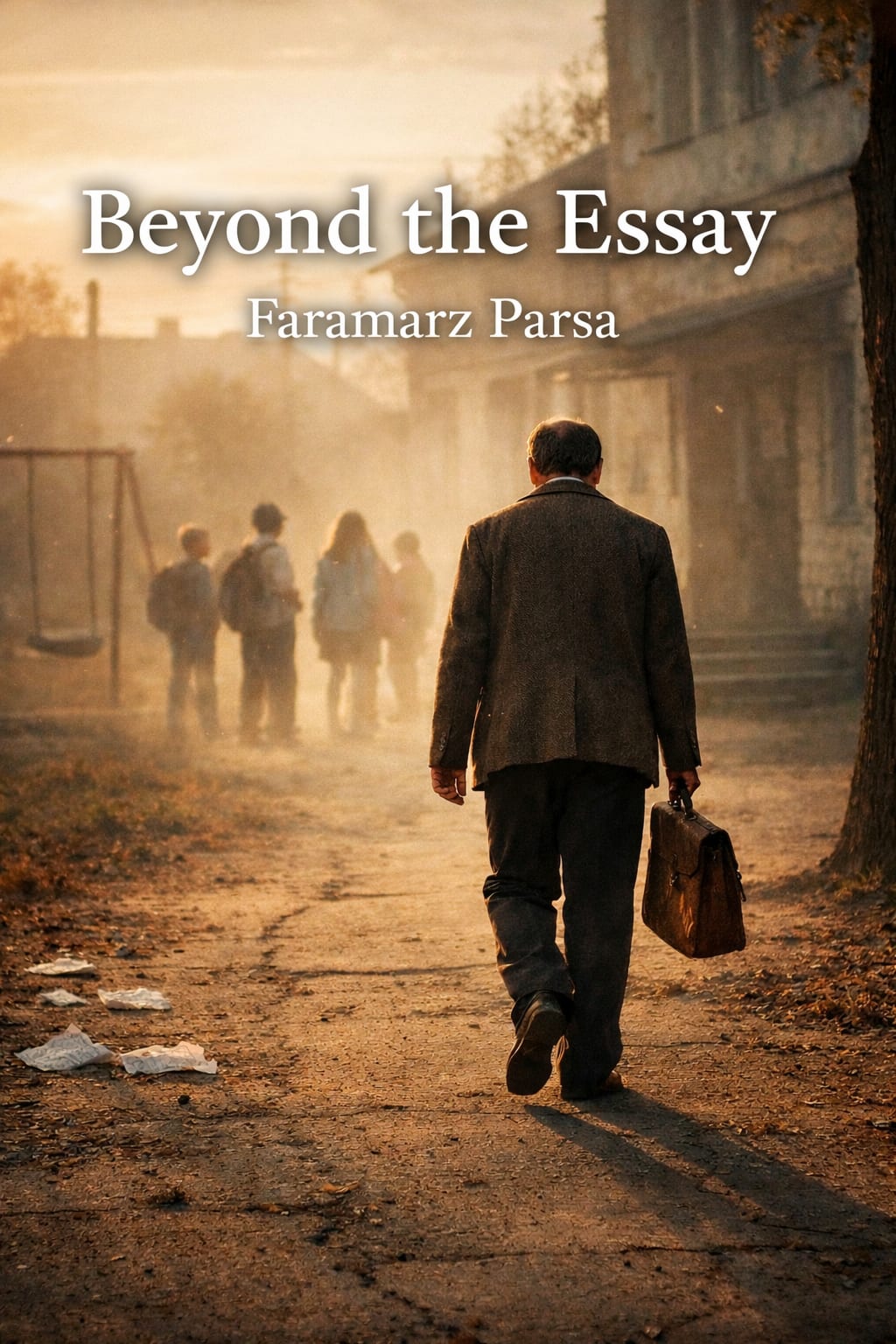
Sometimes the most dangerous thing a child can have is a dream.
In a small school, a simple essay assignment turns into an unexpected conflict between a teacher and a group of parents who fear the power of imagination.
But while the adults argue about reality, the teacher understands something deeper:
if children stop dreaming, the future itself begins to disappear.
“Beyond the Essay” is a short story about education, courage, and the quiet responsibility of those who still believe that a child’s dream is worth protecting.
Essay Topic: The Final Part (From the Teacher’s Perspective)
By Faramarz Parsa
The teacher walked into the school and went straight to the principal’s office. When he opened the door, he was startled by the noise of several parents filling the small room. As the door opened, everyone suddenly fell silent and turned toward him.
Suddenly one of the parents walked up to him angrily and said, “Sir, aren’t you ashamed of yourself? You call yourself a teacher! What does it mean to give eleven-year-old children essay topics that are far beyond their level of understanding?”
The teacher, caught off guard, didn’t know what to say. Meanwhile, one or two other parents began to protest as well. The principal raised his voice and asked them to calm down so he could understand what was going on. Then he asked the other teachers to return to their classes and told the teacher to stay.
“All right,” the principal said. “Speak one by one so I can understand the issue.”
One of the mothers said, “This teacher of yours has already called me to school three times in the past two or three months because my child didn’t write the essay!”
Another mother continued, “Yes, exactly. What does this mean, Mr. Principal? These essay topics are not suitable for children of this age.”
The principal replied, “Please, one at a time! First tell me what the essay topic was.”
Before the teacher could gather his thoughts, one of the fathers stepped forward and said, “Why are you silent now? Why don’t you answer?”
The principal said, “I asked you, not the teacher.”
The father replied, “Yes, Mr. Principal. This teacher gave a topic that doesn’t fit my child’s age at all. He asked them to write about what they want to become in the future! How can an eleven-year-old know such a thing? A person doesn’t even know what tomorrow will bring. You see how he’s corrupting the children’s minds!”
The principal answered, “That’s not true at all. These topics are very good for strengthening students’ thinking and preparing them for the future. A student learns to face and overcome the obstacles that may stand in their way. Are you upset about that?” Then he turned to another father. “What about you?”
The second father said, “Mr. Principal, I really want to know what this teacher was thinking. Does he think we live in the jungle? He asked my child to write about saving a deer trapped by a hunter! For all we know, that hunter could be a runaway thief or a hungry criminal trying to feed himself. This is dangerous for my child. His life could be at risk. Is this an essay topic? What exactly is he trying to teach them? It’s shameful!”
At that moment several others supported him.
“Yes, exactly! Do we live in the jungle? Our children have fathers. Their fathers are not dead!”
Then they shouted at the teacher, “Aren’t you ashamed?”
The principal, surprised by the parents’ way of thinking, said, “These topics are symbolic. They’re not real situations that could put anyone in danger. It’s surprising that you react so strongly to such a simple subject.”
But the father replied, “You’re too naive! What if it happens and my child thinks he’s a hero because of this essay and goes out to save a deer?”
The teacher stood there, confused and stunned, unable to speak.
Another mother said, “My child should think about his studies, not about becoming a president! What does that even mean?” Turning to the teacher, she added, “You have no right to mislead my child’s thoughts or ask whether he wants to become president or not—and then punish him by making him stand on one leg in front of his classmates!”
Another father said, “I punished my child myself so he wouldn’t think he could become the boss of the house with these essays! You are creating conflict in our family and ruining the child’s manners.”
At that moment the teacher finally broke his silence.
“First of all,” he said, “you are not the child’s father—you are his stepfather, and—”
The stepfather interrupted him angrily.
“Our family matters are none of your business! Are you the guardian of other people’s lives?”
Another father asked, “How did you even know he was a stepfather? What does that have to do with you?”
The principal stepped forward. “Please calm down. These essay topics were neither misleading nor immoral.”
The teacher turned to the principal and said, “The student hadn’t written the essay. When I asked why, he said his mother didn’t help him and beat him with a belt. I asked him to bring his grandfather the next day. But the student said, ‘Not my grandfather—the man my mother calls sir, her husband.’ That’s when I realized he was the stepfather and the one in charge at home. The student said all this in class, and everyone heard him.”
Once again the room filled with noise.
Amid the commotion, the teacher quietly slipped out of the principal’s office without anyone noticing. He left the school the same way he had entered and walked home without looking back.
Yet contrary to what one might expect, no seed of despair had been planted in his heart.
As he walked, he thought about the faces of each of his students: the boy who wanted to become an actor, the one who dreamed of becoming a doctor. He knew he couldn’t hold classes for their parents or tear down the walls of fear and prejudice inside their homes. But his heart ached for the students whose dreams were being crushed under the harsh boots of adult reality.
The teacher whispered to himself,
“I may not be able to change their parents’ world, but I can teach these children how to stand firmly on their own feet against the storms.”
He did not give up his love for teaching or encouraging them. He simply realized that from the next day on, he had to teach them a lesson beyond essay writing:
the lesson of standing strong in a world where sometimes even the closest people cannot understand the meaning of dreams.
About the Creator
Ebrahim Parsa
⸻
Faramarz (Ebrahim) Parsa writes stories for children and adults — tales born from silence, memory, and the light of imagination inspired by Persian roots.
Keep reading
More stories from Ebrahim Parsa and writers in Fiction and other communities.
Becca
"Everything is so... flat." Denille said stupidly as she looked around her new neighborhood. She looked around at the muted desert where even the smallest sign of life seemed to have given up. The plant life was shrubs that were half cooked by the heat and where there should have been a lawn, a mess of white rocks laid glistening in the sun. Even the sky looked stretched thin, like the sun had ironed it smooth. She’d moved from Riverside, where at least there were hills, but here in Barstow, everything felt baked and brittle.
By Sara Wilson2 days ago in Fiction
The Hands That Rocked The Baby Killed Its Daddy
The Hands That Rocked The Baby Killed Its Daddy They said she was gentle. They said she had the softest voice in the ward, the kind that could calm a fevered child with a single hush. They said she was patient. Devoted. Harmless. They never listened closely enough.
By George’s Girl 2026 7 days ago in Fiction



Comments
There are no comments for this story
Be the first to respond and start the conversation.