
Time Machine: 3 Choices in Black History
Can Tyreon change the course of Black history for good?

Muhammad's hands shook as he opened the time machine door.
A former member of the Nation of Islam, Muhammad was once fearless. Now he was nervous to the bone. What lay on the other side of the time warp was dangerous.
"You have three options," he told Tyreon. "You can go back to the Reconstruction era, the civil rights era, or the era of the first Black president."
For Tyreon it wasn't an easy choice. He was just a freshman at Howard University, an HBCU (Historically Black College or University) in Washington, D.C.
"Give me a rundown for each era," Tyreon told Muhammad. "I need a refresher."
"Reconstruction after slavery promised a future where Black men and women would have control over their most fundamental decisions," said Muhammad. "They got married, took new names, and worshipped freely in their own churches. They did so under the protection of northern Union soldiers who stayed in the South after the Civil War. It was a thrilling yet brief 'moment in the sun' until 1896. After 1896, the Klu Klux Klan and other white supremacist groups terrorized the Black community causing lost societal progress."
Tyreon wished to intervene. If he could reshape Reconstruction into a permanent era of black-white unity, then he would be successful.
He would first have to reconcile his own experiences with racism.
"You'll never get a better job with a name like that," Mark teased Tyreon.
Mark was Tyreon's coworker at a supermarket in their hometown St. Louis, Missouri. Missouri is not as liberal as D.C. Blonde-haired and blue-eyed, Mark was ignorant to the origin of Black-sounding names.
"Tyreon" is an alternate to Tyrone, a kingdom in Gaelic Ireland. Other Black names have Arabic, biblical, and French origins.
Tyreon didn't waste time explaining himself to Mark. He was at work to get paid and go home. He had always dreamed of winning the lottery but now considered the time machine a better chance.
"Your next option," said Muhammad, "is to enter the civil rights era. The 1960s were defined by the actions of anti-colonial, anti-racist leaders like Martin Luther King, Patrice Lumumba, and Thomas Sankara. All of those men were Black socialists, yet all were assassinated. This time period is also home to the women's liberation movement and the sexual revolution. Please note that the Democratic and Republican parties switched platforms upon the signing of the 1964 Civil Rights Act. Democrats turned liberal while Republicans turned conservative."
"Finally, you can choose the era of the first Black president. Barack Obama was elected in 2008 under much racial progress since Martin Luther King's death 40 years prior. Still, Obama faced massive resistance by his Republican opposition in the House, and a record number of filibuster threats in the Senate."
To Tyreon any era would be a challenge. But he chose Reconstruction to get the earliest head start on Black history.
"Go forth." Muhammad pushed Tyreon into the time machine. There was a blinding white light.
Upon opening his eyes Tyreon was introduced to the 19th century the hard way.
“Where do you think you’re going?” a white man scoffed at Tyreon while using the n-word. The word's impact made Tyreon regret every time he’d used the -a version for camaraderie amongst his Black friends.
Tyreon walked on a dirt road surrounded by greenery. “I’m a free man. I go as I please,” he replied.
“We’ll see about that.” On horseback, the white man touched his handgun holster.
Another man rode towards both of them. Muhammad!
Outnumbered two-to-one, the white man rode away.
Muhammad looked serious. “I go by Matthew now. Mississippi is no land for Muslims.”
Both men had guns to protect themselves. Horses to travel on.
The social changes former slaves experienced were not matched by economic progress. One aspect of society remained fixed: vast cotton production. Many former slaves went back to work for their former masters who imposed low wages and working conditions.
However there were exceptions to the rule.
Muhammad and Tyreon rode to Davis Bend, Mississippi. Former slaves had built a thriving community on land once owned by Joseph Emory Davis, the older brother of Jefferson Davis, president of the Confederacy.
Joseph Davis gave more leniency to his enslaved persons than owners on surrounding plantations. They learned to read and write and how to till the land. Davis fled the plantation when his Confederate comrades were trounced by the Union army.
Benjamin Montgomery, a skilled worker and a favorite slave of Davis, bought the estate-- including an eight-bedroom home-- with a loan in 1862. Soon he began to recruit his fellow former slaves to join him at Davis Bend.
Tyreon hoped to be one of them. The time machine placed him at the perfect time to approach Montgomery.
"Mr. Montgomery, I'm from St. Louis. I've heard that you're renting land here and planting a cotton crop for profit. Can I join the party?"
"You can stay as long as you keep your head straight and your feet moving. That's all I accept here."
"Can my friend Matthew stay as well?" Tyreon motioned to Muhammad.
"Two is better than one."
Local white planters let Montgomery carry on his economic activities as long as he stayed out of the limelight. He did a lot of social work to keep people happy with him, particularly white people. Over several months Tyreon became Ben's best assistant. Also Tyreon made friends with Montgomery's son, Isaiah, a quality planter in his own right. Isaiah would eventually go on to become a politician, the only Black delegate to the Mississippi state constitutional convention.
Altogether they appeased white folks enough to continue profiting from the land. They built the third largest cotton farm in Mississippi.
Still Tyreon's aspirations went beyond building a cotton empire. At Davis Bend he acquired every skill needed to run a plantation. Now he wanted to run for political office.
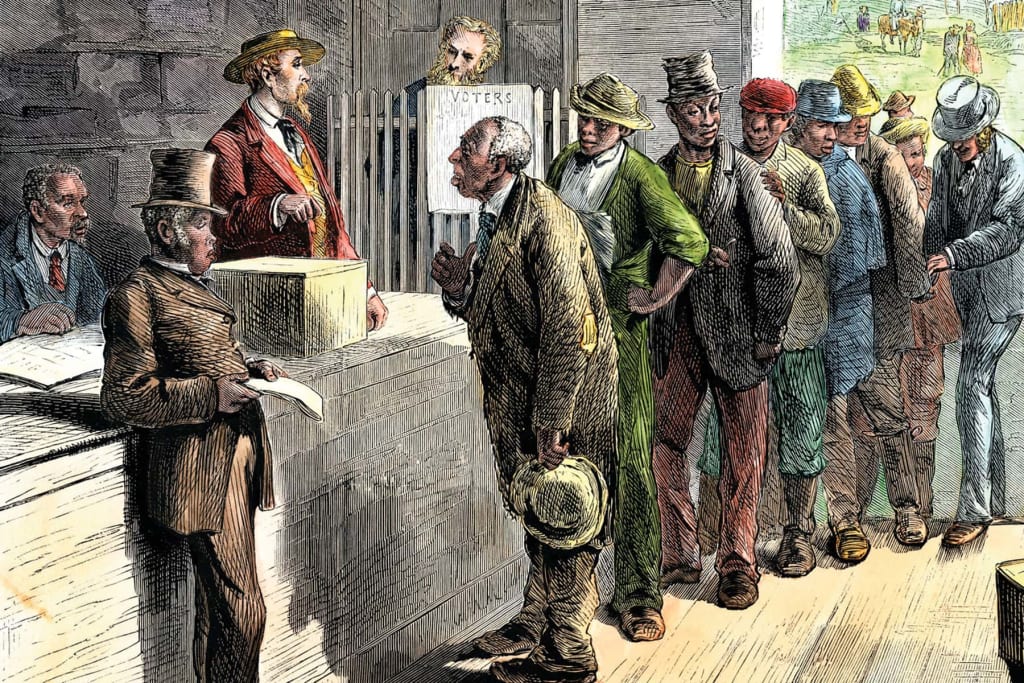
Ultimately African Americans knew that if they were going to protect and extend the freedoms they had gained in the South, then they couldn't depend on the largess of whites. They needed political power of their own. To get it, they needed the right to vote.
If African Americans were given the vote they could create alliances with Northern Republicans to forge an unstoppable political force. The Republican-controlled Congress grabbed the chance, passing the Fourteenth Amendment in 1868. The amendment granted citizenship to all persons "born or naturalized in the United States," including formerly enslaved people, and provided all citizens with “equal protection under the laws.” Furthermore, the Fifteenth Amendment was passed in 1870. It gave Black men the right to vote.
For the first time, Black people had broad representation in the United States Senate and the House of Representatives. There were Black legislators in Alabama, Mississippi, and South Carolina: the states previously most resistant to Black progress. All told, some 2,000 African Americans would hold office between 1868 and 1876. They were sheriffs, justices of the peace, even mayors.
Black politicians promised to use the Reconstruction period to transform the South economically, politically, and socially. But Tyreon's greatest challenge was to intervene before Isaiah Montgomery made a poor political choice: trading away Black voting rights to whites in exchange for an autonomous Black community in Mount Bayou, Mississippi. Isaiah reluctantly voted in favor of literacy tests, knowing that they would effectively bar Black men from voting in Mississippi. With that move Isaiah betrayed Reconstruction. Black voters were handicapped. White terror resumed.
Another betrayal came in 1876. With the presidential election deadlocked and both parties claiming victory, Republican Rutherford B. Hayes cut a backroom deal with southern Democrats. In return for the presidency Hayes promised to remove the final few thousand federal troops lingering in the South.
The amount of white backlash was astounding. In the South there was a lynching about every third day.
If Tyreon's time machine efforts worked, then he would win politically over Isaiah before Southern Democrats took back the South from the Republican Party and its Black legislators.
Tyreon knew that as a politician he would have to give incentives for the white community to join his movement. His political platform centered on universal education and healthcare. His message was that Black and white people may not agree on everything, but at least everyone would have a social safety net geared toward eliminating poverty.
Isaiah and Tyreon had key philosophical differences. Isaiah had no intention of becoming a political problem, no intention of claiming his rights beyond the confines of his business in Mount Bayou. Tyreon instead wanted to unite everyone under a Bernie Sanders-like socialism. One man wanted Black separatism, the other wanted racial integration. Like Booker T. Washington and W.E.B. Du Bois. Like Malcolm X and Martin Luther King.
Over time Tyreon's message won him the Mississippi House, the U.S. Senate, and the U.S. presidency. His populist agenda to white voters outweighed any prejudice they had for Black Americans.
Tyreon Ball, 27th President of the United States, was elected in 1908, 100 years before Obama. The first Black president chose his friend "Matthew" as his Vice President.
The United States under Tyreon's leadership improved. Anti-lynching laws were enacted. A reparations bill was passed. Life expectancy among Americans rose from 46 to 67 years. Literacy rates among African Americans rose from 20 percent to 93 percent. Public colleges were free and student loan debt was erased.
Mission accomplished. The time machine had done its job. Tyreon changed the course of Black history for good.
About the Creator
Keep reading
More stories from Brandon Ford and writers in Fiction and other communities.
The Owls Come Out at Night
2021 was the first full year of the coronavirus (COVID-19) pandemic. In the United States, total deaths went from 500,000 in January to 800,000 by year's end. Northern, liberal cities like New York stayed on lockdown. Southern, conservative states like Texas reopened first.
By Brandon Ford4 years ago in Fiction
Miss Persephone's Manual to a Seemingly Ordinary Life
Miss Persephone was found at the dining table, her blue eyes swollen, her tears arriving and retreating like the tides of the ocean. Earlier that day, her family had visited her in the retirement home where she had lived for eight years. It was her eightieth birthday.
By Imola Tóthabout 24 hours ago in Fiction



Comments
There are no comments for this story
Be the first to respond and start the conversation.