

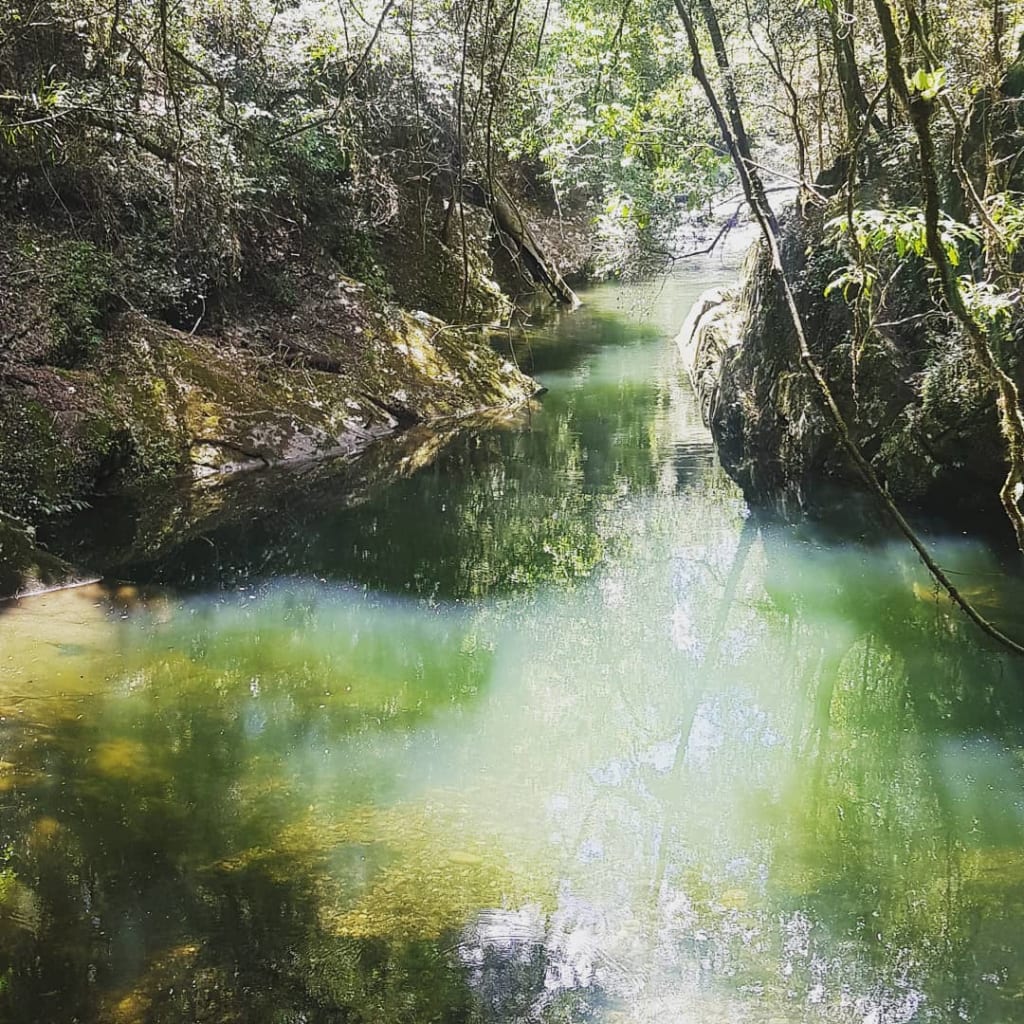
The water in our river comes directly from the Tops.
Water is collected, from rain and snow and hail, in the cool catchments surrounded by vibrant greens at the very peak of the mountains.
My father used to walk through there in his younger years, fishing from a place affectionately called ‘The Big Hole’. He described to me the towering trees and how they reached up into the ether above, holding up the sky. And the water. The pure, sparkling water that you could drink as it trickled through the creek.
This water winds its way down the foothills, through the various streams and brooks to join with our river, flowing gently now under the bridge and past the shady gum trees. This water will always be a part of me.
Flowing through my veins.
Guiding me home.
Growing up on a farm, water was always one of the most important things on everyone’s minds. The presence of water dictated the day-to-day activities; what jobs were going to be done, how many cattle to buy or sell, when to put down the fertiliser or when to buy more hay.
However, for a ten-year-old girl at the start of summer, the only thing that worried me was when I could go swimming. I have always loved each season individually, for its unique personalities and changes they bring to the routine. But summer for me would have to be a favourite, simply because I am a born water baby and I love being outside. Summer is when you can run around in the sunshine and spend your days along the riverbank, cooling off in the crystal water. It is something not to be taken for granted, the calm feeling of river water washing over your body; cleaning away the sweat and grime of a hard day’s work or play.
I remember, whenever there had been a really hot day, mum would always meet myself and my siblings after school at the bus stop with the swimming bag packed. On those scorching summer days where your shoes would melt on the bitumen and playing on the monkey bars meant burning your hands with every reaching grasp, I’d spend the entire day sweating, parked under a tree in the playground during lunch. When the bell screeched in my ears I’d zig-zag my way to each following patch of shade back to the classroom. Finally, the day would draw to a close and I’d race out to the bus lines, waiting rather impatiently in the scorching heat whilst having watermelon seed spitting competitions with my friends.
Each of us seeing how close we could get to the old jacaranda tree in the corner of the playground; its purple carpet below acting as a marker for our rivalry.
Our bus was the second last to arrive so we’d wait and wait until the blue, metal chariot would lurch up to the side of the road; the compression breaks hissing like a pit of snakes as the door squealed open on its metal hinges. Dave the bus driver would be behind the wheel, greeting each Salisbury kid individually with our personal nicknames (mine was Anakin) as we lumbered up the stairs into the vaguely cool interior (at least it was cooler than it was outside). We’d rush to take our seats in the hierarchy, the kindies settling at the front, the ‘cool kids’ venturing as close to the back seat as they could without gaining the attention of the scary high schoolers. I gravitated comfortably to my seat in the middle. Dave would smile in the rear-view mirror as he closed the door with a final shriek of metal on metal and start heading down the dusty, windy road home.
Mum would be there, in front of the old bar fridge on the tree that my great grandfather had nailed there years ago to service his need for a mailbox. She would bundle us into the car and drive the short distance to Tunnibuc Bridge, to swim around in the shade for a bit before heading home for dinner. The water was heaven against my skin, gently caressing my whole body. I would dive under like a frog, moving my legs and arms in unison as I went deeper; my goal being to touch the smooth rocks beneath me. I’d open my eyes to see the murky, green liquid and the reeds growing between the river floor. I reached my hand out to touch them, feeling the slimy and rough leaves as the little fish hiding among the plants darted out and past me. By this point my breath would run out, so with a SPLASH! I’d break the surface and flick my hair back; creating a curtain of sparkling water.
That feeling of being so ridiculously hot from the day’s events and then immediately refreshed as I stepped into the water is something that will always stay with me.
As the weekend rolled around there was always the promise of five dollars pocket money if we helped dad milk the cows, ten dollars if you were keen enough to wake up at 4am to do the morning shift. My brother would always go in for the early start, reasoning that more money was better and then at least you had the whole day after to have fun.
I had different ideas.
You see, the afternoon milking in winter was okay but a little boring, with not as many calves to feed and more time shivering in the cold. Nine times out of ten I’d more likely choose the early morning with my brother and leave our older sister to do the next. The summer afternoon milking on the other hand, came with heaps of potty calves to play with while dad did the boring jobs. And on the way home, much to my own delight, the promise of a quick dip in the river in our milking clothes to cool off and wash away the dirt of the dairy.
So, I’d spend the morning reading and helping mum. Or maybe playing outside with the chickens. Or riding my bike the short distance up the dirt road to my grandparent’s house with my siblings, racing each other to the gate, having a quick lemonade and a chat in that big, breezy kitchen before racing all the way home. As one o’clock rolled around, I’d wolf down a grilled cheese sandwich, grab an apple, a book and a water bottle and head out the door. Just in time for Dad to wake up from his lunchtime snooze and join me at the Landcruiser. Followed by Mum, who would race out after me because I’d forgotten my hat or some sunscreen. Dad and I would climb up into the rusty ute and we’d be off, waving back at Mum as she shrunk in the growing distance.
Our home was down in the valley, sandwiched between rolling green hills, while the Dairy itself was up the road a bit, over the next ridge. The trip up to the dairy was only five minutes or so, past the mailbox, past the cemetery (“Dead centre of town, haha”, Dad would joke), past the turn off to Tunnibuc, then past the old primary school that my grandfather would ride to in his heyday. All that was left of that school when I knew it was an abandoned porcelain toilet in the middle of the paddock, with the remnants of a wall surrounding two sides, and even now the toilet isn’t there anymore. Dad and his brother moved it to improve the yards; now no one would know there was once anything there at all.
Through that route we would drive, clanking along in the rusty ute that had seen so many sunrises. Dad would jam in one of his tapes, John Mellencamp or Paul Kelly mostly, and he’d turn it up really loud.
“This is what it’s like at a rock concert,” he’d yell.
We’d both sing along in our loudest voices to ‘Jack and Diane’, not seeming to phase the cattle one bit as we made our way past the paddocks and to the shed where the milking machines were set up. The milking would pass like clockwork. I’d help dad set everything up before we headed out on the red quad bike, racing through the paddocks to bring the cows in. Cattle are creatures of habit. Most of them knew what time it was and had already started moseying over to the dairy but we had to be there to push on the stragglers and move the fence back, so that there would be more feed for them when they returned.
Getting the cows through the river in summer was an especially long process because, like me, they wanted to be cooling off in the river instead of heading off to work. Each gentle giant would walk over to the river, step in and stand still for a few minutes to let the water flow over their hooves and ankles while they stared blankly at us as if to say, “Why would you want me to move? It’s bloody hot!”
We would gently coax them through, Dad stopping for a moment to give his favourite cow (aptly named “Favourite Cow”) a scratch behind the ears, before following them back to the Dairy entrance. Once the performers were there it was time for the show to start; the milking process running as smoothly and expectedly (most of the time) as a well choreographed pantomime. The cattle would come in and take their places, swinging their tails to the rhythm of the milking machines and feed mill. Dad would line them up and deftly place each cup onto the udders, pausing occasionally to fill up a feed bin or attach a bucket to one of the machines. Saving some milk to feed the calves later on. Five or so minutes later each one would be done, and it would be my job to spray them with iodine to ward off mastitis. There is a very fine art to operating in a pit dairy. You have to know exactly where to stand at all times in order to make sure you don’t surprise the cows, and you have to be on the lookout for the bombardment that comes from the backside of cattle; side-stepping out of the way just in time to avoid anything falling on you.
Once when I was seven, before I had learned any better, I was just standing in the corner watching Dad milk, and out of nowhere I felt a warm, wet splodge fall right on top of my head. I was in shock. And then we both burst out laughing, while he hosed me off. I enjoyed my after-milking swim so much more on that day, and from that day on I kept constant vigilance whenever I was helping milk. This precisely timed performance would continue in quick succession, Dad cupping one side and me spraying the other, until each cow was finished- with every single one getting a sprinkling of water from the hose on their way out; giving them a final cool off before they move back to the green grass and river. The curtains would draw to a close and that would be the end of the show, leaving us then to clean up for the next performance in the morning.
Dad and I would both go out to feed the calves, lining up the little white buckets like dominoes as the hungry babies pushed their heads through the gaps in the fence. He’d tip the fresh milk into the buckets and we’d race to put each one under the wet noses, listening to the hurried slurping that ensued. As each calf finished they’d be looking for something to suck on, like a human baby and their dummies, and I’d place my hand, palm up, into a mouth; curving my hand like Dad showed me so as to avoid the small teeth that were starting to poke through. The feeling of a calf sucking on your hand is hard to describe. It is warm and slobbery, comforting and disgusting at the same time; like pushing your hand into warm, sticky jelly and leaving it there for a while. I once saw my Dad standing in the middle of the calf pen, with three calves on each hand and two licking at the backs of his knees- it was hilarious!
When the fun bit was over I’d rub my hands along my shorts (they were going to be soaked in water soon anyway) and fill up the deep sink that had been in that spot for generations, scrubbing clean all the buckets while Dad hosed out with the big fire-hose. I would read my book and eat my fruit after that, while he finished up and then at last it would be time to swim! We’d get back on the quad and shut the gate behind the cows, who had by now made their way back to the paddock for the night and then, clothes and all, we’d jump into the river.
Think back to how good it felt to get in and go for a swim after a long sweaty day at school, then times that by a million. That’s how amazing it was to be able to wash away all the dirt and sweat and poo and iodine that caked our skin after a long afternoon of milking. The rushing, cold water enveloped me, holding me close in suspended animation as I floated along on my back; closing my eyes and just enjoying the sensation of the water on my skin. After a moment, Dad would splash me on the face, letting me know it was time to go home.
Summer passed by lazily and in a flash; slow and fast at the same time, at least that is how my child brain comprehended it. School started up again and the cool breezes of autumn started floating through the sky. I remember waking up one day to go to school, my sister in her bed on the other side of the room. We got up and skipped into the kitchen, ready for some Weetbix and a hot Milo, when I saw my parents faces. Time stopped.
They were sitting at the kitchen table with disbelief in their eyes and their heads in their hands. Staring at a letter on the table.
I asked what was wrong.
They just shook their heads.
“It’s actually happening.”
The river is a part of every favourite childhood memory of mine, in some way, and the water will always be a part of who I am. You see, I mentioned before that our home is nestled into a beautiful valley; a whole community of farms with cattle and houses and trees and families. This valley was so perfect, in fact, that the people over in Sydney wanted to use it to build a dam.
For years and years, the rumours of it had been there. When my grandfather was young he saw it come and go. In the 80s when my dad was a teenager he fought hard against the dam, side-by-side with the community. But now it was actually happening. Sydney was running out of water, they were saying, and they needed to find more.
And our beautiful valley was it.
Once they processed it themselves, Mum and Dad sat us down and explained what it all meant.
In retrospect, as a fully-fledged adult with a university degree and more life experience, I could argue that it was bad for the environment, that building a dam still relied on decent rainfall, that there were so many more sustainable ways to get more water without ruining our peaceful valley.
But as a child all I could think of was:
‘They can’t take our home’.
I remember my mind going back to that old porcelain toilet in the middle of the paddock, a relic of the past, and thinking, That’s what’s going to happen to our home.
I imagined it covered in the water that I loved so much.
Empty rooms full to the brim, the lounge floating past my eyes.
Green-brown water trickling down the steps out the front.
Fish swimming through my bedroom window.
Reeds growing everywhere, swaying gently in the silence.
A house abandoned, left to drown under the currents, while all the memories and family heritage it contained was washed away.
What followed was years of hardship.
My family was stuck in this constant tug-of-war, Do we leave and start fresh, or do we fight for our home?
The community rallied and lobbied, asking the people in Sydney to find another way.
We were growing tired. After years of fighting against it (both in his youth and now) Dad could not see how they could stop it again.
We lost hope. We sold up. We tried to find a new home.
But we kept on renting our home back. Farming this land was all my family knew for generations. So, we kept on working and kept on looking for a way to move forward as the time passed by.
Five years after the dam was first announced, another rumour started. They were going to bin it. The people in Sydney had thought about it and listened to the environmental impact this dam was going to have, and had decided that it wasn’t worth it. They would find another way. The cherry on the top of this amazing news was hearing that the affected families would have first tender on the land to be sold. We could get our home back.
I remember being at home, four years later, on the day they we found out that our application for re-purchase had been successful. I was freshly nineteen, living in the city so I could complete my first year at university. I had come home for the weekend, to ground myself and catch up with everyone. I woke up, made a cup of tea, and walked into the loungeroom to find my Dad sitting on his worn-out, red tartan armchair. The biggest smile on his face.
“It’s actually happening.”
Mum came into the room with my brother and we all burst into tears of relief, hugging each other tightly and smiling until our cheeks hurt, pausing our celebrations a moment to call my sister and grandparents to share the good news. Since that day we have been rebuilding our lives there, planting new trees and upgrading the things that we left to the side, on the day time stopped for us.
The next summer I brought my friends home with me. Mum cooked us beautiful meals and Dad and I showed them all the Dairy and how it worked. Like the many times before we fed the calves and cleaned the buckets, and then we headed for the river.
As we stood on the bank and gazed into the depths, I looked over at the faces of my friends and could see the joy and wonder that I’d felt on my face many times before. We jumped in and the familiar cool release enclosed me again. After the threat of the dam, I had felt a little resentment to the water, maybe a little disillusionment from the fond childhood memories I held so dear. But at that moment, surrounded by the water and my friends- I felt that childhood awe again.
I’m now twenty-four, living in the city with a finished degree and a full-time job.
But I still always go home to visit. One day I’ll go back there for good and plant my own roots.
The land,
the trees,
the air,
the river,
all call me back.
The water will always be a part of me.
Flowing through my veins.
Guiding me home.
About the Creator
Annie McDonald
Writing to heal and appreciate the world surrounding me.
Short stories, memoirs, poetry and everything in between.
Keep reading
More stories from Annie McDonald and writers in Fiction and other communities.
The Devil's Triangle
The sails ruffled in the breeze as we cruised along. The Sea Breeze was a mid-size catamaran that sailed out of Royal Naval Dockyard in Bermuda. We had booked this trip weeks in advance and were now looking at our Captain, Spike and two boat hands. Paddy and Wilson seemed like nice guys, joking around with the passengers and telling us some stories about Bermuda that only locals would know. Their island accents sounded almost British but they were pleasant to listen to.
By Barbara Gode Wiles4 days ago in Fiction
The Throne Room
The smoke hung heavy in the air, overtaking the sweet and savory smells that permeated the festival. The wooden poles that held the steel grates over the roaring flames were overturned, and the meats were ravaged by the beasts that hunted with the red-eyed shifter.
By KA Stefana 6 days ago in Fiction


Comments
There are no comments for this story
Be the first to respond and start the conversation.