

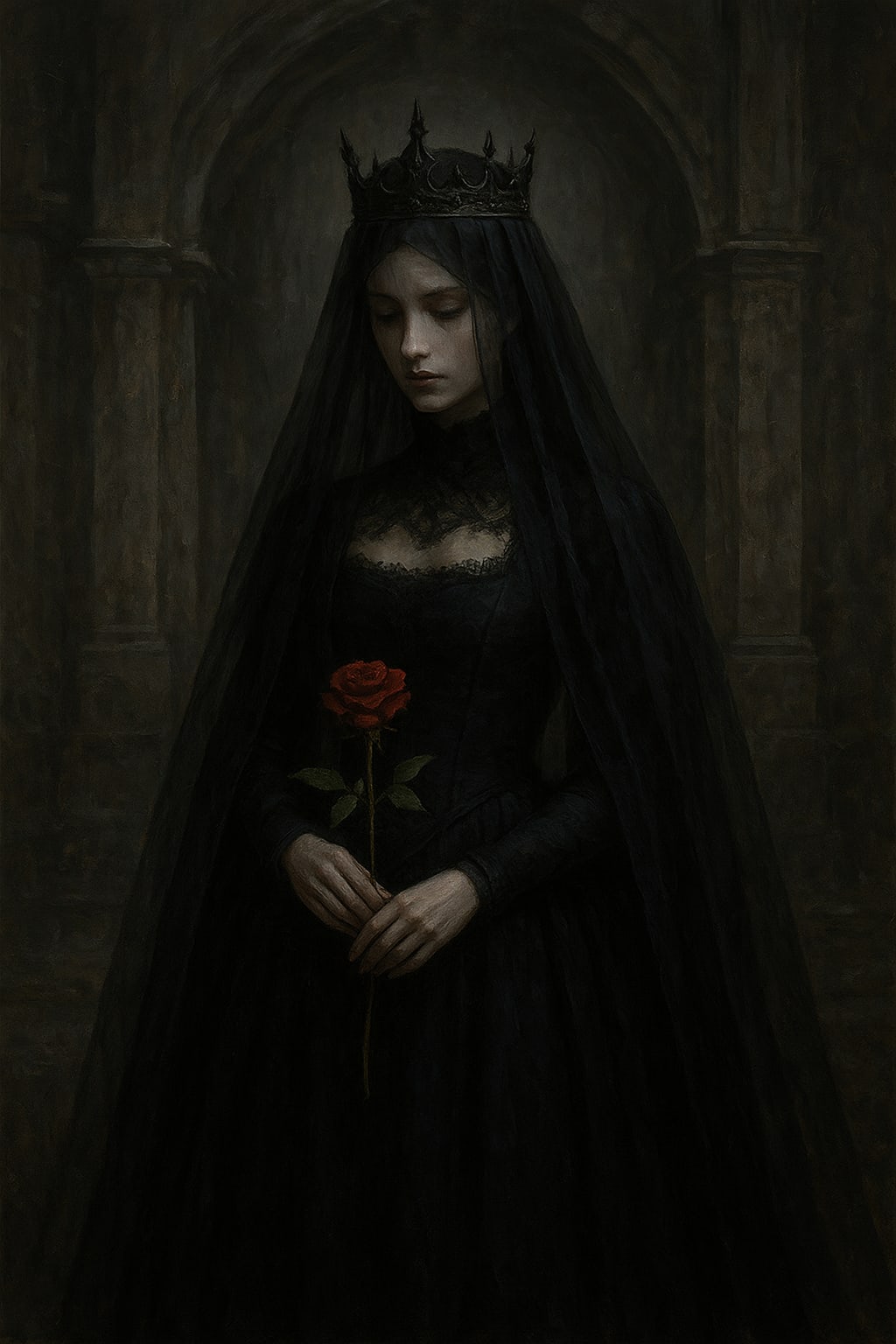
The great halls of Eryndral had always been filled with music—harp strings trembling like sunlight, choirs echoing beneath jeweled ceilings. But since the death of King Aric, silence lingered in every archway like a ghost. No bells rang. No laughter stirred. The palace lived in mourning, and at its heart stood the Widow Princess, Lysandra.
She was no ordinary princess. At just nineteen, she had been both bride and widow within a single season. Her black gown trailed like shadows across the cold marble, her veil hiding her pale face, and her crown—iron wrought in the shape of thorned roses—rested heavy upon her head. In her hands, she carried a single red rose, the last bloom from the gardens her husband had planted before his passing.
The people pitied her, some with sincerity, others with envy. Many whispered that her marriage had been cursed, that she had brought death to the king’s household. Others claimed she had poisoned her groom, her beauty masking a heart of ambition. Lysandra heard the whispers but never answered them. Her silence became a weapon, one sharper than any sword.
In truth, Lysandra loved her husband. Aric had been kind to her in a court of vipers. His sudden illness, the fever that consumed him, had broken something in her that no crown could mend. She wept until no tears remained. But grief did not free her from her role; it bound her tighter.
As queen consort with no children, she was vulnerable. Nobles eyed her throne as wolves eye wounded prey. The council pressed her daily: to remarry, to ally with some lord who would secure the crown. But Lysandra resisted. She had made vows at Aric’s grave. She would wear the black veil until her heart turned to dust.
Yet the palace itself seemed to resist her grief. Strange things began to stir. Candles sputtered when she entered the king’s chambers. Mirrors fogged though no breath touched them. At night, she swore she heard Aric’s voice in the corridors, low and tender, calling her name.
One evening, unable to sleep, Lysandra wandered into the abandoned chapel at the edge of the castle grounds. The moonlight poured through broken stained glass, painting her veil with shards of color. She knelt, clutching the rose, and whispered into the silence:
“Aric, if you are truly gone, let me know. And if you remain, give me strength. I am alone.”
The air grew still. A cold draft swept through the chapel, and the rose in her hands shivered as though caught in unseen fingers. The flame of a forgotten candle leapt to life, and from its glow emerged a faint shape—her husband’s figure, blurred like smoke but unmistakable.
“Lysandra,” the ghost said, his voice both near and far.
Her breath caught. Tears stung her eyes. “Aric… is it truly you?”
“I linger because of you,” he murmured. “But beware. My death was no illness. I was poisoned. And those who killed me now hunt you.”
Lysandra’s blood chilled. “Who? Tell me their names!”
But the vision flickered, his form breaking apart like ashes in wind. “You must uncover them yourself. Trust no councilor. Trust only your grief—it will guide you.”
Then he was gone.
For days afterward, Lysandra carried his warning like a dagger concealed beneath her gown. She began watching the court closely, noticing the tightening of jaws, the shifting of eyes when she entered. Lord Kael, the ambitious duke who had pressed her to remarry, seemed too eager for her hand. Lady Marwen, keeper of the treasury, hid a tremor when she spoke of the late king’s final hours. And always, there was the council chamber where decisions echoed louder than truth.
The Widow Princess became colder, sharper. No longer did she move like a broken girl; she moved like a queen cloaked in mourning, untouchable. At feasts, she raised her cup but never drank. At council, she listened more than she spoke, her silence unsettling the men who circled her like vultures.
One winter’s night, when the halls of Eryndral were hushed by snow, Lysandra returned to the chapel. Again, she whispered into the dark, but this time no ghost appeared. Only the rose in her hand wilted, its petals blackening as if consumed by unseen fire. She understood the sign. Her husband’s spirit had given her what he could. Now, vengeance belonged to her.
She swore then an oath not of love but of retribution: that she would wear her widow’s veil until the blood of Aric’s murderers stained the palace stones. Her mourning would not weaken her; it would crown her with power.
The court continued to whisper. They called her cursed, haunted, fragile. But beneath the veil, her eyes burned with the knowledge of betrayal, and her rose—now pressed and hidden in her chamber—reminded her of both love and wrath.
The Widow Princess would not remarry. She would not bend. She would turn her sorrow into silence, her silence into terror, and her terror into rule.
And when the truth was revealed, when names were spoken and blood spilled, all of Eryndral would learn what it meant to wound a bride and make her a widow. For in that wound, a queen had been born.




Comments
There are no comments for this story
Be the first to respond and start the conversation.