
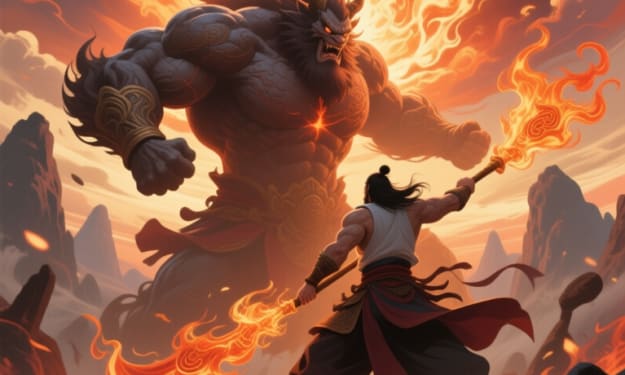
The Yellow Emperor's Battle Against Chi You
How Ancient China's Founding Myth Shaped a Civilization's Destiny

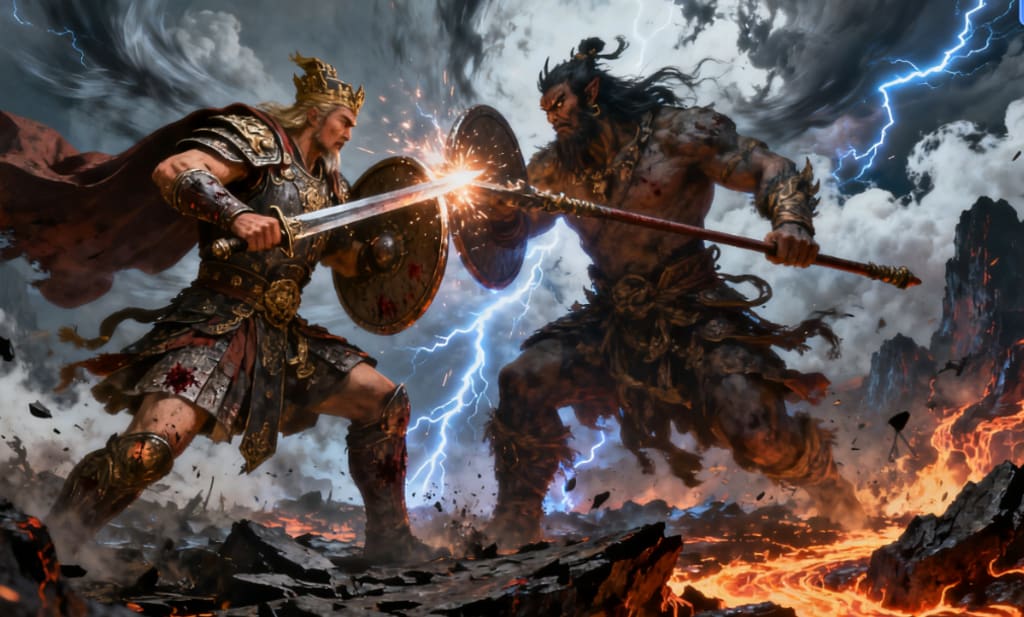
In the ancient times of the Yellow Emperor’s reign, when the world was young and humanity sought order amidst chaos, there lived a wise court historian named Cangjie. His duty was to record the deeds of the ruler and the workings of the realm, but he faced a tormenting challenge: memory alone could not preserve the vast tapestry of human experience. Knots tied on ropes and carvings on bamboo strips were crude and fleeting, failing to capture the subtleties of language, the whispers of the wind, or the wisdom of the ancestors.
The Yellow Emperor, a visionary leader, summoned Cangjie and entrusted him with a sacred task: to devise a system that would eternalize thought and speech. Cangjie accepted with humility, yet his heart trembled with the weight of the endeavor. For years, he wandered through forests and climbed mist-shrouded mountains, observing the patterns of nature—the tracks of birds on riverbanks, the veins of leaves, the constellations in the night sky. But inspiration remained elusive.
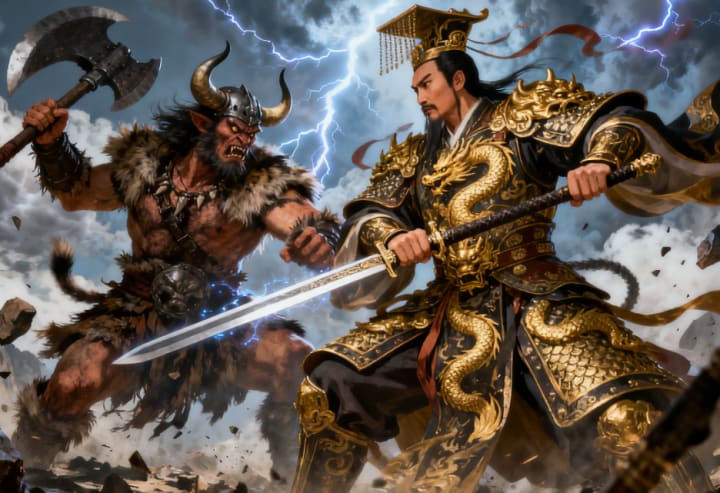
One morning, as dawn painted the eastern horizon in hues of gold, Cangjie rested beneath an ancient oak near the Yellow River. His eyes fell upon a flock of cranes dancing in the marshland, their legs leaving delicate imprints in the wet clay. In that moment, a revelation struck him like lightning: what if symbols could mimic the essence of things? Not mere pictures, but representations of meaning and sound, woven together like the threads of fate.
He began to sketch characters in the earth, each one inspired by the world around him. The character for "river" (河) echoed the flow of water, while "mountain" (山) captured the rugged peaks piercing the clouds. He studied the habits of animals—the alertness of a hare (兔), the strength of a horse (马)—and infused their spirits into his creations. Yet, his work was not mere imitation; it was an art of distillation, where form and philosophy merged.
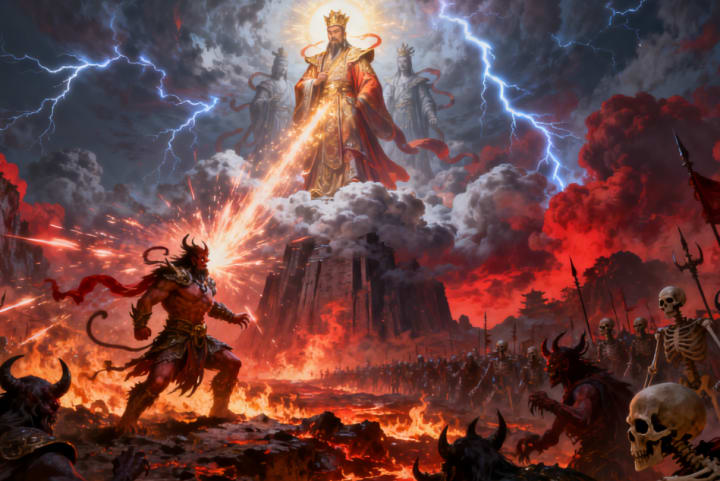
As Cangjie’s system grew, so did its power. Legends say that when he completed the first set of characters, the heavens trembled. Millet rained from the skies, and ghosts wept through the night, for humanity had now gained the tool to transcend mortality, to store knowledge beyond a single lifetime. The very fabric of civilization shifted: laws could be codified, poetry preserved, and history written indelibly.
The Yellow Emperor marveled at Cangjie’s achievement and ordered the characters taught across the land. Scholars gathered in courtyards to learn the intricate strokes, each character a key to unlocking wisdom. Villagers used them to mark contracts, priests to inscribe prayers, and poets to sing of love and loss. Through these symbols, the values of harmony with nature, respect for ancestors, and the balance of yin and yang were perpetuated.
Cangjie’s creation became the bedrock of Chinese culture, a bridge spanning millennia. It carried the teachings of Confucius, the strategies of Sun Tzu, and the verses of Li Bai. Even today, each time a brush dips into ink to form a character, it echoes that primordial moment when a sage saw the world not as chaos, but as a language waiting to be read.
And so, the tale of Cangjie endures—a testament to human ingenuity and the enduring quest to carve eternity out of fleeting moments.
So far,The Yellow Emperor marveled at Cangjie’s achievement and ordered the characters taught across the land. Scholars gathered in courtyards to learn the intricate strokes, each character a key to unlocking wisdom. Villagers used them to mark contracts, priests to inscribe prayers, and poets to sing of love and loss. Through these symbols, the values of harmony with nature, respect for ancestors, and the balance of yin and yang were perpetuated.
About the Creator
David cen
Share Chinese Sory,which you never heard before.China has 5000 years history and it is A kingdom of artifacts.Such as Chinese Kongfu,Qigong etc.
Bomb Scare
It was 2027, and the world never thought it would happen. A missle hit the United States, but it wasn't where they had anticipated. A little town in the northeast was hit by a missile strike, they didn't know why, and they didn't know exactly where it hit, but they did know it was a coastal community, somewhere between Maine and Delaware.
By Gregory Payton7 days ago in Fiction
Worth the Wait: Puerto Viejo, Costa Rica
Beach bumming in a small Caribbean beach town sounded like a perfect way to end our 6-month trip through Mexico and Central America. Or so we thought. The foul, fishy stench of rotten seaweed hit our nostrils as we stepped from the cramped bus and looked out at a rather depressing, empty, and underwhelming black sand beach. It was pouring with rain, and we had to quickly fish out our ponchos. We thought, this couldn’t be it, could it?
By Sh*t Happens - Lost Girl Travel7 days ago in Wander



Comments
There are no comments for this story
Be the first to respond and start the conversation.