
The Year 2050
An Extract from 'Silver Rain: A Dystopian Novel'

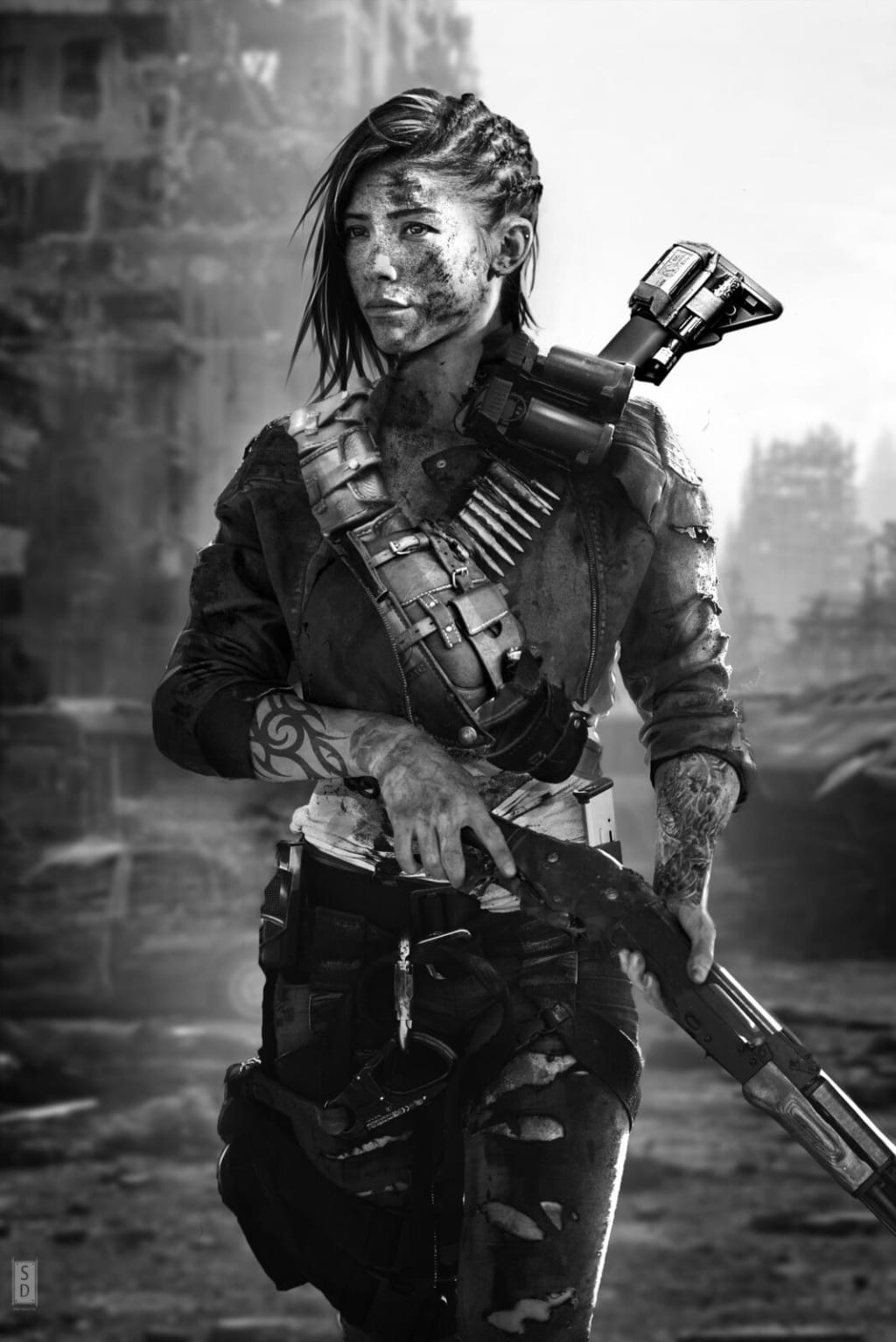
As the dense smog that hung heavy over the city during the twilight hours began to dissipate with the incoming western wind, through her visor Diana could vaguely make out the giant poster over what seemed like it had once been a theatre of some sort. She’d only ever read about such places in books – places of “unsanctioned entertainment” (or at least that’s what authorities called them). Staring up at the building, that had once been a star attraction of London’s West End, she could see why it was no longer open. The main poster hanging directly over the entrance portrayed what seemed to be a little dark-haired girl, no older than 7 and below the image read “Les Mi….” There was a giant tear in the poster that rendered the rest of the letters ineligible but she’d read enough to know that this must have been a place where some sort of theatre reproduction of Victor Hugo’s Les Miserables (which she’d read twice) was shown. She was part of a rebel colony that had defected from the government when the 3rd World War started in 2035 and as a rule of safety, members of these colonies or the “Freedom Front” as they called themselves, used a minimal amount of technology in their day to day lives. Tech meant the government could track you and if they could track you, you could be endangering the lives of everyone in the colony.
Everything Diana knew about the world was from the libraries in the crypt in Veritas Hill – the underground home of about 20 000 rebels. The libraries contained thousands of books, volumes, manuscripts, paintings and sculptures that had been saved before the Sons of Minos – the mysterious organization that had effectively governed Europe, parts of the Middle East and Northern Africa since the war began – could destroy them. There had been a massive drive by the Sons of Minos to destroy any and every relic of the past that spoke to human autonomy, free speech and creative liberty. The library at Veritas Hill was therefore one of the last and most complete annals of history, culture and art, left in the world. Diana could vaguely remember a time (maybe when she was about 6 or 7 years old) when cellphones were owned by both her parents. She could remember playing on an iPad. All that had gone away when the war started in 2035. It was simply too risky to have any tech around that was not absolutely necessary and so she, like many other children in the colony, had learned to read voraciously.
This is how now, 15 years later, she had known that she was in what used to be London’s famous West End and that the reason why the building she was looking at was derelict and partially destroyed was because there was no way the government were going to allow a building that once housed a production about revolution and anarchy to stand, but then again, the city had been decimated in the war and she couldn’t tell whether the damage to this theatre was incidental or deliberate.
As she was prone to do, her mind began to wander when the crackle of the radio piece in her radioactive mask abruptly broke through the silence: ‘D! D! Do you copy?’
She quickly shook herself out of her daydream. It was Kobe. Her relief was palpable – she hadn’t heard from him in almost an hour and was starting to consider abandoning the mission to try to look for him.
Kobe’s family, like her own, had fled to the Swiss Alps and joined the Veritas colony to live free from the increasingly draconian and oppressive rule of the Sons of Minos when the initial state of emergency had been declared in 2035. They had been childhood friends and even remembered the worried looks on all four of their parents faces on one winter’s eve as they watched the live images of the Chinese invasion of Taiwan from her parents’ London apartment. Diana and Kobe had simply watched the looks of bewilderment and concern on their parents faces from the carpet where their toys were but understood very little of what was happening or why the adults were upset. But now, 15 years later, it was very clear. Diego, Kobe’s dad, had said that the US would intervene but if they did, it wouldn’t go nuclear. A former professor of history at University College London, Diego had said that the mutually assured destruction principle (M.A.D) that had ensured cooler heads prevailed when the Soviets and Americans were building their nuclear arsenals during the Cold War between the late 1940s and 1990, would apply to prevent the world's powers from escalating the current situation into a nuclear war that was sure to destroy the world completely.
He had been right, but it might as well have been nuclear because the war that followed had killed almost 5 billion people worldwide through famine, biological warfare and casualties of war. Landmasses of entire nations had been reduced to poisonous wastelands, water was scarcer than ever and with the almost complete destruction of habitats like the Amazon and Congo rainforests, atmospheric oxygen and rain were almost non-existent in some places.
‘You’re alive! Where the hell were you? I’ve been worried shitless!’ she responded to the voice coming through her radio piece.
‘Got a bit lost, my navigator stopped working. Whatever though, I’m back on course and should be able to meet you at the museum. What’s your location?”
‘I can’t see much in all this smog but it’s an old theatre looking building near what I think is Picadilly Circus’ she said looking up again at the image of the little girl, who she was pretty sure now was Cosette.
‘Ok, gimme a second…locating…ok I think I got you. Don’t panic now but you’ve got a bull coming up on your location, 300m West. Be very, very careful’
Just then the putrid stench of rotting human flesh wafted towards her on the breeze, setting off her gag reflexes. Diego was right, there was a minotaur nearby, the stench was so rank and distinct that it was a dead giveaway of the creature that was fast approaching. Minotaurs were the human/bull chimeras that had been created by the Western Alliance scientists in the years leading up to the war and then deployed in ensuing battles as super-soldiers. Having the head, horns and legs of a bull but the arms and torso of a man, these intelligent creatures had been designed with the sole ambition of destruction. On average they stood over 8 feet tall and looked like they weighed about 700lbs, which was made even more imposing by the fact that their bulk was mostly comprised of visible, striated muscle. Diana, had, however, seen much bigger ones whilst participating in raids across the continent.
They had been lab-produced in their millions in the years after 2035 and with the ability to leap an entire storey in a single bound, see up to a mile away, smell like a bloodhound and run distances of up to a hundred miles in a single day, they were the ultimate warriors. Incredibly loyal, they could be trained in basic combat techniques and weapons usage but with the majority of them having IQs of less than 84, they lacked the initiative, tactical cunning or intelligence to do any of the special forces work normally ascribed to American Navy Seals or the former UK’s Royal Marines. Minotaurs were omnivorous and in times of relative plenty, ate a similar diet to human beings but the creatures were not averse to feeding on human flesh and often would gorge themselves on the raw flesh of political prisoners, the weak among society and the old. Dead or alive – it did not matter. It was this feeding habit that made the stench that Diana was now sensing in the air so distinctively foul.
The Sons of Minos kept minotaurs on the streets of major cities as a policing service of sorts. They were intelligent enough to perform basic surveillance duties, intimidating and keeping the working class in check but nothing more. Eurasian society could be described in pyramid form, with the ruling elites, the Sons of Minos, at the top. The identities of the men who comprised this elite body were mostly unknown but their leader, a man referred to as Malachi the Mage or simply ‘The Mage,’ was a bald-headed, dark man of African descent who looked like he was in his late 50s. Sporting a well-trimmed beard and a clean white tunic, he made daily appearances on the giant screens dotted across the cities of Eurasia to convey whatever message the government had about the war, rebels that had been captured and rationing measures that the government was implementing in ‘the interests of the people.’
Under them were a sort of ‘bourgeoisie,’ a middle class of skilled workers known as the ‘eunuchs,’ perhaps so named because in antiquity the personal servants of Ethiopian, Babylonian and various other monarchs were often eunuchs. They wore distinctive green garments and were comprised of everything from scientists to software engineers and administrators of the various realms. Entry into this class was purely based on merit and there were no ‘families,’ as it was the belief of the government that love of family eroded the individual’s devotion to the well-being of the State. The children bred amongst members of the eunuch class were, like the children of the lower working class, raised from birth in the children’s district, a place the old maps referred to as Prague and from there, were sorted into their various societal classes according to skill and natural inclination to certain occupations. The lowest class, a sort of peasantry called ‘drones’ comprised 85% of all non-military citizens and wore bright red overalls day-to-day. They were the factory workers, office workers, cleaners and everything else required for a functional State.
Ducking into an ally behind the theatre to avoid the hulking mass of the minotaur that was approaching her location. She slowed her breathing as she often had to remember to do when she felt afraid and conjured up the image of the little heart-shaped locket they had come to retrieve. It had belonged to her mother when she was alive. She had been killed just a few days before. Even now, Diana could picture the scene so freshly and vividly in her mind – a giant minotaur, bigger than any she’d ever seen, crouched over her mothers dying body, it reaching around her neck to take the locket off her, her rushing to her help her screaming mother. She had been too late. She had cocked her rifle and taken aim but before she could fire, the monster had bounded over the ravine into the rushing river below.
Her mother’s dying wish had been that she retrieve the locket. To Diana, its value was partly sentimental but more, importantly, it contained the chemical composition of a vaccine that, if manufactured successfully, could give the rebel soldiers immunity to a host of various diseases and radioactive chemicals in the air and therefore greatly increase their chances of not only sustaining the resistance but even perhaps, one day, overthrowing the Sons of Minos. Her mother, Dr Michaela Porter, had been the lead scientist on the project when their lab was raided by a combination of special forces and minotaurs who razed the place to the ground. Fortunately, she’d left a tracker on the locket and they had successfully managed to track it all the way from Paris to central London.
The rancid scent of rotten flesh got closer and Diana knew that she wouldn’t be able to hide much longer. She calmly turned on the night vision feature on her mask, jammed a new magazine into her semi-automatic SAW and took aim towards the entrance of the alleyway.
About the Creator
Stephen Bhasera
Just a dude with a pen (well, in this case a computer) and his mind, trying to tell my vision for the world
Keep reading
More stories from Stephen Bhasera and writers in Fiction and other communities.
The Secret Chord
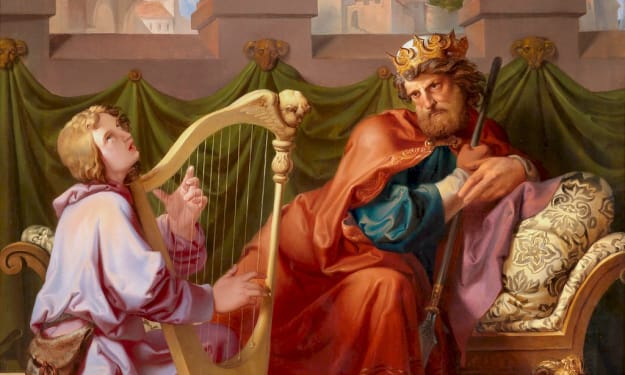
The Hebrew scriptures tell the legend of how King Saul, the first recorded King of Israel was, from time to time, tormented by an evil spirit. His advisors suggested that a skilled harpist be found and David, who would later become King, was put forward as a potential candidate. The King ordered that the young man be brought to him and a rather strange thing happened because the chronicle records that every time the evil spirit visited Saul, David simply played his harp and the spirit left the King alone. Perhaps it was this “secret chord, that David played and it pleased the Lord” that Leonard Cohen was referring to when he wrote his iconic ballad “Hallelujah.” What the king’s advisors knew back then, is a scientifically confirmed fact today and it is this: Music has the ability to alter not only the mind but also one’s very physiological state of being, reducing stress, alleviating anxiety and pacifying emotions.
By Stephen Bhasera5 years ago in Beat
Miss Persephone's Manual to a Seemingly Ordinary Life
Miss Persephone was found at the dining table, her blue eyes swollen, her tears arriving and retreating like the tides of the ocean. Earlier that day, her family had visited her in the retirement home where she had lived for eight years. It was her eightieth birthday.
By Imola Tóth6 days ago in Fiction
Homeless, Hopeless, and Heavenless in the City of the Angeles
“No medicine cures what happiness cannot.” ― Gabriel García Márquez My cousin, Byong, remains poor, for he never graduated from high school. Indeed, he gave up on life a long time ago because his mother was a sex worker, he never met his father, and he suffered from poverty. He gave up on his dreams, but he was the most amazing street dancer I ever saw. When you watch Michael Jackson, some of those moves are the moves Byong, invented, because the famous Michael hired LA street dancers to teach him new performance moves. K-pop was invented on the streets of Lost Angels.
By WILD WAYNE : The Dragon Kingabout 15 hours ago in Fiction
My New Book is Finally Here
My poetry collection Beautiful and Brutal Things is done. It's actually done and finally published over 270 pages. Over a year of my life went into this book. More than a year, really. Long days at my computer, sometimes seven days a week because I couldn't stop even when I probably should have. Then two months of editing that felt harder than the writing itself. But it's finished, and I'm still standing, and the book is real.
By Tim Carmichael4 days ago in BookClub



Comments
There are no comments for this story
Be the first to respond and start the conversation.