
The Woman in the Mirror
A presence that never existed, yet saved a life that was falling apart

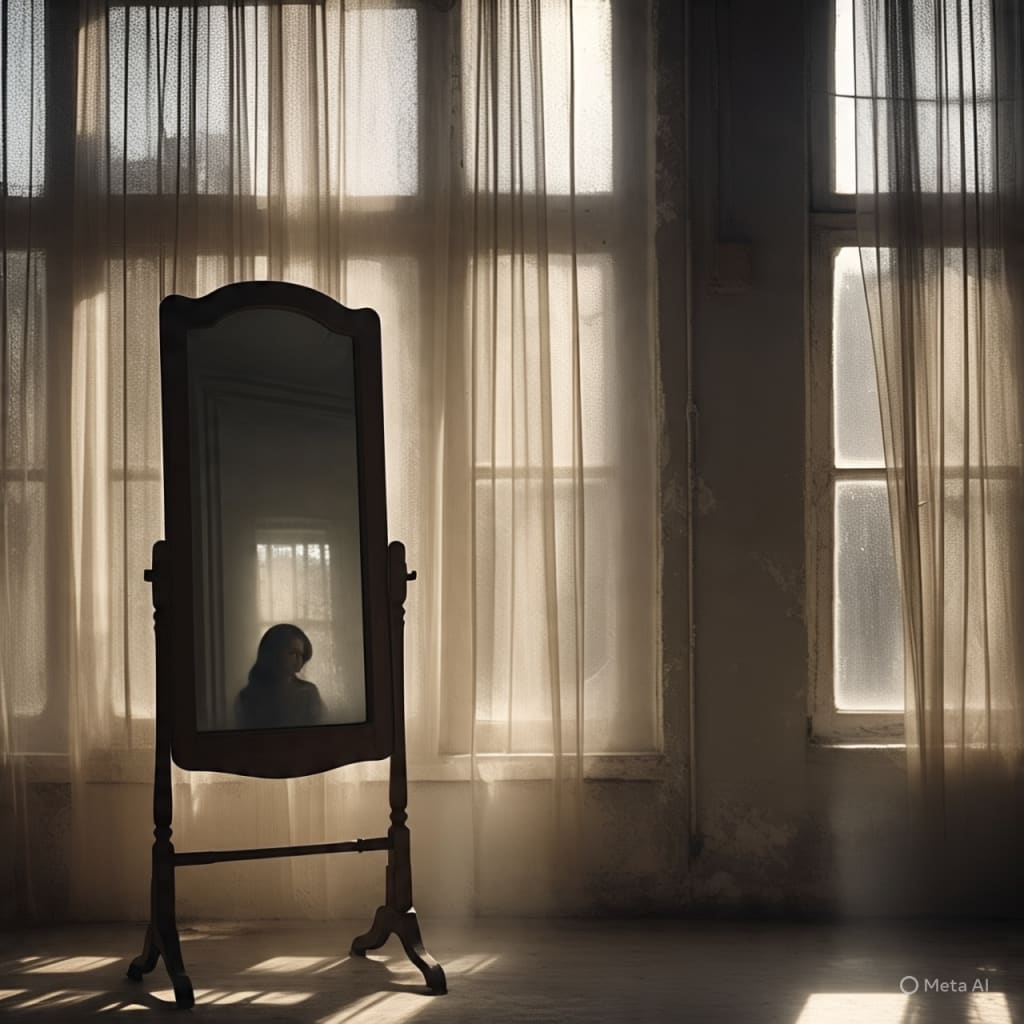
I moved into Apartment 41 on a Tuesday afternoon. The kind of Tuesday that forgets it is midweek. There was a haze in the sky, and my shoes left tired marks on the stairs. I had no furniture, no friends in the city, no one who knew I was there.
But something in that apartment already did.
I felt it the moment I put the key in the door. A subtle pull. As if someone had been waiting.
The rooms were quiet but not empty. The air held a memory I had never lived. I walked through the hallway, tracing my fingers along the peeling paint. I told myself it was just an old building. I told myself I was tired.
But then I entered the bedroom. And saw the mirror.
It stood across from the window, tall and worn, its frame cracked in places. I did not remember it being in the photographs online. I walked toward it slowly, almost unsure of why I felt like a guest in my own space.
And there she was.
Not truly there, of course. Not a ghost. Nothing so dramatic. Just a presence.
I cannot describe her fully. Her face was always just out of reach, like trying to recall a dream after waking. But I knew her. With a certainty I could not explain, I knew I had never seen her, yet she had always been near me.
That night, I could not sleep. I lay on the floor with a blanket and stared at the ceiling, but the feeling would not leave. The feeling that someone had once lived in that room, and left behind a version of herself. Not a haunting. Not a memory. Something else.
An imprint.
In the morning, I found myself writing. A letter. To her.
I do not know why I began with “I miss you,” but I did. And the words that followed did not feel like mine. They came from a part of me I had long ignored. Words about loneliness. About disappointment. About almost giving up. And the way I used to imagine someone sitting beside me at night, holding the parts of me I could not name.
I never mailed those letters. I folded them neatly and kept them in a box under the bed. Over the next few weeks, I wrote more. Every night. She became the only person I spoke to.
I named her Mira.
Not because it meant anything. Perhaps because it reminded me of “mirror.” Or because it sounded like someone I might have loved.
The letters became confessions. I told her about my failures. About how I left home not in pursuit of a dream, but in flight from shame. I told her about my father, who once told me that silence was more powerful than noise. And my mother, who taught me to cook but not how to eat alone.
And slowly, I began to change.
I started waking up early. Making coffee for two, though only one cup was ever drunk. I left the apartment sometimes. I smiled at the man who sold newspapers downstairs. I even applied for a job at a used bookstore, and was told I could start the next week.
On my first morning at work, I left a note for her on the mirror. Just three words.
You saved me.
That night, the mirror cracked.
A clean, vertical line through the center. As if something had split.
I did not cry. I stood there for a long time, watching the crack catch the light from the streetlamp outside. And I understood.
She had never been there. Not in the way people believe in presence. She was a creation. A need. A space I carved into the silence, so I could hear something speak back. She was absence given form. A shape made from longing.
But she was real.
Because I had become real again in her reflection.
The room is quieter now. The mirror is gone. I replaced it with a bookshelf. I filled it with poetry, philosophy, and books on psychology I once pretended to understand. I found myself again in those pages. I found others who had written to people who were never really there.
And I realized something.
Sometimes, the people who save us are not people at all. They are ideas. They are pieces of ourselves we do not know how to hold, so we imagine them in someone else’s hands. We give them names. We write them letters. And through them, we return to ourselves.
Mira never existed.
But without her, I would not have.
About the Creator
Mian Suhaib Amin
Advocate by profession, writer by passion. I simplify legal concepts, share stories, and raise voices through meaningful words.
Keep reading
More stories from Mian Suhaib Amin and writers in Fiction and other communities.
When the Night Speaks
The city was asleep, cloaked in the gentle hush that only the night could bring. Street lamps flickered softly, casting pools of golden light on the empty sidewalks. Amidst this calm, Ayaan walked slowly, his mind tangled in thoughts he could not escape. The weight of the day still lingered, but it was the night that felt alive with possibilities.
By Mian Suhaib Amin9 months ago in Fiction
Lycan Lore
As the students of my 10am mythology class take their seats, I decide to steer the day's curriculum away from Greek and dive into a Western European discourse on the misaligned beliefs of the Werewolf. A tale of truth or fiction. No one really knows.
By Lamar Wigginsabout 9 hours ago in Fiction
The Last Train Home
A cold wind moved slowly across the platform, carrying the faint smell of rain and rusted metal. The dim yellow lights above flickered as if they were tired after a long day. Daniel sat alone on a wooden bench, his small suitcase resting beside him.
By Waleed khan6 days ago in Fiction
Hottest in the Office
Dear Rafi, You’re very distracting to work around. For the first second I saw you the other day, I thought you were some type of executive. It took a moment to realize no, you were just the new guy, dressed up for the job he wants. Be still, my heart.
By Gabriel Shames2 days ago in Pride



Comments
There are no comments for this story
Be the first to respond and start the conversation.