
The Window Without Glass
He saw the world through a broken window. But still, he saw hope

The Window Without Glass
By Noor Muhammad
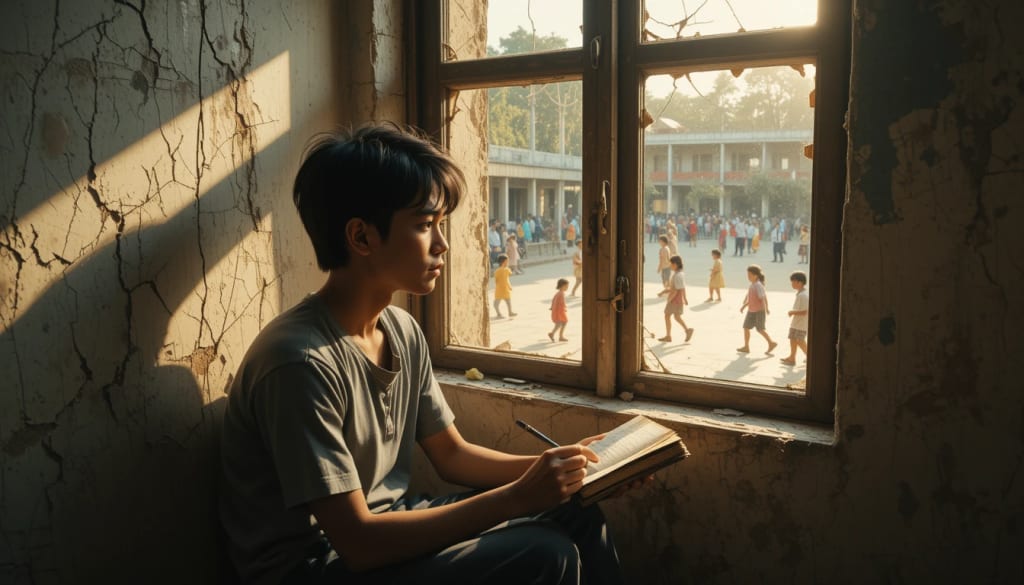
In the dusty corner of a crowded street in Lahore stood a crumbling house with no proper gate, faded paint, and a window that hadn’t seen glass in years. Behind that window lived a boy named Haris.
Haris wasn’t the kind of boy people remembered. He wasn’t loud. He wasn’t especially bright in school. He wasn’t athletic or funny. What made Haris different was that he noticed things—quiet things, like the way his mother sighed after folding laundry or how his father’s hands trembled every evening after pushing a fruit cart all day.
Their house was small—two rooms, a leaking roof, and a kitchen that barely functioned. The broken window in Haris’s room faced a school playground across the street. Every day, he watched kids in clean uniforms play, laugh, and run freely. He watched them while tying the same worn laces of his school shoes for the third year in a row.
But Haris never complained. He had learned early on that complaints didn’t change anything. What changed things was belief.
📻 The Day the Radio Broke
One evening, while helping his father repair the old fruit cart, Haris heard something from a nearby shop—an English news broadcast on the radio. He didn’t understand all the words, but he caught some: “global... effort... innovation... future.”
Those words stuck in his mind like a song.
The next day, he went back to that shop and stood outside until the shopkeeper waved him in. “You like the news, boy?” he asked. Haris nodded.
“You understand English?”
“Not all. But I want to.”
That’s how it started. Every day after school, Haris would stop by the shop and listen for ten minutes. The shopkeeper, amused at first, grew fond of the boy’s curiosity. He gave Haris an old grammar book. “Try learning from this.”
And so, Haris did.
He practiced verbs and tenses under candlelight. He repeated English sentences in front of the broken window, imagining he was talking to someone on the other side of the world.
💻 An Accidental Discovery
At 15, Haris was given a gift by his cousin—an old, barely-working smartphone with a cracked screen and no SIM. But it connected to Wi-Fi.
Haris didn’t waste time. He found a free online English course. He watched motivational videos. He discovered Google Translate. He typed slowly, one thumb at a time, and wrote small paragraphs about his life just to see how they sounded in English.
Then one night, while browsing YouTube, he found a video titled: “How to earn money online through writing.” His heart skipped a beat. He clicked.
That video changed his life.
✍️ His First Story
He spent three days writing his first story—about a boy who wanted to fix his broken window and see the world clearly. It was fictional, but it was also him. He submitted it to a small writing website. Days passed.
Then came an email: “Your story has been accepted.”
They didn’t pay him. But they published it. And that was enough.
He wrote another, and another. People left comments: “This moved me.” “You have a gift.” “Keep writing.”
He cried the night someone messaged him from Canada saying, “Your story reminded me of my childhood.”
💡 When Hope Became Purpose
Haris saved enough from online gigs—rewriting blogs, editing captions, translating Urdu essays—to buy a better phone. He started a blog. He posted quotes and small fictional stories in English and Urdu. His followers grew.
At 18, he applied for a remote internship with a digital magazine. The editor wrote back: “We don’t usually hire people your age... but your writing feels real.”
He got the job.
🌍 The View Now
Today, Haris still lives in the same house. The window is still there, still without glass. But now, he sees more than just the playground. He sees messages from readers in Indonesia, Pakistan, even Germany. He sees story ideas. He sees freedom.
He teaches writing to younger kids in his neighborhood. He tells them, “Your words are more powerful than your wallet. Never forget that.”
One evening, while watching the sunset through that same old window, his little brother asked, “Will we ever live in a better house?”
Haris smiled. “We already do. It's not the walls that matter. It's what lives inside them.”
About the Creator
Keep reading
More stories from Moonlit Letters and writers in Fiction and other communities.
Hottest in the Office
Dear Rafi, You’re very distracting to work around. For the first second I saw you the other day, I thought you were some type of executive. It took a moment to realize no, you were just the new guy, dressed up for the job he wants. Be still, my heart.
By Gabriel Shames3 days ago in Pride


Comments
There are no comments for this story
Be the first to respond and start the conversation.