
The Whole Universe Is Against Me
What Chance Do I Have?
He had failed his PhD dissertation. Who does that? It wasn't sent back for revision. It was just flat rejected.
We regret to inform you that your thesis has been rejected summarily due to its irrelevance to any meaningful impact on the postgraduate educational environment, nationally or internationally. We suggest you change your advisor and choose a subject that is credible for any legitimate consideration.
He tried the so-called preview sites for academic investigation, and their responses, while more terse, were the same. There were no peers to peer-review his work. In the world of PhD candidate, Byron Masters, what he was interested in interested only him and no one else.
Byron began in Zoology but then moved to neuroscience. Specifically, he was interested in what was the threshold of synapse interaction that determined the tripwire for self-awareness.
How many connections had to interact before sentience kindled? And did the connections have to be only neurons?
He couldn't understand his rejections. After all, What is life? What is self? — these were existential questions he hoped to answer with his grand unification theorem which, as it turned out, was displayed so clearly on page 29 of his submitted thesis. Certainly, everyone was interested in these questions, so why was no one interested in Byron Masters' arrival at the answer? There. On page 29.
Byron had computed the density of neurons in the human brain, how convolutions in the brain amplified the interactions per cubic area, and how the speed of thought was adjusted on the fly to allow for synchrony of nerve transmission. All there on page 29:
S = f (D/m3) N x 2.56 P
It didn't help his doctorate journey that he didn't specify what, exactly, the S, D, N, and P stood for in his formula. In good time, he felt, he would reveal that. But first, he would demonstrate the formula's validity that found the "S" at which self-awareness was achieved in any system of interacting parts of something — the self-aggrandizing "Masters' Threshold."
To his mind, he felt his hypothesis of intelligence among trees, as sustained by the "S" of the fungi that interconnected them, was intuitive evidence.
The academic world responded with a collective, "Huh?" No reviewer made it past page 8.
He became obsessed, arguing his point with anyone who would be polite enough to listen. This included the chat box on Customer Support, the loan officer at the bank, his realtor, and even people on public transit.
But not his wife. Her anger and frustration, under a particularly powerful moment of self-awareness, had reached their own Masters' Thresholds and she left him.
He lost his job, his friends; even his family chose estrangement over any continued relationship. He was evicted from his apartment and he was arrested for fraudulent use of the emergency responder system when he began calling 9-1-1 to present his concepts. (He felt it was an emergency.)
At a boarding house several weeks later, in his 23rd hour of uninterrupted sleep, a loud noise awakened him. He wiped the sleep from his eyes and lifted his head from the pillowcaseless pillow. No lights were on, but he was aware of a soft glowing phenomenon coming from the corner of the room. There, in a chair, sat a luminescent being, arms folded, legs crossed. The being appeared calm and perhaps even smug.
He turned back over, intent on getting into a 24th hour of sleep when the being spoke.
"Byron?" it said.
Byron bolted upright. Was this a dream? No, he was awake. Was he dead? Was this an angel?
"Who — might I ask — wants to know?" he asked tentatively. The being smiled.
"You were right, Byron." It sparkled a bit when it spoke.
"I was right? About what? Who are you?"
"Did you not state that S equals the function of density over cubic meters times N times 2.56 P?"
"Um, yes," Byron stammered. "I guess."
"It is correct. Assuming the N and P are quaternary. Which they are, according to you."
"Who says? No one else thinks so."
"The universe says, Byron."
"The universe? You mean the whole universe?"
"Yes. And that's me, in a way."
"You're the whole universe? Please, maybe I'm stupid, but you've got to do better than this."
"You're not stupid, Byron, but it is indeed complicated. No, the whole universe isn't sitting on this very uncomfortable wicker chair. But a point-transition of universality is constructed here to represent it."
"You."
"Me. You see, just like the trees and the fungus —"
"Aha!" shouted Byron. "I knew it!"
"OK, OK, but...just like them, Bryon, if I may, the S threshold is easily met by the universe. In the human brain, interconnectivity meets that threshold and sentience arises. But it doesn't have to be neurons or synapses or glia, necessarily. It can be any particles that interface, from space dust to whole galaxy clusters. It can be any energies that interact. Think of the Ns and the Ps that are possible in an entire universe."
Byron's eyes began tearing. "Of course, the S of the universe would be infinite. The ultimate intelligence."
"Why, thank you, Byron."
"So, Mr. Universe — if I can call you that —"
"Sure, I guess that works."
"So, Mr. Universe, I have a question. Can the N and the P of situational interactions make for an S, too?"
"What exactly do you mean, Byron?"
"I mean, I can't catch a break. My life is pathetic. My wife left me, my dog died, I'm broke and homeless, I have no friends, my thesis is going nowhere —"
"Yea, hard to believe."
"— and I can't understand how I've even survived all these personal disasters."
"Well, Byron, that's kind of why I'm here."
"Oh?"
"Yes, Byron. You see, I don't really like you."
"Excuse me?"
"Well, here you have the most profound and startling realization in the history of cognition, and you put it into a sloppy PhD thesis that no one would take seriously. I mean, trees and fungi?"
"But you yourself said —"
"I know. I said you were right about the trees and fungi. But those are just Earth constructs. Do you have any idea what meeting the threshold means in the entire universe?"
"I think we discussed that. I imagine the implications would be huge."
"Well, yes, if you actually did the imagining. Thank God you didn't."
"God?"
"Forget I said that. No need to complicate this any more than need be. Thankfully, you didn't do the imagining. Your Nobel-worthy discovery would be forgotten at the bottom of some pile of computer code beginning with a semicolon."
"What?"
"A semicolon means ignore what follows. It's a computer code thing. My metaphor."
"Oh, yea, I guess there've been a lot of semicolons in my life."
"That's not by accident, Byron. Remember, I said the universe just doesn't like you."
"So you said."
"Yes, Byron. The universe can't abide such buffoonery in the face of discoveries of Alan Guthian proportions. You should be ashamed. But what it really cannot abide is for someone to find your gibberish who knows what it means and can find a way to manipulate it. If you know what makes awareness, you can manipulate it. You can even weaponize it. On a universal scale. Pretty scary when you think about it. No, Byron, both you and your ideas had to go. For the universe, and I do speak for it, I find you unacceptable."
"Well, I'm sorry you feel that way. Maybe we should each just go our own way, then."
"Sorry, Byron, it's too late for that. I mean, look at what the universe has done to you. It got rid of your wife, your friends, your money, your career, your means, and your very life. Now I hear your dog, too. Even I didn't know that. But simply, the universe wants you gone. Dead. Forgotten."
"Wrong, Mr. Universe. I think therefore I am. My S more than equals f(D/m3) N x 2.56 P, therefore I am."
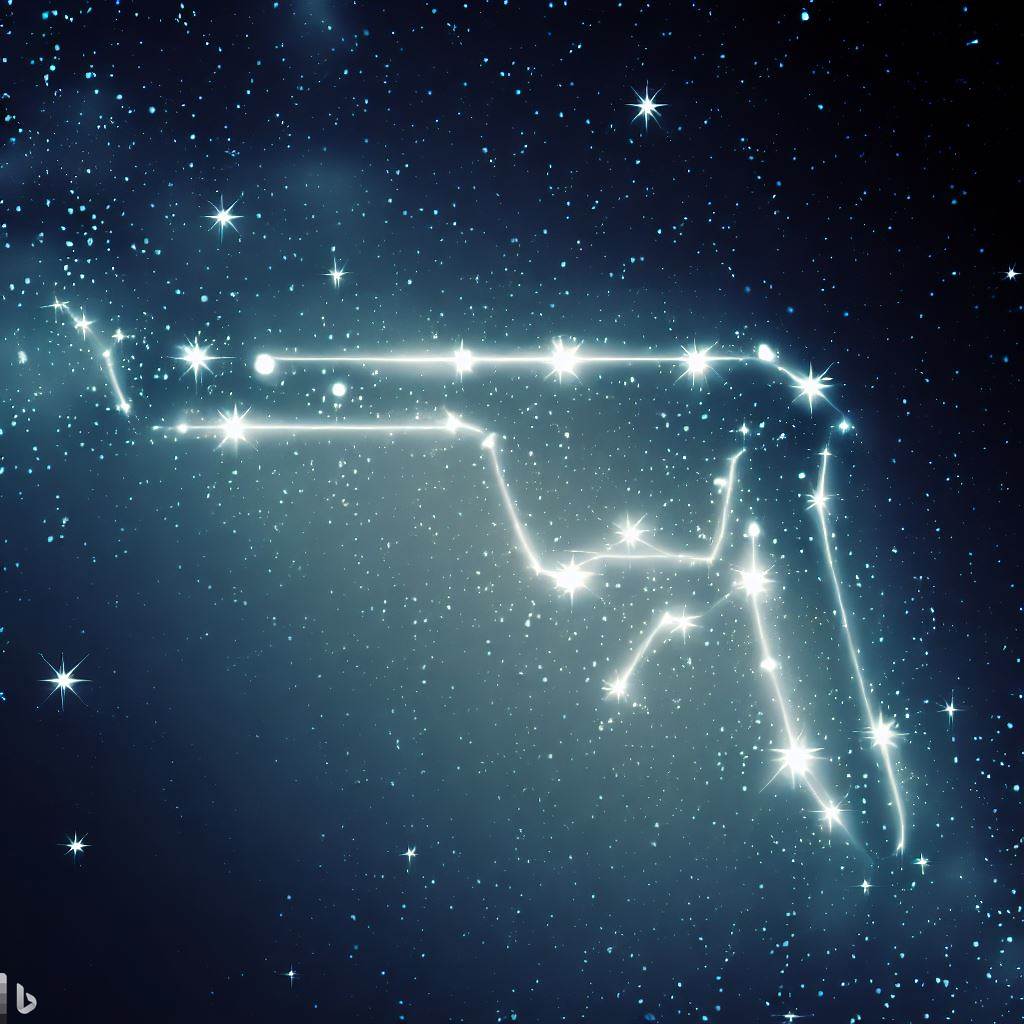
Byron then saw the luminous being reaching behind his back. From there he produced what looked like a pistol. It was glowing, which seemed to depreciate the gravity of things; but it was a gun indeed.
"Now I'm confused, Mr. Universe. Is that a gun? What's the universe need with a gun?"
"What's anyone need with one, Byron? I know. Silly, isn't it? Since you couldn't take a hint — or even like a million hints — or even N x 2.56 P hints, which would give your bad luck a sentience of its own — and believe me, you wouldn't want to cross paths with that fella in a dark alley — "
"Ha! Too late. I'm sure I've bumped into it already."
"No, Byron. Believe me, you'd know. Where was I? Oh, yes...but since you couldn't get the hint, I figured I had to take care of you in a more conventional way. The only true ambition you had was the pertinent negative of refusing to commit suicide or even succumbing to a brilliantly staged accident. Remember that runaway bus? You zagged instead of zigged. Remember the airplane that crashed? You volunteered your tickets for the cash they offered for overbooking the flight. Remember the —"
"I get it. So now you're just going to shoot me with — with — some sort of magic gun?"
"Not magic, Byron. I have enough matter to forge stars, for God's — I mean — for goodness' sake. I put together the Magellanic clouds in my sleep. Do you think a semiautomatic 9 mm pistol would be a challenge?"
"I suppose not," Byron admitted. "Am I special? Or has the universe targeted others before?"
"You already know the answer to your specialness — or lack thereof. Trust me, you're not. The universe targets people all the time. You read about them in the obituaries every day. But this day is your day, and the universe sighs with relief, even though it had to get personally involved. I'm sorry."
"Born a loser, lived a loser, and I'll die a loser," Byron mumbled, almost incoherently.
"Byron, my good fellow, is there anything you'd like to say before I, um, remedy this universal crisis?"
"You mean, remedy me? Well, that's just grand. So fitting. The one place I should belong doesn't want me. The universities didn't want my thesis, and the universe doesn't want my S. Instead, it's going to shoot me with a gun of all things. It's going to kill me because it doesn't like me."
"Well," said Mr. Universe, "there's that. But your Masters' Threshold formula kind of sealed the deal."
"Tell me, Mr. Universe, did I ever matter to anyone?" Byron asked sadly.
"The trees were ambivalent," the glowing being responded, "but the fungi really liked you a lot." The being seemed to light up a little more when it mentioned the fungi. "Goodbye, Byron."
Byron's work, ideas, thesis, hypotheses, and life ended with an unsolvable homicide that day — a cold case as chilly as -273.15 degrees Celsius. He no longer interacted with anything again, on any level. His awareness sank below the Masters' Threshold faster than the speed of the ballistic projectile that finished him.
The trees continued to sway in the breeze unconcerned, but Byron would have been pleased that the fungi mourned. And the more the universe thought about its visit to Byron Masters, among its many Masters' Threshold connections, the more it was satisfied that things were back to normal.
About the Creator
Gerard DiLeo
Retired, not tired. Hippocampus, behave!
Make me rich! https://www.amazon.com/Gerard-DiLeo/e/B00JE6LL2W/
My substrack at https://substack.com/@drdileo
Reader insights
Outstanding
Excellent work. Looking forward to reading more!
Top insights
Excellent storytelling
Original narrative & well developed characters
Expert insights and opinions
Arguments were carefully researched and presented
Eye opening
Niche topic & fresh perspectives
Compelling and original writing
Creative use of language & vocab
Heartfelt and relatable
The story invoked strong personal emotions
Keep reading
More stories from Gerard DiLeo and writers in Fiction and other communities.
Becca
"Everything is so... flat." Denille said stupidly as she looked around her new neighborhood. She looked around at the muted desert where even the smallest sign of life seemed to have given up. The plant life was shrubs that were half cooked by the heat and where there should have been a lawn, a mess of white rocks laid glistening in the sun. Even the sky looked stretched thin, like the sun had ironed it smooth. She’d moved from Riverside, where at least there were hills, but here in Barstow, everything felt baked and brittle.
By Sara Wilson7 days ago in Fiction
The Last Lightkeeper of Lake Kivu
On the northern edge of , where the water turns molten gold at sunset and the fishing boats drift like shadows across the horizon, stands a lighthouse that most maps have forgotten. It is small, built of aging stone, and leans ever so slightly toward the wind. And inside it lives Emmanuel Nkuranga, the last lightkeeper.
By Nsengiyumva Benit Ricardo5 days ago in Fiction



Comments (2)
Whoaaaaa! Imagine the universe personally coming to kill you because it doesn't like you. Lol! Such a brilliant story!
Ah, the fungus! the roots are all interconnected, it's everywhere! Really nice work there! Greatly enjoyed this