
The Weight of Water
A woman discovers a hidden, flooded room beneath her grandmother’s old farmhouse. Every time she enters it, memories of a traumatic family event resurface — but distorted, as if the room itself remembers things differently.

The Weight of Water
By [ABDUL RAUF]
The farmhouse had always smelled of thyme and mothballs, but now it held something else—something cold, like wet stone or secrets kept too long.
Clara returned after the funeral, alone. Her grandmother’s house, perched on the edge of the Michigan marshland, hadn’t changed since she was twelve. Same rusted wind chime. Same green rocking chair on the porch. Same silence inside, thick enough to bite through.
She came to clean out the house, settle the estate, and maybe—just maybe—bury something deeper than a body. But she didn’t expect the floor in the back pantry to crack beneath her boot. Didn’t expect the creak, the hollow echo. And she certainly didn’t expect the hidden staircase revealed beneath the broken boards.
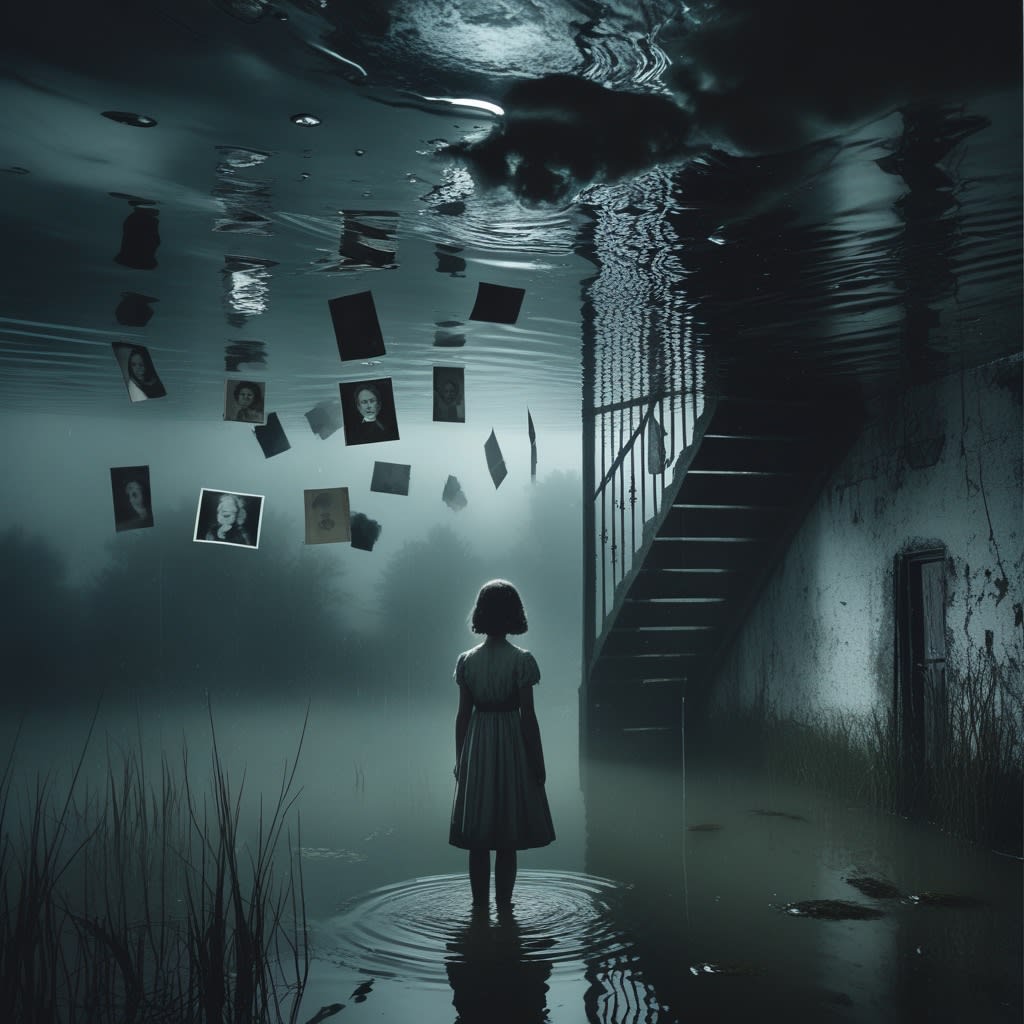
At first, she thought it was an old root cellar. But as she descended, flashlight trembling in her grip, she found not dirt—but water.
A single, flooded room stretched before her. Brackish and dark. The water came up to her shins. Her boots filled slowly. It smelled like the pond behind the house in summer. Like algae and loss.
On the far wall, family photos hung in crooked lines—some of people she recognized, some of strangers. Her mother’s face appeared younger, blurred by condensation. Her grandfather, long dead, stood behind her, arm frozen mid-wave. And there was one picture Clara had never seen before: herself at age five, holding her brother Jonah’s hand.
But Jonah had drowned when he was seven.
She stepped closer. The flashlight flickered.
Suddenly, she wasn’t alone.
“Clara?” a voice called—soft, high-pitched.
She turned, but no one was there.
Her skin chilled. Her heartbeat, slow and deliberate. She knew that voice. It had echoed in her dreams for years.
“Jonah?” she whispered.
And then she was seven again, standing on the edge of the pond, her brother daring her to jump from the dock. Her mother was inside. Her grandmother asleep. Jonah always went first.
But the memory shifted. She blinked, and it was her who ran down the dock, leaping into the green water. Jonah hesitated. She turned to wave.
He never jumped.
She gasped and stumbled back. The room reasserted itself. The water, deeper now, lapped at her thighs. Her flashlight sputtered and died.
Panic rose like tidewater in her throat.
She scrambled back up the stairs, out of the pantry, slamming the trapdoor shut and piling heavy furniture on top.
She didn’t sleep that night. Rain ticked at the windows. Her memories itched, unsettled. The next day, she returned with candles and her grandmother’s old Polaroid.
This time, the water was at her ankles. The air was humid and still. New photographs had appeared. One showed her mother with bruises on her arm—something Clara didn’t remember seeing. Another of her grandfather shouting at someone out of frame.
A final photo rested on the water’s surface, dry as bone: Clara, soaked and sobbing, dragging Jonah by the hand through marsh reeds, looking over her shoulder in terror.
But that never happened.
Did it?
The room whispered again.
“He wanted to leave,” it said.
The water lapped, gentle, like breath. “He said he heard her crying. Under the pond.”
Clara remembered something then—something she had buried. Jonah had told her he heard voices from under the water. That the pond had a “bottomless door.” That Grandma said the land was cursed. That’s why Grandpa drank. Why Mom left. Why no one stayed.
The water pressed on her legs, heavy now.
“It wasn’t your fault,” the room whispered.
But the photos told another story. Every time she returned, the water rose higher. The memories shifted. Some gentler. Others darker. Sometimes her mother smiled. Sometimes she screamed. Jonah was laughing. Or drowning. Clara was running. Or pushing.
She stopped eating. Couldn’t sleep. Couldn’t stop going back.
Each visit peeled back another version of the truth. Or a lie. Until she no longer knew which was which.
One night, the water reached her chest. The room was almost full.
“You can stay,” the voice said. “You can forget.”
The surface shimmered like glass. She saw herself as a child, holding Jonah’s hand, walking backward into the pond.
She didn’t go back up the stairs that night.
Weeks later, when the lawyer arrived, the house was empty. The pantry floor sealed tight. But when the wind blew through the fields, sometimes it sounded like water. And if you stepped just right, the floor would creak beneath your feet—hollow, calling.
And in the pond out back, two sets of footprints led toward the water.
Only one ever came back.
About the Creator
Abdul Rauf
love you all 💕❤️
Keep reading
More stories from Abdul Rauf and writers in Fiction and other communities.
The Cat and the Clever Rat”
In a quiet old bakery nestled at the end of a cobbled lane, there lived a cat named Miro. He was sleek, with a coat as black as midnight and eyes like polished amber. He belonged to the baker, who relied on Miro to keep the shop free of pests, particularly rats.
By Abdul Rauf7 months ago in Fiction
The Devil's Cut
“Comrade, finally you’re awake.” The voice was smooth, sensual. A flickering incandescent bar was all that lit the white, sterile room. All Vladimir remembered was everything going black. He tried to move his arms and found them strapped to the gurney.
By Matthew J. Fromm3 days ago in Fiction
Him
Him. An unsuspecting commuter on an A-train... he sits gazing out the window, immersed in the view, seeing beyond a world of art which whizzes by as the landscape undulates, ebbs and flows. There is a surreal, dreamlike and beautiful view of nature beyond the window, where bamboo stalks grow impossibly tall, reaching towards a sky painted in the swirling, vibrant colors of a Baroque masterpiece. The interior of the train is dimly lit, casting long shadows. The peace it exudes evokes a painterly illustration with dramatic bright and dark lighting filled with rich textures.
By Antoni De'Leona day ago in Fiction


Comments
There are no comments for this story
Be the first to respond and start the conversation.