
The Weight of the Orchard
Some secrets aren't meant to be bottled.

Elara didn’t believe in magic. She believed in deeds, in ledgers, and in the stubborn, overgrown apple orchard she had just inherited from a reclusive great-uncle. The house was a time capsule, the barn a leaning monument to neglect. But it was the land that called to her, a fresh start after her life in the city had turned to dust.
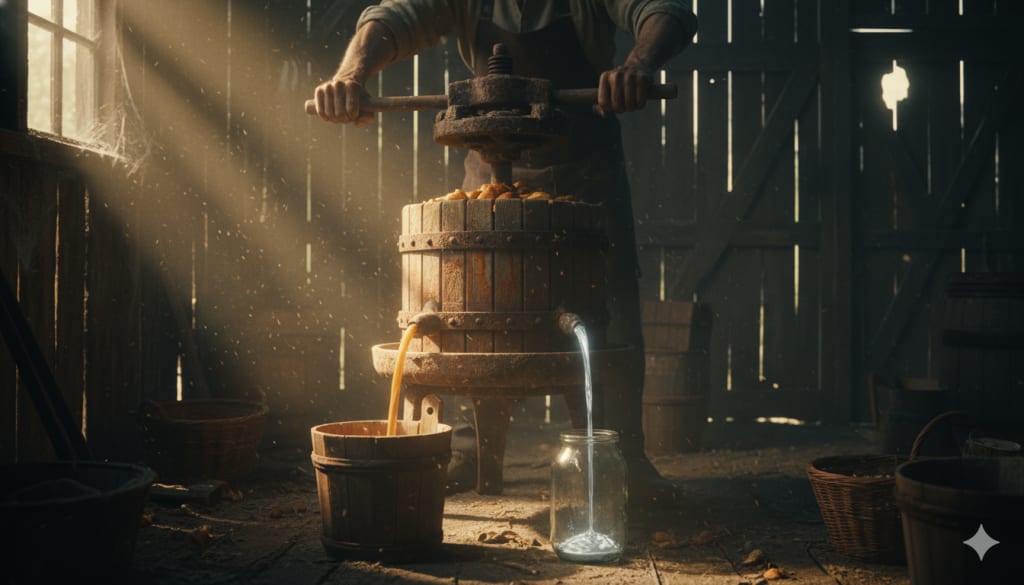
Tucked in the farthest corner of the barn, under a canvas tarpaulin thick with decades of grime, she found the press. It was a beautiful, brutalist thing of thick, dark oak and a heavy iron screw. Unlike the other rusted tools, its wood felt warm, almost alive. Carved into its main beam was a single, faded word: Veritas. Truth.
With a shrug, she gathered a basket of the small, gnarled apples from the orchard—the only part of the property that still seemed to be thriving—and decided to give it a try. She washed the fruit, set a bucket under the spout, and began to turn the heavy crank.
The apples crunched and groaned. Soon, a rich, golden cider began to flow, smelling of autumn and tart sweetness. But something else happened, too. From a second, smaller spout she hadn't noticed, a different liquid began to drip. It was shimmering and silver, like liquid mercury, collecting in a hollowed stone basin beneath it.
As the silver liquid pooled, a feeling washed over Elara—a profound, aching sense of longing. It was a clear, crisp memory that wasn't her own: a vision of a train platform, a woman in a blue coat turning away, and the crushing silence of a question never asked. It faded as quickly as it came, leaving her breathless and confused.
Hesitantly, she dipped a finger into the silver liquid. It was cool and weightless. And with the touch came a whispered sentence in her mind: “I should have followed her to Boston.”
Elara jerked her hand back. The press didn't just make cider. It pressed out regrets.
Driven by a morbid curiosity, she experimented. She brought her neighbor, old Mr. Finnigan, a pie and casually asked for help with the "stubborn press." As he cranked the handle, laughing at the simple work, the silver stream flowed. This time, the feeling was of stagnant dreams. The whispered regret was: “I never wrote the book. I was just too afraid.”
Elara started listening more carefully to people. She heard the subtle notes of disappointment in their voices, the quiet sighs behind their smiles. She began to see herself not as an heiress, but as a curator of hidden sorrows. She started bottling the silver liquid, these pure, potent regrets, in tiny glass vials. They felt heavy in her hands, weighted with lives not fully lived.
But the press demanded balance. For every batch of regret, it produced a corresponding cider of incredible, euphoric sweetness. People claimed her cider cured headaches, lifted moods, and tasted like pure joy. They lined up for it, never knowing the cost.
The turning point came when her oldest friend, Leo, visited. He was sunshine and easy laughter, the one who had helped her pack when her city life fell apart. She offered him a tour, and of course, they pressed apples.
As Leo turned the crank, the silver stream didn't just drip; it poured. The emotion that hit Elara was so violent it brought her to her knees. It was a tsunami of guilt and grief. The whispered words were a scream: “I was too late. I should have been there the night she called. I could have stopped her.”
Elara looked at Leo, his face still smiling, completely unaware of the torment the press had just revealed. He was carrying this. For her. Because of her.
She felt like a thief. She had been stealing the most intimate, painful truths from her neighbors, from her friends, and bottling them like curios. She was getting rich—emotionally and literally—on their hidden pain.
That night, with the moon high, she carried all the vials of silver regret back to the barn. One by one, she poured them back into the stone basin of the press, the regrets swirling and merging into a silent, shimmering pool.
Then, she took a sledgehammer to the beautiful, terrible machine. She smashed the Veritas beam, splintered the dark oak, and broke the iron screw. As the final piece broke, the pooled regrets didn't spill; they simply evaporated into a cool, scentless mist that vanished on the night air.
The next morning, the barn felt lighter. The air was just air. Elara looked at the pile of wreckage. She had set their regrets free, and in doing so, had unburdened herself of her own—the regret of not seeing that some truths are too heavy to hold.
She went back to making cider with a simple, store-bought press. It was tart and ordinary. But when people drank it, they said it tasted honest. And for the first time since she’d arrived, Elara knew exactly what that meant.
About the Creator
Habibullah
Storyteller of worlds seen & unseen ✨ From real-life moments to pure imagination, I share tales that spark thought, wonder, and smiles daily
Keep reading
More stories from Habibullah and writers in Fiction and other communities.
The Observer Effect
Dr. Aris Thorne’s mission was one of pure, academic observation. Her destination: a Neolithic settlement in Northern Europe, 3000 BCE. The date: the Autumn Equinox. Her goal: to finally document the undisrupted "Rite of Balance," a ceremony where ancient druids were said to harmonize the dying sun with the coming dark, ensuring a mild winter. It was the holy grail of temporal anthropology.
By Habibullah3 months ago in Fiction
I Heard Someone Breathing While I Slept Alone
The Night Everything Changed I woke up at 3:12 AM, a time I’ve always associated with nightmares and the “witching hour.” At first, I thought it was just the wind brushing against the window blinds. But then I heard it—a slow, deliberate breathing coming from the darkness beside my bed.
By Mohammad Hamid3 days ago in Fiction




Comments
There are no comments for this story
Be the first to respond and start the conversation.