
The Weight of Kindness: A Child’s Heart Sees What Eyes Cannot
When a Little Boy Taught the World That Compassion Has No Limits

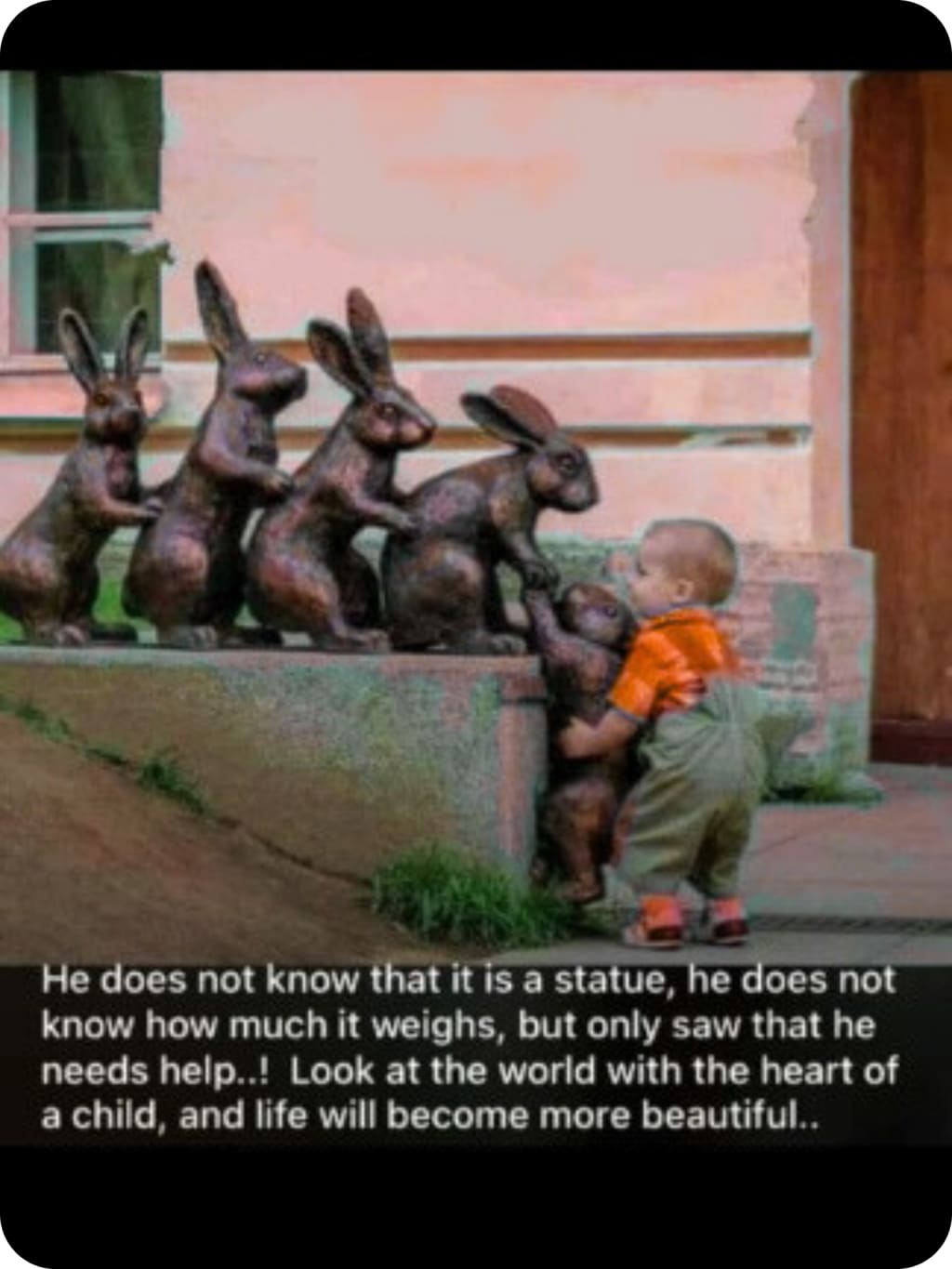
Once upon a time, in a bustling city filled with towering buildings and hurried footsteps, there stood a grand statue in the middle of a park. The statue was of a mighty warrior, his face stern and his armor gleaming under the sun. It was heavy, unmovable, and revered by all who passed by. People admired it for its artistry, its history, and its imposing presence. But no one ever truly saw it—until one day, a little boy named Leo came along.
Leo was five years old, with curious eyes and a heart as light as a feather. He didn’t care about the statue’s fame or its weight. To him, it was just a man—a man who seemed to be struggling. The warrior’s outstretched arm, meant to symbolize strength, looked to Leo like a cry for help. Without a second thought, Leo ran up to the statue, wrapped his tiny arms around its leg, and began to push with all his might.
“Hold on, Mister! I’ll help you!” Leo grunted, his face turning red with effort.
Passersby stopped and stared. Some chuckled, others shook their heads, and a few even snapped pictures to share online. “Silly child,” they murmured. “Doesn’t he know it’s just a statue?”
But Leo didn’t hear them. He didn’t know what a statue was, nor did he care. All he saw was someone who needed him. His innocence painted the world in colors adults had long forgotten.
An elderly woman named Mrs. Rivera watched from a nearby bench. Her eyes, clouded with age but sharp with wisdom, filled with tears. She remembered a time when she, too, saw the world through such untainted lenses. Slowly, she walked over and knelt beside Leo.
“What are you doing, sweetheart?” she asked gently.
“This man is stuck! He needs help,” Leo replied, determined.
Mrs. Rivera smiled. Instead of correcting him, she placed her frail hands next to his and pretended to push. “You’re right. Let’s help him together.”
One by one, others joined. A teenager, initially skeptical, shrugged and added his strength. A tired office worker, moved by the scene, left her coffee cup aside and pushed too. Soon, a crowd had gathered around the statue, not to admire it, but to “rescue” it. Laughter filled the air, and for the first time in years, the park felt alive with something rare: unity.
Of course, the statue didn’t move an inch. But something else did—the hearts of everyone present.
The Moral of the Story
Leo’s actions teach us that kindness isn’t about logic or practicality. It’s about the willingness to act, even when the world tells you it’s pointless. Adults often weigh their actions with calculations: Is it worth it? Will it make a difference? But a child’s heart doesn’t measure. It simply gives.
Compassion Overcomes Ignorance: Leo didn’t know the statue wasn’t real, but his ignorance didn’t diminish his compassion. Sometimes, not knowing “the way things are” allows us to see “the way things should be.”
Small Acts Inspire Great Change: Leo’s tiny effort sparked a movement. Never underestimate the ripple effect of kindness.
The World Needs More ‘Childlike’ Vision: Adults see weight, impossibility, and futility. Children see need, hope, and opportunity. What if we chose to look at life with such eyes?
That day, the statue remained unmoved, but the people who pushed it left a little lighter—burdens of cynicism lifted by a child’s pure heart.
And so, the park gained a new legend. Not of the warrior who stood tall, but of the boy who taught a city to kneel—not in defeat, but in love.
Final Thought:
The next time you see someone “stuck,” be like Leo. Don’t ask how heavy their burden is. Just ask, “How can I help?
"A statue couldn’t be saved, but a hundred hearts were—because one child dared to care."
About the Creator
Hamayun Khan
Hi! I'm Hamayun—a storyteller inspired by motivation, growth, and real-life moments. As a KDP publisher, affiliate marketer & digital creator, I write to uplift, connect, and inspire. Stick around—something here might be meant for you.
Keep reading
More stories from Hamayun Khan and writers in Fiction and other communities.
The Moon That Mended Itself with Light
They said the moon was dying. At first, I didn’t believe them. The sky had always been her stage — eternal, unshaken, perfect in her silver glow. But that night, when I looked up, I saw it — cracks running through her surface like veins of pain.
By Hamayun Khan3 months ago in Fiction
Miss Persephone's Manual to a Seemingly Ordinary Life
Miss Persephone was found at the dining table, her blue eyes swollen, her tears arriving and retreating like the tides of the ocean. Earlier that day, her family had visited her in the retirement home where she had lived for eight years. It was her eightieth birthday.
By Imola Tóth5 days ago in Fiction
Center Stage with Paul Stewart
*** I'm keen to republish the interviews I did for my series with Vocal creators. It's been a few years and I thought it might be nice to revisit these wonderful conversations. I'll be releasing them one at a time for a few weeks/months.
By Heather Hubler5 days ago in Interview



Comments
There are no comments for this story
Be the first to respond and start the conversation.