

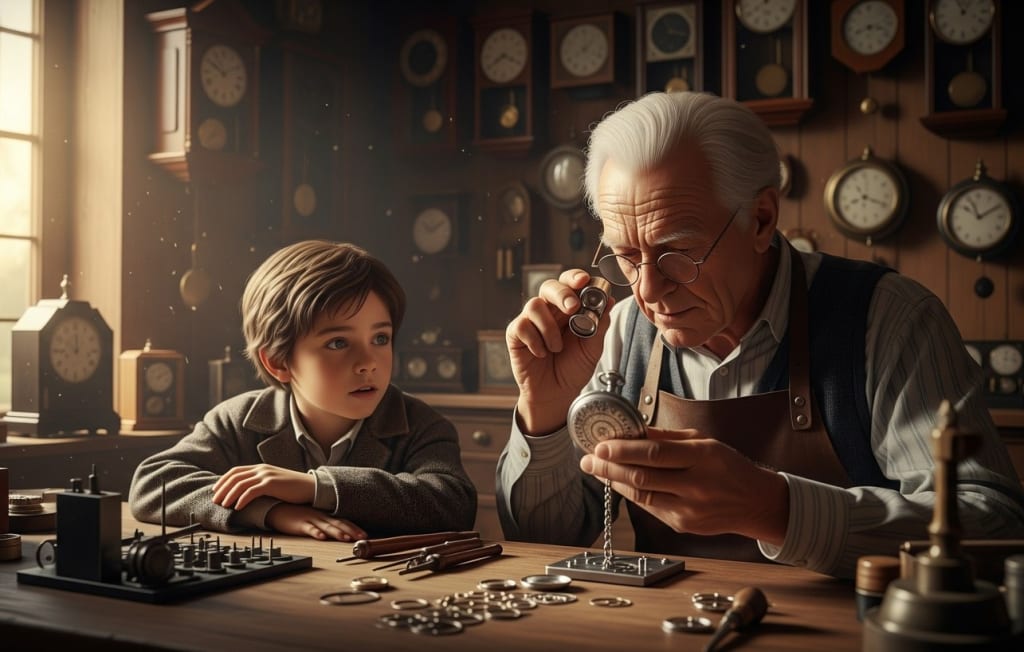
The shop smelled of dust and old oil. It was a comfortable smell. It was the scent of patience. Elias sat behind his heavy wooden counter. He wore a thick leather apron that had seen better days. The walls around him were filled with clocks. There were tall clocks that stood on the floor like soldiers. There were small clocks that sat on shelves. There were round clocks and square clocks.
They all ticked.
The sound was like a heartbeat. Tick. Tock. Tick. Tock. It was a rhythm that Elias loved. He had spent fifty years in this shop. He knew every gear and every spring. People in the town said that Elias could fix anything. They brought him toasters that would not toast. They brought him music boxes that would not sing. But mostly they brought him watches.
The bell above the door rang. It was a sharp sound that cut through the ticking.
Elias looked up from his work. A young boy stood in the doorway. He looked nervous. He held a small red velvet bag in his hands. The boy could not have been more than ten years old. His shoes were muddy and his jacket was too big for him.
"Come in," Elias said softly. "Close the door. You are letting the cold air inside."
The boy stepped inside and pushed the door shut. The noise of the street faded away. Now it was just the boy, the old man, and the hundreds of clocks.
"My name is Leo," the boy whispered.
"Hello, Leo. I am Elias. What do you have in that bag?"
Leo walked to the counter. He placed the velvet bag on the wood. He opened it slowly. His fingers trembled a little. He pulled out a pocket watch. It was silver and very shiny. It looked expensive.
"It belonged to my grandfather," Leo said. "He gave it to me before he passed away last week. But it does not work. I wound it up. I shook it gently. It will not move. Can you fix it?"
Elias picked up the watch. The metal was cool against his skin. He held it up to his ear. Silence. There was no ticking inside. It was completely dead.
"Let me see," Elias said.
He took a small tool from his pocket. He carefully opened the back of the watch. He expected to see broken springs or rusted gears. He expected to see dust or dirt.
But the inside of the watch was perfect. The brass gears shone under the lamp light. The springs were tight and clean. There was no rust. There was no dirt. Mechanically, the watch was perfect.
Elias frowned. He took a thin metal pin and gently nudged the main wheel. It moved freely. But the moment he took the pin away, the wheel stopped. It refused to turn on its own.
"Is it broken bad?" Leo asked. His eyes were wide with worry. "My mom said it is just junk. She said I should throw it away."
"It is not junk," Elias said firmly. "And it is not broken. Not in the way you think."
Elias looked closer. He adjusted his magnifying glass. He looked at the tiny spaces between the gears. Then he saw it. It was so small that most people would have missed it.
There was a tiny grain of sand wedged between two teeth of the escapement wheel. Just one single grain of white sand.
Elias smiled. He looked at the boy.
"Leo, where did your grandfather live?"
"He lived here in the city," Leo said. "But he used to tell me stories about the ocean. He said he met my grandmother there a long time ago. He said it was the happiest day of his life."
Elias nodded. "Come here, Leo. Look."
He handed the magnifying glass to the boy. Leo leaned over the counter. He squinted through the glass.
"Do you see that white speck?" Elias asked.
"Yes," Leo said. "Is that a rock?"
"It is sand," Elias said. "Sea sand."
Leo looked up. "How did sand get inside? The watch was always closed."
Elias closed the back of the watch. He pushed it across the counter to Leo. He did not remove the sand.
"Watches are strange things," Elias said. He leaned back in his chair. "People think watches are only for measuring minutes and hours. They think a watch is just a machine. But a watch is a witness. It sits in your pocket against your heart. It feels your pulse. It travels with you."
The old man pointed to a large clock on the wall.
"Time moves forward. We cannot stop it. We cannot pause it. But sometimes, people try. Your grandfather did not break this watch, Leo. He stopped it."
"Why?" Leo asked.
"Because he wanted to save a moment," Elias said. "Perhaps he was on a beach. Perhaps he was holding your grandmother's hand. Perhaps he looked at the ocean and felt perfect peace. He did not want that moment to end. So he opened his watch. He dropped a single grain of sand inside. And he stopped the gears."
The shop was quiet. Even the ticking of the other clocks seemed to fade into the background.
Leo looked down at the silver object in his hand. He rubbed his thumb over the smooth metal.
"So you can fix it?" Leo asked. "You can take the sand out?"
"I can," Elias said. "It would take me one minute. I could use my tweezers. I could pluck that grain of sand out. The gears would spin again. The hands would move. It would tell perfect time."
Elias paused. He looked into Leo's eyes.
"But if I do that, the watch becomes just a machine again. Right now, it is a memory. It is holding onto that one perfect second from years ago. If I start the watch, that second is gone forever."
Leo stood still. He looked at the watch. He thought about his grandfather. He thought about the stories of the ocean. He realized that the watch was stuck at 4:12.
"He died at 4:12 in the afternoon," Leo said softly. "The nurse told us."
Elias nodded slowly. "Maybe that was not when he died. Maybe that was when he went back to the beach."
Leo closed his hand around the watch. He felt the weight of it. It was heavy with history. He realized he did not want the hands to move. He did not want the seconds to tick away. He wanted to keep the sand exactly where it was.
"I think I understand," Leo said.
He put the watch back into the red velvet bag. He pulled the strings tight.
"How much do I owe you?" Leo asked. He reached into his pocket for some coins.
Elias waved his hand. "You owe me nothing. I did no work. I did not fix anything."
"You fixed me," Leo said. He smiled a small, sad smile. "I was sad because I thought it was broken. Now I know it is just waiting."
"Exactly," Elias said. "It is a keeper of secrets. Keep it safe, Leo."
Leo turned and walked to the door. He opened it and the noise of the city rushed back in. Cars honked and people shouted. But inside the shop, the air remained calm.
"Goodbye, Elias," the boy said.
"Goodbye, Leo."
The door closed. The bell rang once and then went silent. Elias sat alone in his chair. The clocks on the wall continued their work. Tick. Tock. Tick. Tock.
Elias looked at his own wrist. He wore an old leather watch. It ticked steadily. He listened to the rhythm. He thought about the grain of sand.
He reached into his pocket and pulled out a small photograph. It was a picture of a woman with a bright smile. She was standing in a garden. Elias looked at the picture for a long time.
He took his own watch off his wrist. He held it in his hand. He pulled the small dial on the side. The ticking stopped. The second hand froze.
The room felt quieter.
Elias placed his watch on the counter next to the photograph. He did not need to know the time anymore today. He just wanted to sit in the silence and remember.
Outside, the sun began to set. The light in the shop turned gold and then blue. The day was ending. But for Elias, and for a boy named Leo, time had paused just enough to let them breathe.
Sometimes, the best way to fix a thing is to leave it exactly as it is.
About the Creator
Muhammad Adil
Master’s graduate with a curious mind and a passion for storytelling. I write on a wide range of topics—with a keen eye on current affairs, society, and everyday experiences. Always exploring, always questioning.
Keep reading
More stories from Muhammad Adil and writers in Fiction and other communities.
The View Was Beautiful. But I Was Not in It
The view was perfect. From the top of Hill Nine, you could see the entire valley below — green fields stretching like a velvet cloth, a small lake shining like a silver mirror, and tiny houses scattered like children's toys. The sky was a soft blue, almost unreal, and the clouds looked like they had been painted with careful strokes.
By Muhammad Adil8 months ago in Fiction
Flower Bloom 369
FLOWER Bloom 2/25/26 Wednesday By Mariann Carroll Karen had been with Tony for 7 years. Tony started acting strangely after her surgery. He would mow the lawn in the rain and be on his cellphone. He started pushing Karen away. Tony came clean about seeing someone. Karen moved out two months later. Karen moved in with a friend. She felt betrayed.
By Mariann Carroll3 days ago in Fiction
The Cost of Existing
I sat groaning at the table by Vinny's breakfast shop. I normally loved this place because of the great view. Unlike many of the full-on restaurants on the promenade that held expansive views of the stars all around us, Vinny's faced inward and let me look over the entirety of the workings of K-Rax, and I loved it.
By Alicia Anspaugh6 days ago in Fiction
A Knight of the Seven Kingdoms Series Review (Season 1)
As one of the biggest properties in fantasy, A Song of Ice and Fire remains immensely popular with audiences. After reaching far into the past with House of the Dragon, a second spin-off was on the cards. A Knight of the Seven Kingdoms serves up a bite-sized slice of action and drama, but it still claims a spot among the best small-screen titles.
By Robert Caina day ago in Geeks




Comments
There are no comments for this story
Be the first to respond and start the conversation.