
The War Dog Legacy
Dogs have been used in battles since time immemorial. Here's a story of one canine hero

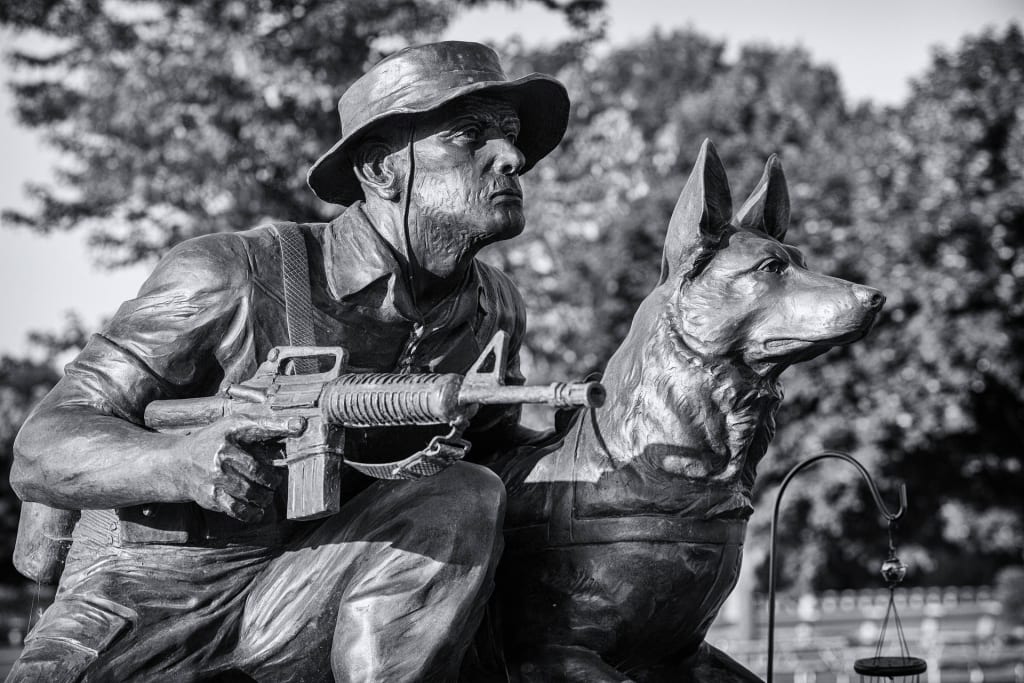
It was an odd sized casket, too small for a man, too big for a child. A flag was draped over it, a smallish one. It was carried by four men in uniform, though it was hard to tell for sure from a distance what uniform it was, or even if they were all men. There wasn't room for the usual six pallbearers due to the small size of the casket since it would have made for a comical service to have all six jammed together, shoulder-to-shoulder, crowding around an under-sized coffin. So the extra pallbearers were in the ranks of many others in uniform standing beside a small open grave. The officiant wore a robe instead of a uniform and must have said something because there was a long silence, then a burst of laughter.

Caleb has never been far away from Desi at any time in his life, joining the military ranks as a handler, with his loving pet by his side. If ever, I thought, he marries, the new bride may have little choice but to share a life with two partners. But of course, that was of little consequence now that Desi had left the stage.
It all harks back to Afghanistan, a land as foreboding as the enemies that hide in the hills and valleys. It was deemed as a perilous mission, providing border patrols in the northern sector facing Pakistan. It was truly no man’s land, an area as dry and stifling as a Saharan outpost yet many times more dangerous with thieves and terrorists mingling with the human deluge traversing the narrow passes.
En route to meeting with the 3rd Security Force Assistance Brigade near the Malaki refugee camp, Caleb’s unit was set upon by insurgents from Al Qaeda. Amid the confusion and crossfire, Desi had disappeared. Then Caleb heard a familiar growl, turning to see Desi crunch the weapon from an assailant’s hand, giving the unit time to respond with counter fire. Two Al Qaeda terrorists were dead but fortunately, the unit encountered no casualties. It was the first of many occasions where Desi saved the day for the unit.
It was part of the many stories Caleb had related to me during his breaks stateside. He was the youngest son of my older brother, Brad Johnson, and the most fragile. Unlike his siblings, John, a Marine and Willy, a Navy seaman, he wasn’t as tough as nails but instead was someone who had a deep affection for fellow humans and animals. His mom passed away when he was 17, poor Caleb took it badly. It was one of the reasons why the family decided to get him a pup. Desi became his crutch, the one he would turn to whenever he was down in the dumps.
Then years later Brad would pass but Caleb dealt with the sadness better. Following that he would spend all his holidays at my home in San Antonio, having heaps of fun with his cousins, Josh and Herb. Not forgetting Desi of course, who came to be an important member of the family.
Desi came from a breed of black labs that had clocked up years of service for the military, some of them were also given military memorial service. She would eventually give birth to three pups but only Lana survived, growing up to become a respected military working dog, assigned to a Pennsylvania platoon. It was hard not to feel uncertain about the whole issue. The military did its bit for canines who died serving the country. But there was an exception.
I remember the case of Cips, the German Shepherd mix breed who served during World War II in Italy, France, North Africa, and finally, with the Seventh Army in Germany. The canine was awarded a Silver Star for valor and the Purple Heart for injuries. Later the military withdrew the awards, citing canines were considered as equipment and couldn’t receive such recognition. It boiled my blood when I read the report. I just hoped nothing that embarrassing would happen to Desi and Caleb.
I was woefully wrong though. It was like peeling an onion, each new layer revealing more juice. What would take place in Iraq and the aftermath would blow my mind. It made me question my loyalty. I had three nephews and two sons in the military, nothing made me prouder. It made me think, a professor of history knows zilch. Knows nothing about the real world. As much as I was annoyed about my naivete, I felt aggrieved by the sheer agony it caused Caleb.

After three tours of duty in Afghanistan, the Army was impressed with Desi, assigning her and Caleb to Iraq. The new theatre of operations was more dangerous than Afghanistan as Desert Storm left a leadership vacuum and all sorts of militia rushed in to claim their share of the territory. The Army too had their plans.
They wanted Caleb to feed Desi meals they called ‘super high protein,’ a diet formulated to give canines greater acuity and quicker reflexes. He questioned the move, asking for more details but he hit a brick wall of silence. He gave in, once his commanding officer, Col. Herbert Prescott gave the nod for the exercise. Caleb noticed Desi, already 11 years old was quicker but wasn’t sure about her sight.
“She never hesitates whenever an enemy is in sight. On two walkabouts she didn’t attempt to engage the enemy. Now she whimpers frequently whenever we are on patrol. I look at her eyes, I see glaze-like porcelain as if she’s in some dream, some bad dream.I’m betting it’s the food but I’m not sure,” Caleb told me in a phone call from Baghdad. I tried to prop him up with words of encouragement saying maybe it was a passing phase, maybe Desi will return to her normal self.
Then one day I got the frantic call, Caleb was crying like a baby, making it difficult for me to decipher his words. In between sobs, I found out that Desi had been shot. But that wasn’t the awful part, Desi had turned on Caleb, almost tearing off the side of his face and neck as well. She was shot in the leg by Cpl. Benji in a bid to save Caleb’s life.
“Aargh...Uncle Hank, it’s crazy! She bit me like she wants to kill me! What have they done? This is not Desi!” His words shook me to the core. I asked about the whereabouts of Desi. Silence. Then he came back on the line, “They took her to the vet.” Caleb spent two weeks in hospital before he was medically boarded out. The decision on Desi was heartbreaking but not unexpected. She was considered unfit for duty and too unpredictable for retirement. She was euthanized.
Caleb returned to stay with me, still in trauma, the emotional scars more pronounced than the physical. He was glad that the Army still wanted to honor Desi with a military funeral for her nine years of yeoman service. He was still sad and haunted by the unknown. He didn’t know or understand what made Desi change into something so alien to him.
Years passed before I knew why. I got a call from a retired army vet Dr. Kurt Henson, who wanted to meet at my home. It seemed a puzzle to me but I reluctantly agreed. “Did Caleb do something wrong? My mind contorted with ugly possibilities. It got more intriguing when he made me swear not to tell Caleb about what he was about to tell me. I said no, not until I know what it is. Dr. Kurt relented, revealing that the Army had started an experimental drug program under a covert project known as Superior Canine Developmental Program (SCDPK9). “Unfortunately, Desi was the first control subject, which in many controlled trials will have some side effects. In her case, it ended with disastrous results. It caused horrific neurosis, it made her able to see heat signatures of people hiding in buildings but the confusion led to delusions that persisted. “That’s why she attacked Caleb. Even if she was taken off the drug program she would suffer from Post Traumatic Stress Disorder (PTSD). Another thing, the drug wasn’t in her food, she received injections without Caleb’s knowledge,” confided Dr. Kurt.
Sitting dumfounded it took me a while to gather my senses. Am I dreaming? This seemed so surreal like it was an episode from a movie track. Logic told me I had no choice but to sign the non-disclosure form, keeping a lid on this hare-brained scheme. I should have known better, any establishment that can consider dogs as the equipment is capable of anything. But I had to keep my moral outrage to myself for the sake of my dear Caleb.
Those secrets did not taint my love for military working dogs. From what I’ve seen of Desi and Lana impresses me. They can be playful and cuddly at home yet fearless in the heat of the battle. It’s because of them I had to salute, perhaps the greatest of them all, Sergeant Stuby. The only dog to hold that rank he could have been a human in disguise for all we know. He warned frontline troops of incoming gas attacks during World War 1. The dog caught a German spy singlehandedly and for his feats was duly rewarded, culminating with three visits to the White House. Stuby also became the mascot for Georgetown University after the war.
I looked at Caleb thankful that he made a speedy recovery. He greeted me at the funeral site saying: “This is my final farewell to Desi. She was an amazing dog. I feel at peace now, knowing that Lana is doing well in her unit. Oh, yeah, did you know? She’s having pups. Got a name?” I said I had a few, realizing the baton was being passed.

The grave wasn’t ready until sunset, so the whole event was rushed and disorganized, except for the very last part. The grave was a massive affair, more of a crater than a grave, and it took until dark to roll the casket down to the bottom. If any prayers were said, they couldn’t be heard over the dull thudding of the clods raining down on the casket far below. It was an odd sized casket, too big for a man, too small for a dream, but just right for a dynasty.
About the Creator
Bomb Scare
It was 2027, and the world never thought it would happen. A missle hit the United States, but it wasn't where they had anticipated. A little town in the northeast was hit by a missile strike, they didn't know why, and they didn't know exactly where it hit, but they did know it was a coastal community, somewhere between Maine and Delaware.
By Gregory Payton7 days ago in Fiction




Comments
There are no comments for this story
Be the first to respond and start the conversation.