
The Vessel
Some containers are meant to carry water, others to carry fate.
The villagers always said the vessel was older than the river itself.
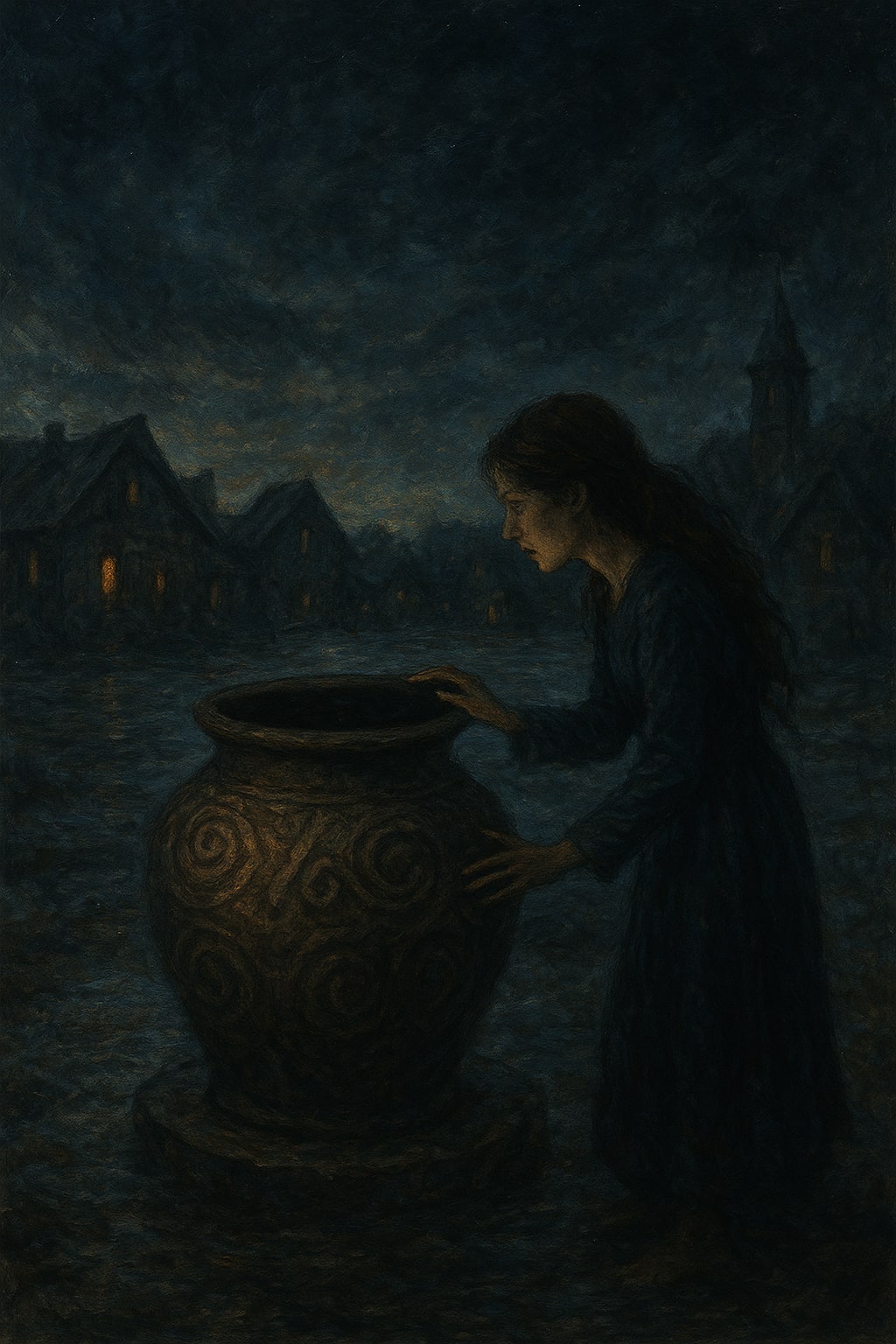
It stood in the center of the square, a clay urn taller than any man, its surface carved with spiraling patterns that seemed to shift when the light struck them. No one remembered who had made it, only that it had always been there, as if the village itself had been built around it.
The vessel had one rule: do not open it.
At first, the warning was easy to obey. The urn had no lid—just a wide, shadowed mouth yawning toward the sky. Yet no one dared drop even a pebble inside. When curious children peered into its depths, they saw nothing but blackness—deeper than pitch, as if it didn’t contain emptiness but the absence of the world itself.
Parents told stories to frighten their children into obedience: that the vessel swallowed souls, that the vessel had no bottom, that those who stared too long into it never returned the same.
But stories lose their power when told too often.
And Mira was never afraid of stories.
She was seventeen, restless and sharp-eyed, with a mind that constantly clawed at mysteries. While the other villagers worked in the fields or stitched cloth by the fire, Mira filled her notebooks with sketches of things that did not fit—the strange birds that migrated through the valley, the fragments of pottery she dug from riverbanks, and most of all, the spirals carved into the vessel.
Each day, she sat before it with charcoal-stained fingers, tracing the grooves on its clay surface, convinced there was a pattern waiting to be unlocked. “It isn’t decoration,” she whispered to herself. “It’s a map. A language.”
The elders dismissed her questions with the same phrase: It has always
been here. It must always remain.
But Mira wanted answers, not warnings.
That was when the dreams began.
At first they were fragments—images of water pouring endlessly into the vessel, vanishing without sound. Then came the voices, rising from the darkness, soft and muffled, yet unmistakably calling her name. And finally, the most terrifying dream of all: the vessel shattering, shards scattering across the square like broken stars, and the world beneath it collapsing into blackness.
She woke from those dreams gasping, drenched in sweat. But instead of scaring her, the visions drew her closer.
On the first night she dared to act, the moon was pale and thin, a silver coin lost among clouds. Mira crept barefoot into the square, carrying a flask of river water. Her hands trembled, but her curiosity outweighed her fear. She climbed onto the vessel’s base and poured.
The water didn’t splash. It didn’t trickle down the sides. It simply vanished.
And then came a sound.
A heartbeat.
Slow, steady, enormous—so deep that the stones beneath her feet seemed to tremble in rhythm. Mira staggered back, but her pulse hammered with excitement. The vessel was not empty. It was alive.
Night after night, she returned, each time with more to offer. She poured river water, fruit, even a drop of her own blood from a pinprick on her fingertip. The vessel drank it all, the heartbeat growing stronger, echoing through her bones.
But with each offering, the village began to change.
The river swelled beyond its banks, flooding the fields. Fish were found gasping on the dirt roads. Livestock panicked at night, tearing free from their pens. Children woke screaming from dreams of drowning. The elders muttered of bad omens, but none suspected the girl who lingered in the square after sunset.
Mira alone carried the weight of her secret. And the more the vessel demanded, the more she gave.
Until the night it whispered back.
Her name rippled from the darkness, soft as a sigh. “Mira…”
She froze, flask in hand. Her voice shook as she leaned close to the vessel’s yawning mouth. “What are you?”
The reply was a tide of sound that filled her skull. “I am what you have filled. I am hunger, I am tide, I am the flood you have awakened.”
The spirals carved into the urn began to shift before her eyes, twisting into new shapes—waves, teeth, unblinking eyes. Mira stumbled back, her knees weak.
And then the vessel began to overflow.
From its mouth poured water—but not the muddy water of the river. This was liquid glass, luminous and filled with drifting specks of light, as though it carried the stars themselves. It spilled over the rim, cascading onto the square, rushing into the streets.
The sound was deafening. The air smelled of salt and storm.
Villagers woke to the roar and ran barefoot into the square. They screamed as the luminous water spread, devouring torches, flooding doorways, climbing stairwells. Some fled uphill. Others fell to their knees, begging the gods for mercy.
Mira stood frozen before the vessel, her body trembling with cold spray. She wanted to run, but her feet were rooted in place. The voice rose again, booming now, woven into the roar of the flood.
“You are the vessel,” it thundered. “Not me. You chose. You poured. You opened.”
The truth struck her like lightning.
The urn was never the danger. She was. Her choices had filled it. Her offerings had awakened it. She was the container of the hunger, the tide, the catastrophe.
As the water rose to her chest, her breath shuddered. “I didn’t know,” she whispered.
The voice laughed, a sound like crashing waves. “No vessel ever does—until it overflows.”
The flood swallowed her words.
By dawn, the village was gone. Only the vessel remained, standing silent in the square, its spirals still shifting in the morning light. The waters had receded as if they had never been, but the homes were empty, the streets abandoned.
And deep within its mouth, if one leaned close enough, there was still an echo—of a girl’s voice whispering back.
About the Creator
Sajjad khan
hello dear friends and brothers i live in france i am a student please visit my profile
Keep reading
More stories from Sajjad khan and writers in Fiction and other communities.
The Man Who Remembered Tomorrow
The first time Noah woke up with tomorrow’s memories, he thought it was a dream. His alarm buzzed at 6:15 AM, but in his mind, the day had already happened. He knew the café’s barista would spill cinnamon powder on his cappuccino at exactly 8:03, apologizing with a flustered laugh. He knew the delivery van would break down at the intersection of 7th and Pine, causing a traffic jam by 9:40 that would have commuters leaning out of their windows in frustration.
By Sajjad khan7 months ago in Fiction
The Persistence of Elpis
Everything disastrous in that household had been Epimetheus's idea, and Myrto had worked for the family long enough to know that when the master of the house said something like it's perfectly safe, just don't open it, the correct response was to begin mentally cataloguing which of your personal belongings could be easily replaced.
By Tim Carmichaela day ago in Fiction


Comments
There are no comments for this story
Be the first to respond and start the conversation.