

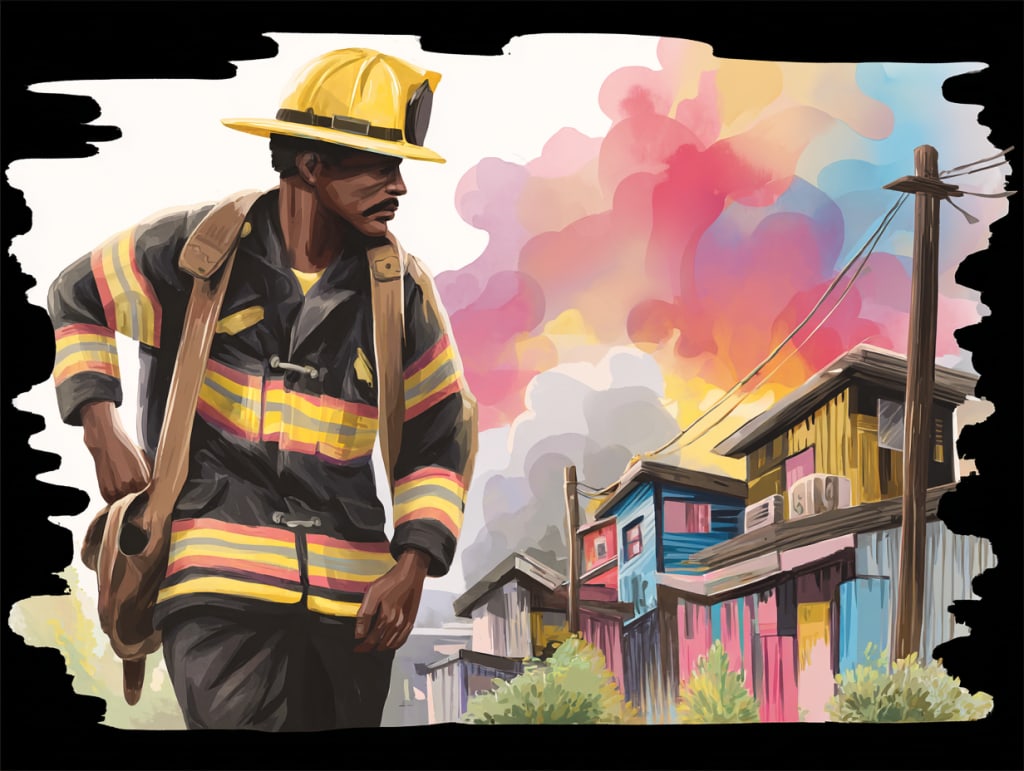
The sky is a bruise tonight, blooming pink and violet above the crooked rooftops. Smoke unravels in slow ribbons as if the fire is less an emergency and more a performance. Even after a decade on the job, I still feel it, a hollow in my chest where courage meets dread.
I tell myself the weight on my shoulders is just the rolled canvas hose, but that’s a lie I’ve been rehearsing since the first time I suited up. No matter how many times I lace my boots, tug the heavy coat over my shoulders, snap the buckles against my ribs, the truth never leaves me: I am trying to put out something that was set ablaze long before I arrived.
Some fires are born of wiring faults or a forgotten candle. Others are lit by hands no one sees. That’s what I suspect tonight; someone did this on purpose. Arson is a singular purpose masquerading as chaos. That knowledge sits in me like a stone, pressing against old wounds I pretend to ignore.
It isn’t just about stopping the flames. It’s about chasing the ghost of whoever started them. Because every fire has a phantom, and some phantoms never leave.
As I jog toward the houses, I catch sight of the bright blue panels nailed over warped plywood. The paint is cheerful, someone’s attempt to beautify the inevitable decay. The buildings sag under the weight of neglect and the dreams no one had the money to finish. It is the kind of neighborhood people write off as a lost cause, until a fire makes them pay attention.
I feel a lapse then, a momentary suspension of time. It happens sometimes; like the universe takes a breath, and in that hush, I hear her voice.
You know what you’re looking for, Marcus.
Her voice is soft, almost amused, the way it always was when she’d catch me reading her case notes over her shoulder.
She never existed, at least, that’s what the department psychologist insisted after I finally admitted I kept seeing her at the edges of my vision. But what would they know? The mind makes ghosts of whatever it cannot bury.
In that quiet lapse, the smoke becomes a veil, and I see her silhouette walking through it; gearless, untouched by the heat. She turns back, beckoning.
I shake my head to clear the image, but the vacancy she leaves behind is worse than the illusion. Because whether she’s real or not, I’ve built my purpose around her. Around the need to finish what she started, even if it costs me everything.
Her name was Eliza Stone. Or maybe it wasn’t. Maybe I invented her, wove her out of dispatch recordings and newspaper clippings, the way a lonely child invents an imaginary friend. But in my mind, she was the first woman firefighter in this district, back when nobody wanted her here.
The legend says she died in a warehouse fire on a night just like this, bright with sunset, stinking of accelerant. The official report called it a structural collapse, a tragic accident. But every instinct I have tells me it was arson, a targeted act designed to erase her.
I’ve spent years trying to prove it, filling binders with half-evidence and speculation. I tell myself it isn’t obsession. It’s duty. But there’s a thin line between the two, and I crossed it a long time ago.
Tonight feels like an echo of her final call. Same abandoned structures, same neighbourhood nobody wants to claim. Even the air feels complicit in repeating history.
I adjust my helmet, steel myself, and move forward.
Inside, the world is nothing but darkness and noise. The flames have wormed their way through the walls, licking at rafters and gnawing at the floorboards. Every footstep is a gamble.
My radio crackles, a disembodied voice shouting my call sign. “Unit 12, do you copy?”
I squeeze the mic. “Copy. Advancing interior.”
“Be advised, structural integrity compromised.”
“Understood.”
Understood. Another word that means nothing. We understand that we might die here. We understand that our families will get a folded flag and a handshake if we do.
But we go in anyway.
I pass through a doorway, and the floor shifts under my weight. Smoke floods my mask, and for a moment, I’m blind. That’s when I feel it; her hand on my shoulder. Light as memory.
“You have to find it,” she whispers.
Find what?
But I already know.
I push deeper, stepping over a charred couch. In the far corner, the flames burn lower, as though something is dampening them. A small metal box sits half-swallowed by debris. I pull it free and cradle it against my chest.
The walls groan. A beam cracks overhead.
“Marcus, you need to get out!”
My captain’s voice cuts through the roar, urgent and terrified.
But I can’t leave yet.
I pop the latch on the box and find a stack of old photos. Black-and-white. Faces blurred by time. But one is clearer than the rest, a woman in turnout gear, helmet in the crook of her arm. She’s smiling, even as soot streaks her cheeks.
Eliza.
I close my eyes, and for a heartbeat, the void inside me fills with something like peace.
The ceiling gives way behind me, jolting me back to reality. I tuck the box under my arm and run.
Outside, the sky is darker now. Sirens wail in the distance as I stagger clear of the doorway. The air tastes of ash and triumph.
“Jesus, Marcus, you trying to get yourself killed?”
My captain pulls me away from the collapsing house. I can’t answer. My lungs are raw, my throat a hollow tunnel.
He takes the box from my hands and pries it open. His face softens as he lifts the photograph.
“Where did you find this?”
“Inside. Behind the west wall.”
He squints at the image, then at me. “This is from that old warehouse fire. The one you...”
I nod.
He doesn’t say the word obsession. He doesn’t have to.
Instead, he clasps my shoulder. “Maybe you were right.”
Maybe. Or maybe I’ve wasted my life chasing a story I made up.
Later, when the flames are smothered and the hoses coiled, I sit on the tailgate of the engine. The photograph is in my hands again. Her smile is softer in the dim light, less a declaration and more a secret.
“Why did you have to go?” I whisper.
A breeze shifts the smoke, and for a moment, it feels like she’s standing beside me.
She never existed.
Or maybe she did.
Maybe she was just a woman who refused to be erased, and I’m the fool who couldn’t let go.
Some part of me understands that this vacancy I keep trying to fill isn’t really about her. It’s about the hollow in myself, a place where purpose meets desperation.
I think of all the hours I spent combing archives, all the nights I lay awake imagining her voice. I think of the quiet conviction that if I could prove she was real, then I’d be real, too.
A lapse of sanity. A void I kept trying to patch with smoke and stories.
I slide the photo back into the box and set it aside.
I don’t know if Eliza Stone ever walked into that warehouse. But tonight, as I watched those buildings burn, I felt her hand on my shoulder.
Maybe that’s enough.
As dawn breaks, I stand in the grey light, helmet under my arm. The neighbourhood looks almost peaceful in the aftermath—rows of scorched timber, the fire’s hunger finally spent.
I see children peeking from doorways, eyes wide and wondering. For a moment, I imagine what it would feel like to tell them the truth: that sometimes heroes are just people who can’t stand the vacancy in themselves.
That sometimes, you chase a ghost because it’s easier than admitting you’re lost.
The radio crackles. A new call. Another fire. Another chance to pretend I’m not haunted.
I take a long breath, tasting ash and memory.
“Unit 12, responding,” I say, my voice steady.
I climb into the cab, and as the engine rumbles to life, I glimpse the box on the dashboard.
Eliza’s smile catches the morning light.
Maybe she was never here.
But she’s coming with me all the same.
About the Creator
Diane Foster
I’m a professional writer, proofreader, and all-round online entrepreneur, UK. I’m married to a rock star who had his long-awaited liver transplant in August 2025.
When not working, you’ll find me with a glass of wine, immersed in poetry.
Keep reading
More stories from Diane Foster and writers in Fiction and other communities.
A Slice of Sunshine
In the heart of an aging Victorian neighbourhood, nestled between lace-curtained windows and wrought iron balconies, stood The Velvet Teacup; a quaint tea shop renowned for its fragrant brews and delicate pastries. At the base of a sprawling citrus grove just beyond the back garden, Maribel ran the shop with quiet devotion, inheriting it from her grandmother. The air was always tinged with the scent of fresh blossoms and simmering tea leaves, but Maribel’s pride was her lemon meringue pie, a recipe passed down with its perfect balance of citrus tang and sugary sweetness.
By Diane Foster9 months ago in Fiction
Echoes of the Silent Key
To the stranger who borrowed my silence and called it your own: I used to wonder what kind of person does that. Not steal money. Not steal fame. But steal something quieter — something invisible. An idea, a symbol, a piece of meaning that someone else built in the privacy of their own mind.
By Yasir Rehmanabout 9 hours ago in Fiction


Comments (3)
Clever take on the challenge… I feel like she was real.
Beautifully, poignantly & powerfully told, Diane.
Stunningly written and emotionally layered. Eliza may be fiction—or not—but the ache she leaves behind feels real. This piece burns slow and deep, like memory wrapped in flame. Beautiful work, Diane.