
The Uppermost Chamber
A Chamber Sealed by Love and Madness


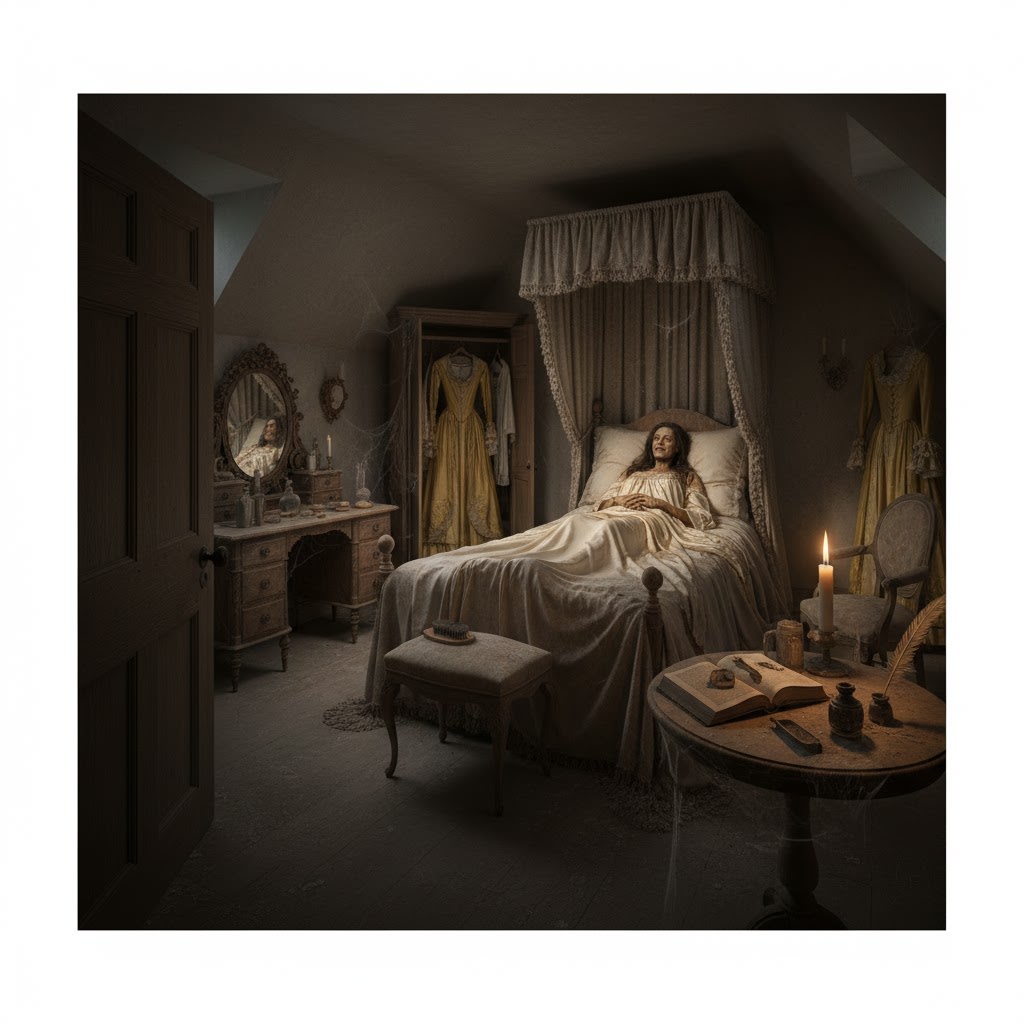
The house on Ashford Lane had belonged to my uncle for thirty-seven years before his death, and in all that time so the servants say he had never once ascended to the uppermost chamber. Not once in all those long decades had he permitted his foot to fall upon the narrow staircase that wound its serpentine way to that sealed door. When I inherited the estate in the autumn of 1847, I thought little of this peculiarity. My uncle had been an eccentric man, prone to strange habits and stranger silences. That he should choose to abandon an entire room of his own house seemed merely another manifestation of his melancholic temperament.
Yet as the weeks passed and I settled into my inheritance, I found my thoughts returning with increasing frequency to that forbidden space. It was not curiosity alone that drew my mind upward though I confess curiosity played its part but rather a sensation I can only describe as a persistent, gnawing unease. The house, you understand, was otherwise quite comfortable. The rooms were well appointed, the furnishings handsome if somewhat antiquated, the gardens pleasant enough in their autumnal decay. But always, always, there was the consciousness of that chamber above, pressing down upon the lower floors like a great weight, like a thundercloud that refuses to break.
Mrs. Holloway, the housekeeper who had served my uncle for twenty years, would not speak of it. When I inquired as to why the room had been sealed, her lined face would pale to the color of parchment, and she would busy herself with some sudden task that required her immediate departure. The groundskeeper, old Thomas, was scarcely more forthcoming. "Master sealed it up after the mistress passed," he muttered once, when I pressed him. "Said it was to remain closed. Said it particular, he did. And a man's wishes ought to be respected, even in death."
But what wishes had my uncle truly harbored? And why should a room a mere assemblage of wood and plaster hold such dread significance? These questions plagued me through the lengthening nights of October and into the gray desolation of November. I would lie awake in my bed, listening to the house settle around me, and it seemed that I could hear though I knew this to be impossible the faintest whisper of sound from above, as though the sealed chamber breathed in its abandonment.
It was on the fourteenth of November, during a storm of such violence that it rattled the ancient windowpanes in their frames, that I resolved to open the room at last. Perhaps it was the wine I had consumed at dinner, or perhaps the storm itself emboldened me with its wild energy, but I found myself seized by an irresistible compulsion. The hour was late well past midnight and the household had long since retired. I took up a candle and made my way through the darkened corridors to the narrow staircase.
How strange it appeared in the wavering candlelight! The steps were thick with dust, undisturbed save for the tracks of mice, and the walls seemed to press inward as I climbed, as though the house itself sought to dissuade me from my purpose. The air grew close and stale, heavy with the scent of decay and something else something sweetish and cloying that I could not identify. My heart beat against my ribs like a trapped bird, and more than once I nearly turned back. But no, I had come too far, and my determination, once kindled, was not easily extinguished.
The door at the summit was of heavy oak, its surface unmarred save for a tarnished brass handle. There was no lock, no visible seal, yet when I grasped the handle and pulled, the door resisted as though held fast by some tremendous force. I set down my candle and applied both hands to the task, pulling with all my strength, and at last with a groan like a dying thing the door yielded.
The smell that emerged from within was overpowering. I staggered backward, my eyes watering, my gorge rising. It was the concentrated essence of abandonment, of time suspended and air unbreathed, of something precious left to rot in darkness. When I had recovered myself sufficiently, I retrieved my candle and stepped across the threshold.
The room was smaller than I had imagined, and so densely furnished as to seem cluttered. But it was not the furniture that arrested my attention it was the extraordinary preservation of the space. Here, time had not merely stopped; it had been forcibly held at bay. A woman's dressing table stood beneath the window, its surface arrayed with bottles and brushes, combs and cosmetics, all arranged as though their owner had merely stepped away for a moment. A wardrobe stood open, revealing gowns of a fashion twenty years out of date, their fabrics still rich despite the dust that filmed them. And there, against the far wall, stood a bed and upon that bed
But I must be precise. I must not allow emotion to cloud my recollection, however much the memory threatens to undo my composure. Upon the bed lay what had once been a woman. The body for body it remained, though desiccated and diminished was dressed in a nightgown of ivory silk, now yellowed with age. The hands were folded peacefully upon the breast. The hair, still long and dark, was arranged upon the pillow. And the face merciful God, the face! was turned toward the door, the empty sockets seeming to stare directly at me, the lips drawn back from the teeth in what might have been a smile or might have been a grimace of unspeakable agony.
I knew her at once, though I had been but a child when last I saw her. My aunt Charlotte, who had died so I had been told of a fever in the winter of 1825. She had been buried so I had been assured in the family plot behind the church. Yet here she lay, twenty-two years later, in her own bed, in her own room, left to decay in solitude while the house went on around her, while my uncle lived and breathed and moved through the lower chambers, always conscious of what lay above, always bearing the weight of his terrible secret.
The candle trembled in my hand, casting wild shadows across the walls. I should have fled then. Every instinct screamed at me to turn and run, to seal the door once more and forget what I had seen. But I was transfixed by a horrible fascination. I moved closer to the bed, my feet carrying me forward against my will, and as I drew near I perceived that the room held other secrets still.
Upon the nightstand lay an open book, a journal bound in morocco leather. Beside it rested a pen and inkwell, long since dried. With trembling fingers, I lifted the journal and turned to the final entry. The date was January 17th, 1825, the very day my aunt was said to have died. The handwriting was my uncle's, though rendered almost illegible by emotion.
"She has gone," he had written. "The fever has taken her from me at last, and I am alone. They tell me I must send for the undertaker, must make arrangements, must let them take her from this room where we were happy. But I cannot. I will not. Let them think what they will. Let them whisper and speculate. She stays here, where she belongs, where we made our vows to remain together until death and beyond death. They do not understand. They cannot understand. She promised she would never leave me, and I will hold her to that promise. Let the door be sealed. Let no one enter. This is our chamber, hers and mine, and here she will remain, and here I will come"
But the entry ended there, the sentence unfinished, as though my uncle had been unable to continue. I turned the pages that followed and found them blank, save for one final entry, dated years later, written in a hand so shaky as to be nearly unintelligible:
"I cannot climb the stairs anymore. My legs fail me. But I know she waits above, patient and faithful. Soon I will join her. Soon."
The journal slipped from my nerveless fingers and fell to the floor. In the silence that followed, I became aware of a sound a soft, rhythmic sound like breathing. But no, it could not be breathing. It was merely the wind outside, the storm that still raged against the house. Yet the sound seemed to come from within the room, and as I stood frozen with terror, I perceived that the figure on the bed had shifted or had I imagined it? No, surely it was merely the flickering candlelight creating an illusion of movement.
But then the head turned slowly, inexorably until those hollow sockets fixed upon me with unmistakable intention. The lipless mouth opened, and from within that desiccated throat came a sound like wind through a crypt, like leaves rustling in an autumn graveyard.
"He promised," the voice whispered, "that I would never be alone."
I cannot clearly recall my flight from that chamber. I know only that I found myself in the entrance hall, the candle extinguished, my clothing torn, my hands bleeding from where I had stumbled on the stairs. Mrs. Holloway discovered me there at dawn, huddled against the door, and though she asked no questions, I saw in her eyes that she knew where I had been and what I had seen.
I left Ashford Lane that very morning and have never returned. The house stands empty now, for no tenant can be found who will remain there more than a single night. They hear sounds, they say footsteps in the sealed chamber above, and sometimes, in the darkest hours before dawn, the sound of a door opening and closing, opening and closing, as though someone climbs those narrow stairs again and again, compelled by a promise made in life and enforced beyond the grave.
As for me, I have tried to rationalize what I witnessed. The body was surely real some mad preservation of the corpse by my grieving uncle. The movement I perceived was certainly illusion, a trick of light and exhausted nerves. The voice I heard was nothing more than wind through a gap in the window frame.
Yet I cannot rid myself of the memory of those empty sockets turning toward me, or of the words that seemed to emerge from that long dead throat. And sometimes, in my own darkest hours, I wonder if my uncle truly made a terrible mistake or if, in his devotion, he had stumbled upon some forbidden truth about the bonds that hold us even beyond death's door. I wonder if love, carried to its ultimate extreme, might indeed possess the power to preserve, to maintain, to keep faith with the departed even as their flesh decays and time marches heedlessly forward.
The room remains sealed now, the door nailed shut, the staircase blocked with lumber. But I know it is still there, that chamber where time stopped twenty-two years ago, where a promise made in life continues to bind in death. And I know, with a certainty that chills my blood, that she waits there still, patient, faithful, and eternally alone, save for the memory of the one who loved her too well to let her go.
Let this account serve as both explanation and warning. There are rooms in this world that should remain forever sealed, doors that should never be opened, and promises that should never be made. For the human heart, in its desperation and its devotion, is capable of acts that transcend both reason and mercy, and the consequences of such acts may persist long after their authors have turned to dust.
The house on Ashford Lane stands still, a monument to love and madness intertwined. And in its uppermost chamber, in the darkness and the dust, something waits, has always waited, and will continue waiting until the house itself crumbles into ruin and the earth reclaims what was never meant to be preserved.
About the Creator
Tim Carmichael
Tim is an Appalachian poet and cookbook author. He writes about rural life, family, and the places he grew up around. His poetry and essays have appeared in Bloodroot and Coal Dust, his latest book.
Keep reading
More stories from Tim Carmichael and writers in Fiction and other communities.
The Unnumbered Door
When I first walked into the Harrington Apartments, my shoes stuck a little to the hallway floor. The carpet changed color halfway down, as if someone ran out of one kind and just kept going with another. The brass banister was loose in its brackets, wobbling a little when I brushed past. Everything looked clean, but not cared for, like someone kept wiping the same layer of age instead of removing it.
By Tim Carmichael3 months ago in Fiction
If You Love Me, You'll Do It
I met Jason when I was five years old. I could say that I loved him from the moment I saw him. He was so handsome to me and I felt in awe by his presence. When they introduced him as the new kid in school, I wanted to be his friend right away. I remember it like it was yesterday. I remember his smile and how he didn't seem shy. He appeared confident and ready to learn. I waved at him and said "hello," before anyone else could even say a word. He sat next to me, and I asked him if he wanted to be friends. He looked so happy as he said, "Yes!"
By Sidney Smith (Sid Smith)3 days ago in Fiction
A Failed Artist, A Disillusioned Poet, An Underpaid Game Show Host
I took my son and niece to Gori, a small town in Georgia where Joseph Stalin was born. They talked me into visiting the Stalin's Museum, the largest in the post-Soviet space. I had resisted going there because I just can't stand the monster and know enough about him, or so I thought.
By Lana V Lynx2 days ago in FYI


Comments (6)
This was haunting, insane, and actually quite sad, all meshed together. Congratulations on your win, Tim❣ 👏 If it were me, I would have run away screaming for miles and miles.
Wooohooooo congratulations on your win! 🎉💖🎊🎉💖🎊
What a brilliant and unnerving story, Tim. Reading it reminded me forcefully of some of Nathaniel Hawthorne’s short stories. It faithfully echoes the sentence structure and word selection of Nineteenth Century American fiction. Congratulations on placing in the challenge. Richly deserved.
Congrats on challenge placement!
That was so spooky but wonderfully written.
A well-wrought Victorian ghost story!