
The Unraveling of Reality
Fantasy Prologue II

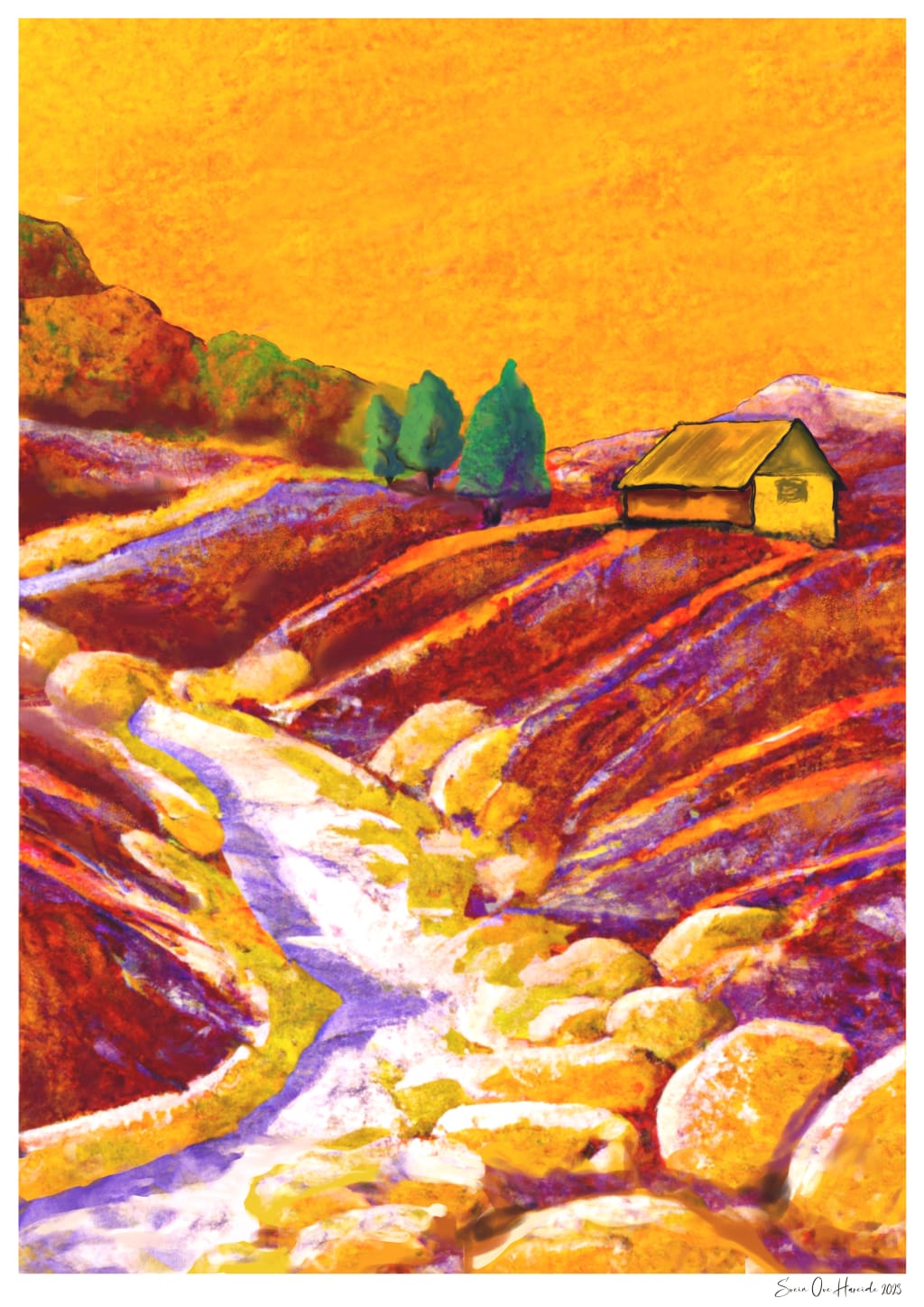
The river ran backwards on the day the Queen vanished. I remember this clearly, but I'm not sure if the memory is real or just a trick of my brain. I stood by the edge of the swollen river and saw the current flowing upwards. Leaves and twigs floated against the stream, as if the river itself defied the passage of time and all science. It was a silent rebellion, slow and purposeful, but still unsettling.
The Queen's disappearance had shaken the world - at least that's what people said and the press reported. People whispered about it in hushed tones, as if her vanishing had torn an invisible fabric of the universe. I had never met her, of course. She was a symbolic figure, a distant sign of power and stability. But the day she disappeared, the world around me began to unravel in ways I couldn't explain.
It started with the river. But it didn't end there.
I stood there watching for what felt like hours. My shoes sank into the wet ground, and I noticed my breathing was heavy in my chest as the unreal continued. When I turned to the woman next to me - a stranger with a shimmering silver scarf that almost seemed alive - she looked at me with a blank expression, as if the river was no different than it had been the day before.
"Don't you see this?" I asked, my voice heavy with disbelief.
"See what?" she replied, her brow slightly furrowed, as if I was the strange one, not the water.
That's when I realized it: I might be the only one experiencing this impossible reality where rivers defied gravity and logic bent like reeds in the wind. Alone, except for the constant buzzing thoughts in my head, asking what was real and what was not.
My mother used to say the mind is the last great frontier, both infinite and dangerous. "It will betray you when you least expect it," she said, her eyes dark with an experience she never shared. "You will see things that don't exist, believe in things you shouldn't. But remember this, child: The brain is not your enemy. It's just trying to protect you, even when it hurts."
I was seven years old when she said that, and back then the words felt like a riddle I was too young to understand. But I've thought about them a lot over the years. Now, standing by the riverbank and watching the water defy its nature, I wondered if this was what she meant. Was my brain trying to protect me? Or was it betraying me?
The next morning, I woke up to find the sun hanging low in the western sky, even though it was barely dawn. The light was strange, casting shadows that stretched and twisted in unnatural ways, as if they too were rebelling against the laws of nature.
When I ventured out, the air was heavy with a silence that felt suffocating, like a presence pressing down on my chest. The streets were empty, though I could hear faint echoes of footsteps that seemed to come from nowhere and everywhere at once.
And then the woman with the shimmering silver scarf appeared again. She was standing on the corner of my street, her eyes fixed directly on me.
"You're not imagining this," she said, as if she could read my thoughts.
I didn't respond. I wasn't sure if I believed her.
I had thought a lot about my mother's words, and I had read a lot about the human brain, and how it is a remarkable thing. It can take fragments of reality and weave them into whole worlds, convince us of truths that never existed. It can create landscapes of memories, populate them with faces we've never seen, and make us live entire lives in a single dream.
I've read that our perception of reality is, at best, an approximation. The brain doesn't show us the world as it is; it shows us the world as it thinks we need to see it. Colors, sounds, shapes - all are interpretations, stitched together by neurons and electrical impulses.
So what happens when those impulses are missing or amplified in strength and frequency? When the wiring of perception shorts out, and the brain begins to falter? Is it madness? Or is it just another form of reality, one that only those "afflicted" can access?
These questions plagued me as I wandered through my city, with the river still ranning backwards in the distance and the sun refusing to move from its place in the western sky. Everything felt skewed, as if I was walking through a dream that wasn't quite my own.
By the third day, the world had become unrecognizable. Trees bent at impossible angles, their branches twisting like the gnarled fingers of an old witch. The birds no longer sang, but emitted low, mournful creaking sounds that sent shivers down my spine.
And always, the woman with the shimmering silver scarf was there, observing.
I began to avoid her, even though it was impossible to escape her completely. She seemed to appear wherever I went, with an unreadable expression, a presence that was both comforting and unsettling.
"This isn't real, you know," she said to me one evening as I sat on a bench in the park, my head in my hands.
"What isn't real?" I asked, though I wasn't sure I wanted to know the answer.
"None of it."
I have often wondered about the brain's capacity for self-deception. It is said that when we experience trauma, the mind will create illusions to protect us from pain. Perhaps that's what was happening to me. Maybe the Queen's disappearance had triggered something deep within me, a need to make sense of a world that suddenly felt meaningless.
But if that were true, why did the illusions feel so real? Why could I smell the salty scent of the river as it ran upwards, or feel the unnatural warmth of the sun in the western sky?
And above all, why could I not shake the feeling that the woman with the shimmering silver scarf was more than just an illusion?
On the seventh day, the river stopped.
It did not return to its natural course, as I had hoped. Instead, it froze in place, the water becoming glass in motion. I stood on the bank, staring at the impossibility before me, and for the first time, I felt a pang of fear.
"What does it mean?" "What in the world does this mean?" I whispered, though I wasn't sure who I was asking.
"It means the end of the old order," the woman with the shimmering silver scarf replied, as she stepped out of the shadows.
She stood beside me, her gaze fixed on the nearly frozen river.
"And the beginning of a new one."
I don't know if any of this is real.
Even now, as I sit here writing these words, I can't be sure if I'm recounting memories or making them up. The brain is a trickster, after all, and memory is its greatest illusion.
But this I know: On The day the Queen vanished, something shifted within me. The world I thought I knew unraveled, replaced by something stranger, darker, and yet strangely beautiful.
Perhaps the river never ran backwards. Perhaps the sun never hung low in the western sky.
But maybe it did.
And if it did, what does that say about the nature of reality? About the brain's ability to create and destroy worlds with just a thought?
I may never find the answers to these questions.
But I will never forget the day the river turned, and the day it stopped.
About the Creator
Svein Ove Hareide
Digital writer & artist at hareideart.com – sharing glimpses of life, brain tricks & insights. Focused on staying sharp, creative & healthy.
Keep reading
More stories from Svein Ove Hareide and writers in Fiction and other communities.



Comments
There are no comments for this story
Be the first to respond and start the conversation.