
The Unopened Window
Sometimes the past isn’t lost—it’s just waiting to be read.

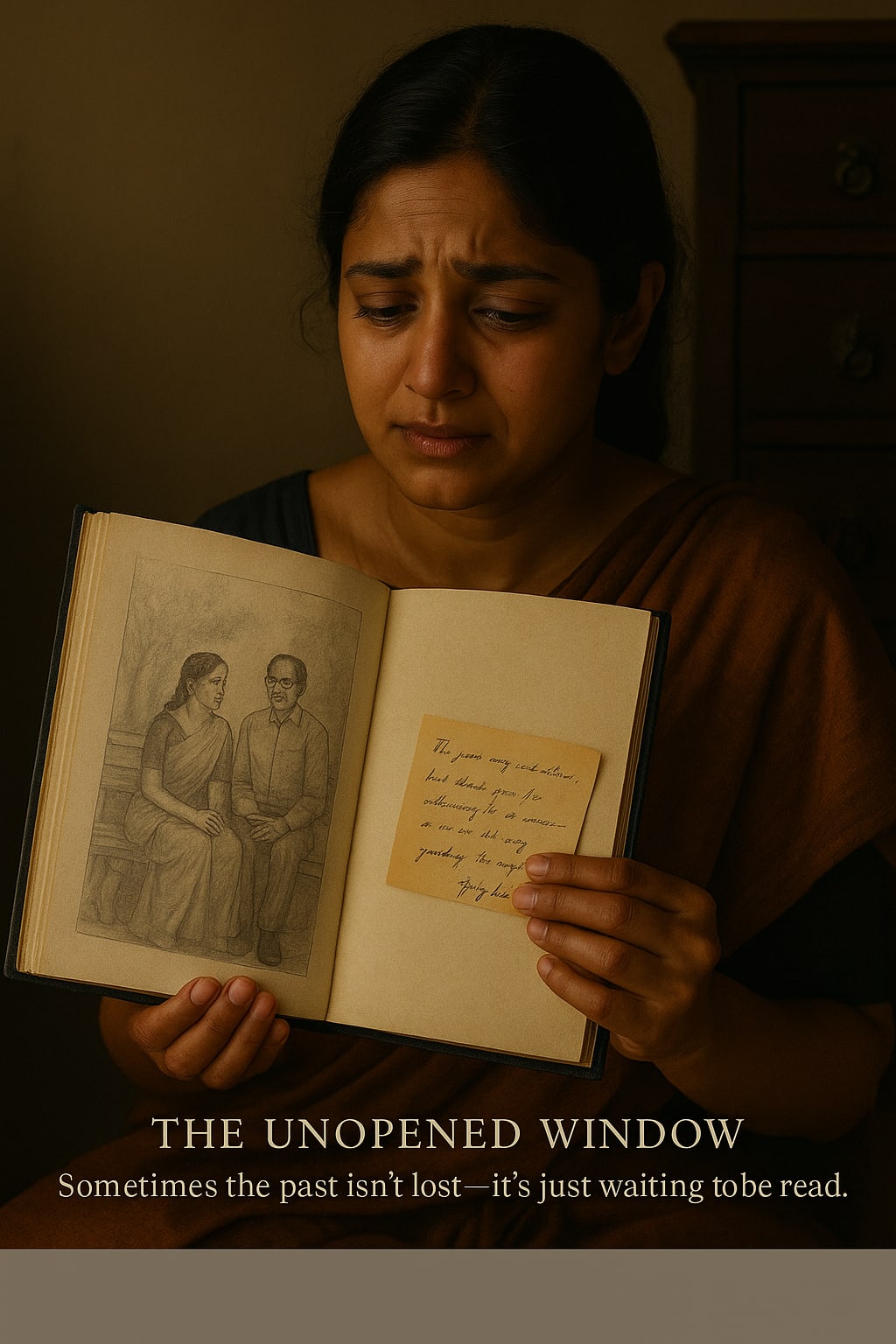
It had been three weeks since Meera discovered the letters. Yet every night, as the clock neared midnight, she found herself returning to the box—lifting a letter, reading it again, holding it as though warmth still lived in the ink.
She kept wondering the same thing: Did they ever meet again?
One evening, after putting her son to bed, she called her mother’s old friend—Mrs. Das, a retired librarian who had been Rukmini’s confidante for decades.
“Did Mom ever mention an Arjun?” Meera asked cautiously.
There was a pause. Then a sigh.
“She made me promise never to bring it up,” Mrs. Das replied. “But she carried his last letter in her purse until the very end. That must mean something.”
Meera's heart beat faster. “Do you know if they ever met again?”
“She disappeared for two days in 2001. Said she was attending a school seminar in Mumbai. But I never saw a flyer or invite. Just her suitcase and a new saree.”
Mumbai. 2001.
The year of the final letter.
Meera’s fingers trembled as she looked at the date again—July 18th. Her mother had indeed gone out of town that month. She remembered vaguely; she was in school then, and her father had been home, unusually quiet, cooking her breakfast.
The puzzle pieces were beginning to move.
Three days later, Meera made a decision. She would go to Mumbai.
She took two days off work, booked a quiet hotel in Colaba, and carried the box of letters with her. It felt like a pilgrimage—not just into her mother’s past, but into a part of herself she had never known.
She had only one clue: the return address on the final letter. It was faded but legible—“B-17, Matunga East.”
The building was old but well-kept. The kind with green shutters, iron balconies, and plants that had claimed the windowsills as their own. Meera stood before the gate, staring at the nameplate. It didn’t say “Arjun.” But she buzzed anyway.
A young woman answered. “Yes?”
“Hi, I’m looking for… someone who used to live here. Arjun Mathur. He wrote letters to my mother.”
The woman’s eyes widened. “You must be Rukmini’s daughter.”
Meera froze.
“How do you know—?”
“I’m Arjun’s daughter. I saw you in a photo once… when my father returned from the hospital the week after meeting your mom. He kept looking at that picture, said, ‘That’s the girl who carries her mother’s soul.’”
The woman opened the gate.
Inside, the living room was simple. Warm-toned walls, an old harmonium in the corner, and dozens of books. Meera felt like she had stepped into one of the letters.
“I’m Naina,” the woman said, offering her chai. “Dad passed away just two weeks after she visited. But he told me everything.”
Meera listened with bated breath.
“He hadn’t written that last letter expecting a reply. But when she came… he looked ten years younger. They sat here, just talking. No drama, no tears. Just memories. She brought him guava sweets. He showed her his sketchbook.”
“Sketchbook?” Meera asked.
“Yes,” Naina smiled. “He used to draw her. From memory. He had hundreds.”
She stood, walked to a chest in the corner, and returned with a thin portfolio. Meera opened it and gasped.
Each page was a sketch—of her mother as a young woman. Laughing in the rain, standing with an umbrella, sitting at a bus stop. Even one of her in a temple doorway, wearing a flower in her hair.
“He remembered her like art,” Naina said softly.
Tears welled in Meera’s eyes. “Did she cry when she saw these?”
“No. She said she had cried enough over the years. But she did ask him one thing.”
“What?”
“If he was happy.”
Meera clutched the sketchbook to her chest.
“And he said yes. Because he had met her once. And again, in the end.”
The rest of the day passed like a dream. Meera stayed for hours. She learned that Arjun had never told his wife about Rukmini. That his daughter, Naina, only knew because of a letter she wasn’t meant to read—but had, just days before his death.
“I used to feel angry,” Naina confessed. “That he held onto someone else. But after meeting your mom, I understood. It wasn’t betrayal. It was... preservation.”
On the flight home, Meera held the sketchbook in her lap the entire time.
Back in Delhi, Meera began writing. Not fiction. Not diary entries. But a memoir—about her mother, the letters, the unanswered questions that now had shape. She titled it: The Window They Never Closed.
When she showed the draft to Mrs. Das, the older woman said with a quiet smile, “Your mother would have been proud.”
But the story wasn’t done yet.
Two weeks later, while browsing through an old almirah, Meera found a second box. Smaller, hidden beneath old greeting cards. Inside were two Polaroids. One of her mother and father, smiling at India Gate. And the other—blurry, but unmistakable—her mother sitting on a Mumbai bench next to a man in glasses. Arjun.
Taped to the bottom of the box was a receipt from a Mumbai bookstore, dated July 21, 2001—the day after her mother visited Arjun.
On the back was a note.
"To Rukmini,
The past may not return, but thank you for returning to it once—so we could say goodbye the right way."
Meera never told anyone about the photo. Some memories, she felt, didn’t need explaining.
Instead, she placed it inside the sketchbook. A final page. A full circle.
And on quiet nights, she still opens the letters—not just to remember, but to feel. To believe in chance encounters, in unfinished sentences, and in the beauty of goodbyes that come late, but right on time.
Because some stories don’t end.
They simply rest—until someone’s heart is ready to read them again.
The End… or perhaps, just another beginning.
About the Creator
Gaurav Gupta
Passionate about crafting fiction thrillers that keep readers hooked until the very last page. I love weaving intricate plots, creating complex characters, and building suspenseful worlds that take you on a rollercoaster of emotions.
Reader insights
Outstanding
Excellent work. Looking forward to reading more!
Top insights
Compelling and original writing
Creative use of language & vocab
Easy to read and follow
Well-structured & engaging content
Excellent storytelling
Original narrative & well developed characters
Eye opening
Niche topic & fresh perspectives
Heartfelt and relatable
The story invoked strong personal emotions
Keep reading
More stories from Gaurav Gupta and writers in Fiction and other communities.
The Last Letter
The smell of old paper and lavender hung in the air as Meera opened the last drawer of her mother’s wooden cupboard. Nestled beneath worn-out sarees and faded photographs was a box she had never seen before. Intrigued, she lifted it, dusted off the top, and opened the fragile lid. Inside lay dozens of letters, neatly tied with a crimson ribbon.
By Gaurav Gupta9 months ago in Fiction
Lightning Never Strikes Twice
The distant rumble, the sudden deluge, the crescendo of sound, the flash of light, the explosive energy — it never gets old. I became an amateur storm chaser about two years ago. My wife, Cindy suggested it. Sort of. She said, "Alex, you know this cancer is killing me. I've come to terms with that, but you're smothering me. Go join a band, write a book, or become a storm chaser, for all I care. I love you, but you need a hobby."
By Julie Lacksonen5 days ago in Fiction
Review of 'Man on the Run'
My wife and I saw Man on the Run, a nearly 2-hour documentary on Amazon Prime, about Wings, Paul McCartney's group that flew around the world from shortly after The Beatles broke up in early 1970 to shortly after John Lennon was murdered at the end of 1980, making a Beatles reunion forever impossible.
By Paul Levinson4 days ago in Beat



Comments
There are no comments for this story
Be the first to respond and start the conversation.