
The Tree with a Beating Heart
Some friendships don’t speak — they listen

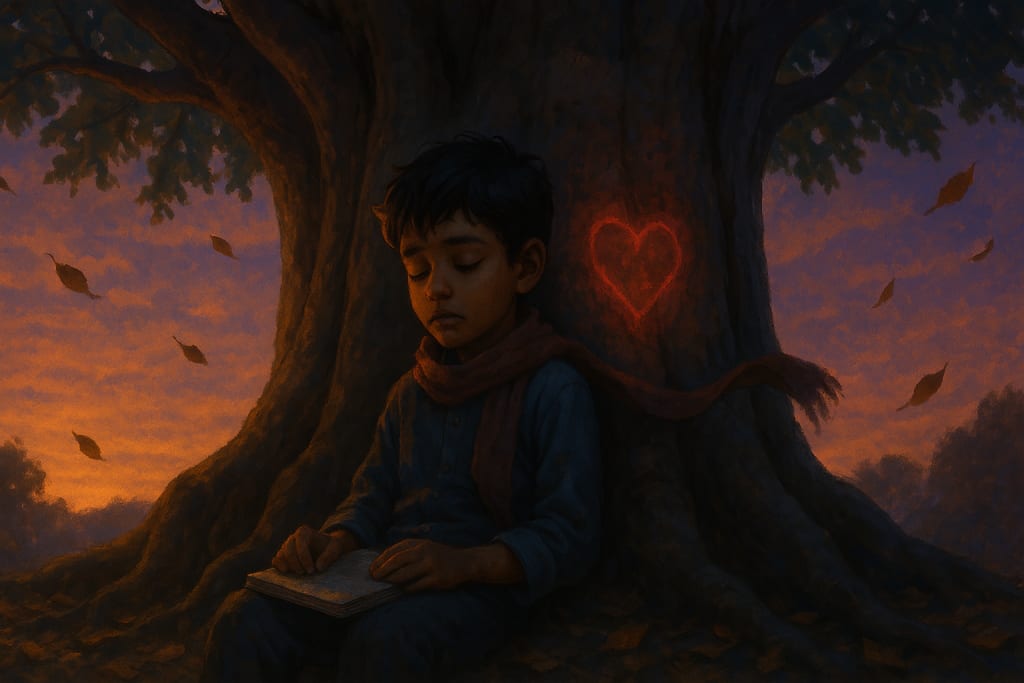
Sarfaraz was never loud, even before his father died. But after that day, silence wrapped around him like an extra layer of skin.
He stopped talking at school. His laughter, once soft but frequent, vanished. Even at home, where his mother tried her best to fill the air with warmth, he remained quiet — a shadow in corners, a sigh in stillness.
There was only one place he didn’t feel invisible: the old banyan tree behind his school.
It stood taller than all the buildings in his town, its branches like open arms, roots crawling over the earth like ancient veins. Some said it was over 300 years old. Others said it had a soul.
Sarfaraz didn’t care about myths. He just knew that when he sat under the tree, his chest didn’t feel so heavy.
So he went there. Every day.
He brought his lunch. He brought his stories. And most importantly, he brought his silence.
At first, the tree said nothing.
It creaked in the wind, rustled its leaves, dropped the occasional twig — the way old trees do. But to Sarfaraz, it was listening.
He began to whisper to it.
“Abu used to bring me mango juice in summer,” he told the bark one afternoon.
“He said trees can cry too, but they cry inside.”
Another day:
“I don’t know how to be… strong. I just pretend to be quiet because people think that means you’re okay.”
Some days he just sat, back pressed against the trunk, not speaking at all — and the tree said nothing in return.
Until one day, it did.
It was after a heavy monsoon. The ground was wet. Sarfaraz arrived with muddy shoes and sad eyes.
As he touched the bark, something strange happened:
He felt a faint thump.
Then another.
Like a slow, gentle heartbeat.
He froze. Pressed his ear against the trunk. There it was again: thump… thump… thump.
It wasn’t loud. It wasn’t fast. But it was real.
And in the rustle of the leaves, he heard something he couldn’t explain — not words, exactly — but memory.
“You were seven when you first said you hated goodbye.”
“You missed your father the most on Tuesdays.”
“You once asked if trees could hold secrets. I’ve been holding yours ever since.”
Sarfaraz stumbled backward, eyes wide.
“Who… who are you?” he whispered.
The tree didn’t reply with sound. Instead, a breeze passed through its branches, and dozens of yellowing leaves floated down gently — like a nod.
He wasn’t scared.
He came back the next day.
And the day after.
Now their conversations were different. The tree didn’t always “speak” — but when it did, Sarfaraz felt it in his chest, not just his ears.
It remembered everything. Every secret. Every sorrow.
Weeks passed. Then months.
Sarfaraz began drawing again. Laughing a little. Talking more at home. He still visited the tree, but not out of loneliness — now, it was friendship.
One afternoon, as spring returned, he brought a notebook with him.
He sat under the banyan and wrote:
“This tree has a heart.
It doesn’t beat for blood,
But for everything it’s loved.”
That evening, before he left, the bark behind him grew warm.
He turned to see a small green sprout breaking through the earth — right where he always sat.
He smiled.
Years later, Sarfaraz became a writer. He published stories, poems, even a children’s book. But he never told anyone about the banyan tree that once whispered to a grieving boy.
He didn’t need to.
Instead, he dedicated every book the same way:
“For the friend who listened when no one else could.
The one with roots deep in memory and a heart older than time.”
💚 Final Note
Sometimes, healing doesn’t come through words.
Sometimes, it comes through listening —
Even if the one listening has leaves instead of ears.
About the Creator
Keep reading
More stories from The voice of the heart and writers in Fiction and other communities.
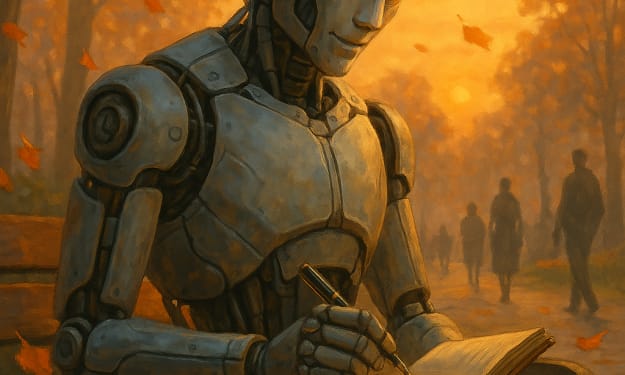
The Robot Who Wrote PoemS
In the year 2091, humans built machines to make life easier. Some cleaned homes. Some worked in factories. Some drove cars. But in a quiet laboratory at the edge of a rainy city, an engineer named Dr. Laila Rehman was working on something different.
By The voice of the heart6 months ago in Fiction
If You Love Me, You'll Do It
I met Jason when I was five years old. I could say that I loved him from the moment I saw him. He was so handsome to me and I felt in awe by his presence. When they introduced him as the new kid in school, I wanted to be his friend right away. I remember it like it was yesterday. I remember his smile and how he didn't seem shy. He appeared confident and ready to learn. I waved at him and said "hello," before anyone else could even say a word. He sat next to me, and I asked him if he wanted to be friends. He looked so happy as he said, "Yes!"
By Sidney Smith (Sid Smith)6 days ago in Fiction


Comments
There are no comments for this story
Be the first to respond and start the conversation.