
The Town That Slept for 100 Years
a magical-realist story of a village waking up in the modern world after a century-long sleep.
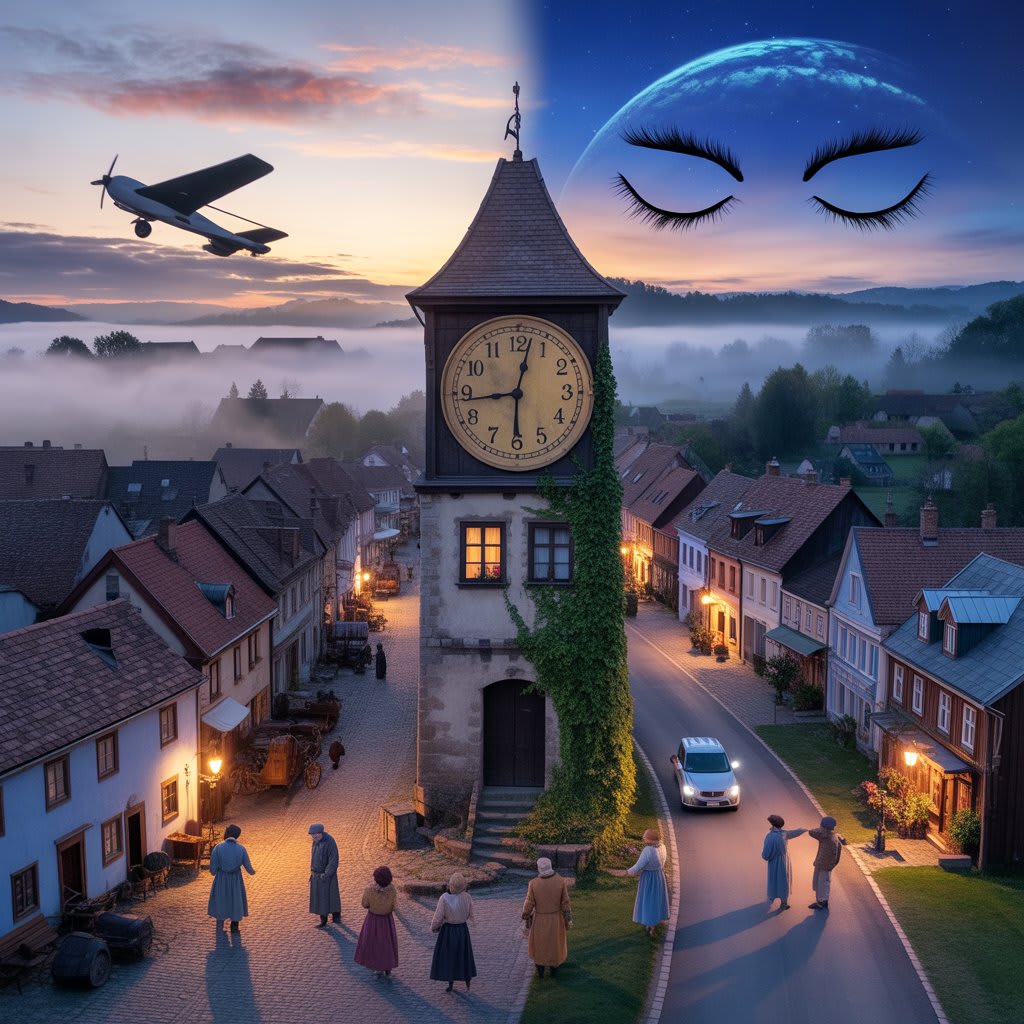
When the travelers first stumbled upon Maravelle, they thought it was abandoned. The cobblestone streets were dustless, the wooden shutters half-open, the fountains still pouring streams of clear water as if they had been tended only yesterday. Yet not a single voice, not a single step echoed through the town.
It was only when one of the travelers, a curious young woman named Liora, peered into a bakery that she realized something was deeply strange. Behind the counter, the baker stood frozen mid-motion, his hand stretched toward a loaf of bread, his eyes closed as though he were napping. The bread was still warm, the scent of yeast alive in the air.
“Something is wrong here,” she whispered.
The people of Maravelle had fallen asleep exactly one hundred years ago. No one knew it then, of course. To them, it was simply a night like any other, filled with crickets and lantern light. They went to bed, dreaming of the next day’s market or their children’s laughter. But dawn never truly came for them.
The sun rose, but they remained asleep—locked in a century-long slumber while the world outside moved on. Empires rose and crumbled, machines were born that carried people into the skies, wars raged and ended, and the seasons passed like rushing water. Yet in Maravelle, time held its breath.
And then, suddenly, the breath was released.
On the morning Liora entered the bakery, the baker’s eyes snapped open. The loaf fell from his hand with a thud. All over town, shutters banged closed and then flung open again as voices rose in confusion. Mothers called out for children. The mayor stumbled into the square, still clutching the speech he had planned to give a century earlier. The fountain’s splash was drowned by the babble of voices shouting the same question:
“What happened?”
The townsfolk thought they had only slept through a single night. But when Liora pulled out her glowing phone to take a picture, the crowd gasped as though she had summoned lightning in her palm.
“Is that sorcery?” the blacksmith demanded, his hammer still clutched in one hand.
“No,” Liora said gently. “It’s… well, it’s a kind of magic we call electricity.”
The townsfolk blinked at her words. To them, the world still lived in candlelight and horse-drawn carts. They did not yet know of engines, skyscrapers, or the quiet hum of satellites circling above their heads.
The news spread quickly beyond the valley. Historians, journalists, and scientists rushed to Maravelle, marveling at the untouched preservation of its buildings, its language, its people. The villagers were thrust into a spotlight they had never asked for. They were specimens of wonder—living relics from another century.
Some reacted with fear. The schoolteacher fainted when shown a television screen, crying that the moving images were spirits. The butcher refused to leave his shop, muttering that the outside world smelled of smoke and metal.
But others were curious. The children, especially, swarmed around visitors, eager to touch their strange clothing, to ride in their cars, to taste foods wrapped in shining plastic. They learned quickly, absorbing new words and ideas as though they had been waiting for them all along.
Elias, the mayor’s son, became fascinated with airplanes. When shown a video of a rocket piercing the sky, he whispered, “So this is what we dreamed of.” For in their century of sleep, the people of Maravelle had dreamt vividly—dreams of flight, of voices carried across oceans, of towers scraping the sky.
It was as if their long slumber had prepared them for the future they awoke to.
Still, adjustment was not easy. Some wept when told that their neighboring towns, their friends, their distant cousins were long gone. Graves they expected to visit were already a hundred years old. The world they remembered no longer existed.
One evening, as the sun bled gold over the rooftops, Liora sat with the baker outside his shop.
“I don’t understand,” he said softly. “Why us? Why were we made to sleep while the rest of the world lived?”
She had no answer. Perhaps it was fate. Perhaps a trick of time. Perhaps Maravelle had been chosen to remind the world that history is not always buried, sometimes it waits.
The villagers, after much debate, decided to rebuild their lives—not as museum pieces, but as part of the living world. They embraced some modern ways, but also preserved their own. Their songs still filled the square at dusk, their bread still baked golden in the morning ovens, but now their children learned to read both the old books and the glowing screens of tablets.
Maravelle became a place between times—a bridge where past and present met. Travelers came not just to witness the miracle of the sleeping town, but to feel something of their own history alive again.
And when the villagers looked up at the airplanes etching white lines across the sky, they no longer felt left behind.
For though they had slept a hundred years, they had awakened with dreams that belonged to the future.
About the Creator
Lightning Never Strikes Twice
The distant rumble, the sudden deluge, the crescendo of sound, the flash of light, the explosive energy — it never gets old. I became an amateur storm chaser about two years ago. My wife, Cindy suggested it. Sort of. She said, "Alex, you know this cancer is killing me. I've come to terms with that, but you're smothering me. Go join a band, write a book, or become a storm chaser, for all I care. I love you, but you need a hobby."
By Julie Lacksonen5 days ago in Fiction
Low Hanging Fruit
The dead man hung over the boardroom table. The hangman’s noose affixed to the ceiling rafter was well tied so his shoes just barely hovered above the table and his body lazily swayed back and forth, never fully coming to a complete rest.
By Adam Kolozettiabout 8 hours ago in Fiction
Review of 'Man on the Run'
My wife and I saw Man on the Run, a nearly 2-hour documentary on Amazon Prime, about Wings, Paul McCartney's group that flew around the world from shortly after The Beatles broke up in early 1970 to shortly after John Lennon was murdered at the end of 1980, making a Beatles reunion forever impossible.
By Paul Levinson5 days ago in Beat



Comments
There are no comments for this story
Be the first to respond and start the conversation.