
The Tower Talks
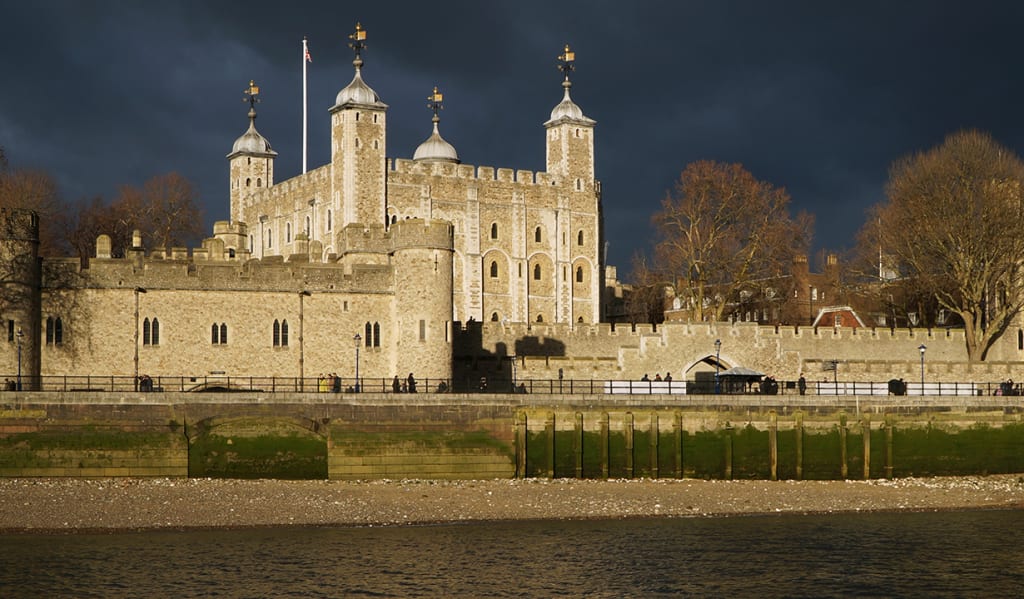
If Walls Could Talk: The White Tower has much to say.

The Tower Talks
D. A. Ratliff
“If walls could talk.”
How many times a day does someone say that? I have lost count because I quit counting quite a long time ago. Let me introduce myself, I am the White Tower, and when I tell you I have seen it all, I am not exaggerating. Allow me to tell you my story.
I am ancient, but holding my age quite well, thanks to the good British taxpayers and tourists wanting to visit the Tower of London. Tourists. Both the bane and the savior of my status. I remember when I served a purpose, but within me now is a museum for the Royal Armouries collections. I always loved the clink of armor, meant to be used, not stored in glass cases with descriptions on little cards. There was a time when I had a notorious prison within, and I was impenetrable. Those were the glory days.
Let’s venture back to when I became aware.
They constructed me from wood. I remember the sensation of two rough boards fastened together and then more added, and I became a building, not just any building but one designed to show the might of William the Conqueror, who was now King of England. William loved building castles to show his power, and as the center of the keep, I was imposing. Few had ever seen a building so large.
While as wood, I certainly attracted attention, but a few years later, the calloused hands of stone masons began to surround me with blocks of stone. The masons chattered about the rag-stone they were using and complained about the Caen stone brought in from France to fancy up my appearance. They were probably right about the French stone. Several hundred years later, I had a facelift of Portland stone. Well, I do still look good, so all is well.
You are likely wondering how I got the name White Tower. Initially, it was because the Caen stone was white limestone., but in 1240 or so, King Henry III decided to whitewash me. He claimed it was supposed to make me clean and strong, but I suspect it was because he loved to follow the trends of the day, and everyone was whitewashing.
Thankfully, after the horrid Great Fire of London, the excellent Christopher Wren removed all that nasty whitewash from my stone and even upgraded the windows embedded in me. I am still the White Tower. And thank goodness, all that paint is gone. I see all these people milling about with their faces painted, and they look cheap. I am not cheap.
I served an essential purpose as a battlement from the beginning, but in 1100, I became a prison, although my first prisoner, Rannulf Flambard, the Bishop of Durham, escaped. I became much better at keeping prisoners confined. Some of my prisoners lived in luxury, and some lived in torture, but only a few suffered that fate. The rack wasn’t for everyone.
Over the ensuing years…. Wait, excuse me for a moment.
Madam, madam, could you please get those children under control…. Oh… those gummy things. When it is hot, like today, and they throw those candies at me, they stick. I’m not fond of that sticky feeling. If the cleaners don’t see it, that mess will stick to me until it rains. Tourists. I don’t like tourists.
Now, where was I? Oh yes, the ensuing years. For a long time, I was alone. But the Wardrobe Tower and the Bell Tower were commissioned in 1190 and completed by 1210, so I had company. I never understood an entire building for the clothing and jewels of the monarch, but no one asked me.
King Henry III decided I needed more companions, which I did not, and he built the Wakefield and the Lanthorn towers. Although I served as a river beacon, a lantern was placed atop the Lanthorn and shone at night to direct traffic along the Thames.
As time passed, more buildings, including a mint, were constructed, along with a wall to enclose the keep. I wouldn’t say I enjoy confinement, but I suppose it was inevitable to keep all of us safe. Speaking of safety, have you seen the Tower guards? The Beefeaters? Rather fancy dress if you ask me, but they do look impressive. They were known as the Yeoman Warders, but an Italian count gave them the nickname ‘Beefeaters” because the King allowed them to eat as much beef as they wanted from his table, and it stuck. I am certainly glad no one gave me a nickname.
But enough about how I came into existence. Many people ask about my memories of my years on the keep, and when I said earlier that I had seen it all, I meant it. Where do I begin?
As a tower devoted to protecting the crown, much of what happened here resulted from threats against the monarch’s safety. In truth, not all were likely threats, but I heard someone say power begets power. These kings and queens were all about power.
One of my fondest memories was of children laughing on the Tower Green. Young Edward V and his younger brother Richard were brought to the Tower by their uncle. Edward was too young to rule, and his uncle—well, power begets power—imprisoned the brothers. I remember them playing and running about the Green. Then they disappeared. I heard whispers the king had the boys murdered. Rumors swirled about who committed the deed, but I knew they were dead as they died within me. Their skeletons, sadly, were discovered near the chapel much later.
There were few happy times. I witnessed torture within my walls, including Guy Fawkes, who was tortured here but taken to St. Paul’s to die. But many enemies of the reigning monarch died before me on the Tower Green. At least there was a variety of execution methods. One never got bored around here. While beheadings seemed popular for the monarch’s greatest foes, some died by hanging. During the First World War, firing squads dispatched spies, which was quite noisy.
There was a litany of famous figures who, in some way, offended the crown and died as a result. Henry XIII seemed to execute at whim and all for personal reasons. He had Sir Thomas More beheaded for not acknowledging him as head of the Church of England, then beheaded two wives, Anne Boleyn and Catherine Howard. I am not a student of human behavior by any means, but common sense told me the king had issues. Thankfully, I could not voice that opinion during his reign, or I might have lost my turrets to the executioner’s blade.
Some beheadings affected me quite a bit. Queen Mary ordered Lady Jane Grey and her husband executed because she perceived the young Lady Jane as a threat. When the guards brought the couple to the Green, she was nothing but a child, not yet seventeen. I do not know the depths of sorrow, but I felt a loss that day. Others shared that sentiment, and today, across the Green from me is a simple but lovely monument on the site of Lady Jane’s demise.
My favorite resident of the Tower was the young Princess Elizabeth, whose jealous sister Queen Mary imprisoned her. Rumors abounded that she entered her imprisonment through the Traitor’s Gate, but that was wrong. She was escorted across the drawbridge by guards who showed loyalty to her. She was a delight and a breath of fresh air among the rogues that inhabited the Tower. It was the execution of Sir Walter Raleigh, a favorite of Elizabeth after she became queen, that also disturbed me. Raleigh was imprisoned in the Tower but executed at the Palace of Westminster for treason by King James, her successor. Queen Elizabeth would have been sad. I had grown fond of her during her exile, and as the carriage carrying Raleigh to Westminster departed the Tower, I sensed sadness for her.
You ask if I miss those days. Surprisingly, even to myself, I am pleased those days are gone. I know I become testy about the antics of the children who visit and perhaps the adults, but I am relieved. So many centuries of standing watch over the City of London and the monarchy can take its toll.
Today, I stand in the center of The Tower of London Palace as crowds of citizens from around the globe wander through my halls and the other building. They gaze equally in awe at the crown jewels or the armor on display. I am amazed as the enormity of the Tower’s history dawns on them. The children with their parents or on a school trip, although rowdy at times, respect the history I have seen.
As long as I stand, I am content to guard the city, the monarchy, unruly children, and their gummy candies.
Long live the King.
***
-------------------------
Resources
https://www.history.com/topics/middle-ages/tower-of-london
https://www.britannica.com/topic/Tower-of-London
https://www.hrp.org.uk/tower-of-london/history-and-stories/tower-of-london-prison/#gs.p39vpg
About the Creator
D. A. Ratliff
A Southerner with saltwater in her veins, Deborah lives in the Florida sun and writes murder mysteries. She is published in several anthologies and her first novel, Crescent City Lies, is scheduled for release in 2026.
Keep reading
More stories from D. A. Ratliff and writers in Fiction and other communities.
Sacred Ground
Sacred Ground D. A. Ratliff The twin suns of the Icai system were beginning to peek over the horizon as Renata Ledger raced toward the ancient viaduct. Since arriving on the planet, when she was twelve years old, she had met the sunrise on the ancient bridge. Running to the highest point, she stopped, dropped her backpack, leaned on the stone ledge, and watched the orbs rise, one slightly behind the other, and bring light to the day.
By D. A. Ratliff3 years ago in Fiction
What Am I Missing?
Day 1 My mission is simple, to learn about humans by becoming one. They’ve got a written history, but I’d rather go in fresh and improvise. I’ve been doing this a long time and consider myself an expert at blending in. Confidence is the key. If you just look like you know what you’re doing, it’s generally accepted.
By Leslie Writes5 days ago in Fiction


Comments
There are no comments for this story
Be the first to respond and start the conversation.