
The Torenza Passport Mystery: Real Nation, Fake Story, or a Digital Illusion?
Unveiling the truth behind the viral JFK “Torenza Passport” video — a deepfake illusion mistaken for a real-world mystery.
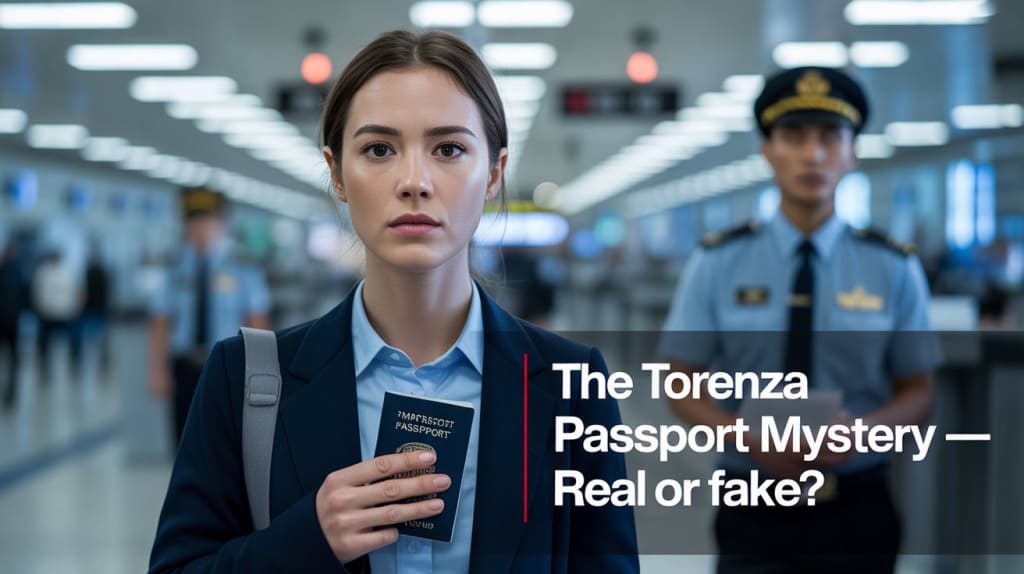
In early October 2025, the digital world found itself gripped by a story so strange, so seemingly impossible, that it blurred the line between reality and imagination. A short video surfaced on TikTok, showing what appeared to be an ordinary scene at New York’s John F. Kennedy International Airport. Yet, within seconds, viewers realized there was nothing ordinary about it. The woman at the center of the frame, calmly standing at the immigration counter, handed over her passport to an officer. The cover bore a single word that would ignite a global firestorm of speculation — “Torenza.”
The name was unfamiliar to everyone. No map, no atlas, and no government database contained any record of a nation by that name. Yet, there it was — printed in bold letters on what looked like an official travel document. The clip’s mysterious tone, combined with the bewildered expression of the officers and the woman’s calm confidence, gave it an eerie authenticity. Within hours of being posted, the video went viral. TikTok users began reposting it with captions like “Hidden countries do exist!” and “Proof of the parallel dimension theory.”
By the evening of October 7, the footage had already crossed several million views and was trending across multiple platforms, including Instagram Reels, YouTube Shorts, and X (formerly Twitter). The narrative snowballed into a full-blown social media frenzy. Some claimed that the woman had arrived on a flight from Tokyo, Japan — a detail that lent the story a strange sense of plausibility, as if the mystery stretched across continents.
Internet sleuths began dissecting every frame of the video. Commenters zoomed in on the woman’s attire, her accent, and even the font printed on the passport. Others tried to locate the exact spot in JFK Airport where the video had supposedly been recorded. Reddit threads grew by the hour, filled with theories ranging from secret global alliances and lost civilizations to interdimensional travel. The story’s magnetism came not from evidence, but from its uncertainty — that thrilling possibility that maybe, just maybe, we were witnessing something extraordinary.
However, as with many internet mysteries, skepticism followed the excitement. Within days, professional fact-checking organizations like NDTV and MalwareTips began investigating the origins of the clip. What they found dismantled the illusion piece by piece.
According to NDTV’s digital verification team, there were no official statements or records from JFK Airport, the Port Authority, or the U.S. Customs and Border Protection agency. A review of the airport’s flight and customs data showed no trace of a detained traveler matching the description. In short, there was no evidence that any woman carrying a passport from “Torenza” had ever passed through U.S. immigration — or any immigration, for that matter.
MalwareTips, a cybersecurity and digital forensics outlet, went a step further. Their analysts conducted a frame-by-frame breakdown of the video using AI forensics tools. They identified several inconsistencies typical of artificially generated footage: the lighting on the woman’s face did not match the surrounding environment, the texture of the passport cover was unnaturally smooth, and the text on the document became distorted when magnified. Most tellingly, the scrolling “news ticker” at the bottom of the clip — intended to mimic a broadcast report — contained no legitimate network branding and featured grammatical errors. To experts, it was a textbook example of a deepfake.
The conclusion was unanimous: the “Torenza Passport” incident never happened. The entire video was a fabrication — an AI-generated illusion crafted to appear real. But while the event itself was fake, the public reaction to it was very real. In just a few days, the myth had reached millions, transcending borders and languages.
Why did it spread so fast? The answer lies in psychology as much as technology. Humans have always been drawn to stories of mystery and the unexplained. The Torenza myth tapped into that timeless fascination — the same curiosity that fueled earlier tales like “The Man from Taured,” the 1950s legend of a traveler in Japan carrying documents from a nonexistent country. It also echoed the 1959 case of John Zegrus, a man arrested in the Middle East for presenting forged papers from an imaginary nation. Both historical cases remind us that the allure of the unknown often outweighs our instinct for skepticism.
In the digital age, however, that fascination is amplified by technology. Artificial intelligence tools now allow creators — and deceivers — to manufacture entire realities. What once required Hollywood studios can now be produced on a laptop with the right software. Experts warn that this accessibility, while creatively liberating, poses serious challenges to truth itself.
By the time the “Torenza Passport” was debunked, many who had first encountered it as entertainment or curiosity had already shared it widely. The line between skepticism and belief blurred. Some users admitted later that even after learning it was fake, the video “felt real.” This emotional residue — the sense that something might be true simply because it looked true — is one of the most powerful effects of AI-generated misinformation.
The broader implications of the Torenza case extend beyond this single viral video. It demonstrates how artificial intelligence can weaponize curiosity. Deepfakes like this one are not just technical tricks; they are psychological experiments in persuasion. They test how far the human mind can be led by realism, narrative, and emotional intrigue.
In response, digital experts and fact-checkers are urging the public to adopt a “trust but verify” mindset. NDTV’s report concluded with a warning: “In the era of AI, seeing is no longer believing.” This sentiment has since been echoed by cybersecurity firms and social media watchdogs worldwide. Platforms like TikTok and X have started labeling suspected AI-generated videos, though enforcement remains inconsistent.
Ultimately, the “Torenza Passport” story is not about a mysterious traveler from an unknown nation. It is about us — our readiness to believe, our hunger for wonder, and our struggle to separate truth from illusion. The passport from a fictional country became a mirror reflecting our collective vulnerability to digital deception.
As the dust settled in late October 2025, the Torenza myth had already joined the pantheon of great internet hoaxes. Yet it left behind a valuable lesson. The boundaries between reality and fabrication are thinner than ever before. The responsibility to question, to verify, and to think critically now rests on every digital citizen.
The Torenza passport was never real. But the world’s reaction to it — the hope, the doubt, the fascination — revealed something deeply human. In an era defined by artificial intelligence, our greatest challenge is not distinguishing nations, but distinguishing truth itself.
About the Creator
Wellova
I am [Wellova], a horror writer who finds fear in silence and shadows. My stories reveal unseen presences, whispers in the dark, and secrets buried deep—reminding readers that fear is never far, sometimes just behind a door left unopened.
Ludacris and Nelly draw backlash over bookings at MAGA-coded music festival
Ludacris and Nelly headlining a mostly right-wing event is good for them. It’s also great for the genre of hip hop. The two rap veterans have showcased their talents on other stages. Why can’t they perform for mostly MAGA folks and grab that bag?
By Skyler Saunders5 days ago in Beat


Comments
There are no comments for this story
Be the first to respond and start the conversation.