
The Time Traveler of Rome
A Journey Through Time to Discover the Heart of an Empire

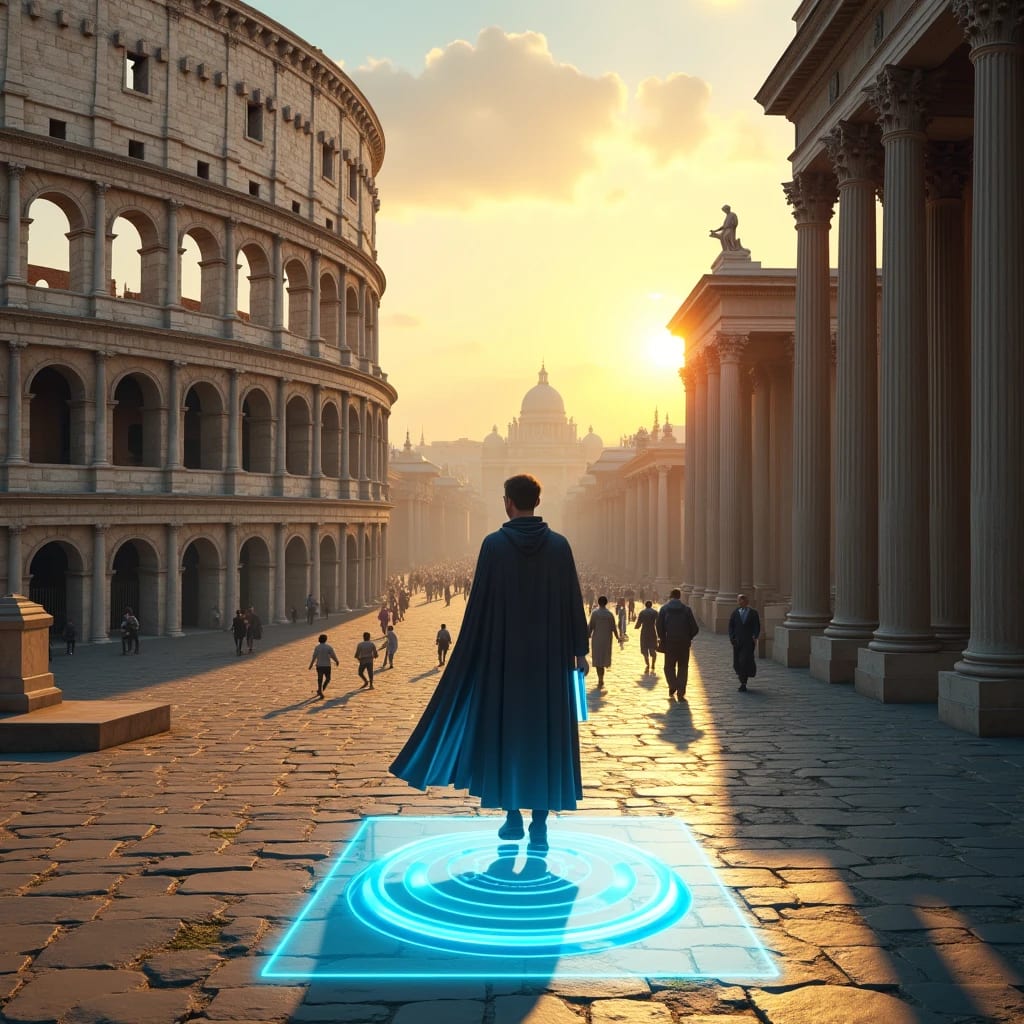
In the year 2457, the world had changed beyond imagination. Climate control domes covered major cities, artificial intelligence governed everything from education to traffic, and diseases were memories stored in history archives. Yet, with all the advances, humanity’s thirst for understanding the past had only deepened.
At the heart of the Global Temporal Institute, nestled beneath the icy Alps of New Europe, Dr. Elian Voss, a 34-year-old temporal anthropologist, prepared for the most ambitious mission ever undertaken: a solo time-travel journey to Ancient Rome, at the peak of its glory during the reign of Emperor Trajan, around 112 AD.
"Remember, Elian," his supervisor warned as he adjusted the neural interface, "observe—don’t interfere. History is not ours to change."
With a nod and steady breath, Elian stepped into the ChronoGate, his body wrapped in a suit that could alter appearance to blend in, and equipped with microscopic tech—an implantable translator, sensory recorder, and a return beacon embedded beneath his skin.
A flash of electric-blue light engulfed him.
Then—heat, light, and noise.
Elian stood amid the sprawling grandeur of Rome, stunned. Marble temples gleamed under the afternoon sun. Bronze statues of gods and emperors towered above him. Citizens bustled in togas and tunics, vendors shouted over carts of olives, honeyed figs, and fish. Chariots clattered past on cobblestone roads.
"By the stars," Elian murmured, blending in with the crowd by adjusting his chameleon cloak to mimic a Greek scholar’s attire. He carried a scroll, blank but enchanted with a recording layer.
His mission: to live among the people, observe daily life, and collect insights no history book could offer. For two weeks, Elian walked the streets of Rome, documenting everything from Senate debates and slave auctions to the games at the Colosseum. The city was alive and complex—a place of both astounding brilliance and haunting brutality.
He met Lucius, a young Roman scribe, outside a bathhouse. Lucius, curious about this strange but wise “Greek,” struck up a conversation in Latin. Thanks to the implant, Elian responded fluently, though sometimes awkwardly.
"Your accent is... exotic," Lucius said, grinning.
"I’ve traveled far," Elian replied, smiling back.
Lucius introduced him to a circle of writers and philosophers who gathered at night in a candle-lit atrium to discuss politics, fate, and the gods. Elian recorded their thoughts, astonished at how modern some of their questions seemed. One elderly senator pondered whether man was a puppet of the gods or if destiny could be shaped by reason. Another young woman, a poet in secret, recited verses that would never be written down—until Elian preserved them.
Yet the grandeur of Rome came with darkness.
Elian watched, heart heavy, as gladiators—some mere boys—were sent to fight wild beasts for amusement. He witnessed a slave girl beaten for spilling wine in a nobleman’s villa. Disease festered in alleyways just beyond the golden facades. Rome's greatness, he realized, was built on the suffering of thousands.
Still, he kept his distance, careful never to interfere.
Until one night, everything changed.
Elian followed Lucius to a secret Christian gathering in a dim underground chamber near the Appian Way. Curious, he observed the rituals, the shared bread and whispered prayers to a single god. But Roman guards, tipped off by an informant, stormed the gathering.
Panic broke out.
As Elian tried to slip away unnoticed, a centurion seized him. His chameleon cloak flickered, briefly revealing a hint of future tech beneath.
"Who are you?" the soldier growled. "A spy? A demon?"
Elian was dragged before a magistrate. Under torchlight, he stood surrounded by officials, some demanding his execution, others intrigued by his strange look and odd speech.
"Speak!" the magistrate shouted. "Who sent you?"
Elian took a risk. He recited Virgil, quoting lines from The Aeneid in perfect Latin. He spoke of fate, empire, and the soul of Rome. The room fell silent.
"A Greek poet?" one official asked.
"A philosopher," said another. "Let him go. He's mad, not dangerous."
They stripped him of his scrolls and warned him to leave the city—or risk being thrown to the lions.
With no time left and his cover blown, Elian activated the return beacon by pressing the base of his thumb. As he made his way back to the portal site near the Tiber River, he paused to watch the sunrise. The city glowed—temples shining like fire, the Forum stirring to life, birds soaring over the rooftops of eternity.
In that moment, he saw Rome not as a collection of monuments or military campaigns, but as a living, breathing civilization—flawed, glorious, curious, and painfully human.
The flash of the portal took him home.
Back in the lab, Elian collapsed into a chair, dazed. "Did you get the data?" someone asked.
He smiled faintly. "Yes. But more than that... I saw them."
The data Elian brought back transformed historical understanding: recorded voices, vanished dialects, unknown poetry, and unfiltered accounts of daily Roman life. But what mattered most wasn’t the facts.
It was the humanity of a people long gone.
And Elian, once just a scientist, became something more—a bridge between worlds, between centuries. A witness to the truth that no matter the age, people laugh, struggle, dream, and love in remarkably familiar ways.
About the Creator
Keep reading
More stories from Muhammad Jawad and writers in Fiction and other communities.
Why I Cut Off My Entire Family and Never Looked Back.
There are moments in life that define you, moments that, once crossed, make you look at the world and your past through an entirely different lens. For me, that moment came when I made the decision to cut off my entire family. It wasn’t a decision made lightly, nor was it one that came without its own struggles, doubts, and long nights of reflection. But in the end, it was the most freeing choice I ever made.
By Muhammad Jawad10 months ago in Confessions
Why Didn't Anyone Tell Us
Men, move along. This is not for you. This is for the women. I was forty-five when I began menopause. It is pretty young for that to be going on in a woman’s life, but I had undiagnosed PCOS, my entire life. Thank you to all the gynecologists I had seen my entire life. That in itself should encourage women to keep seeking second opinions, especially when you are not getting correct answers or any at all.
By Alexandra Grant3 days ago in Humans




Comments (1)
very intersting