
The Threshold of Then
Every autumn behind the door was real. The hardest part was choosing which one to keep.

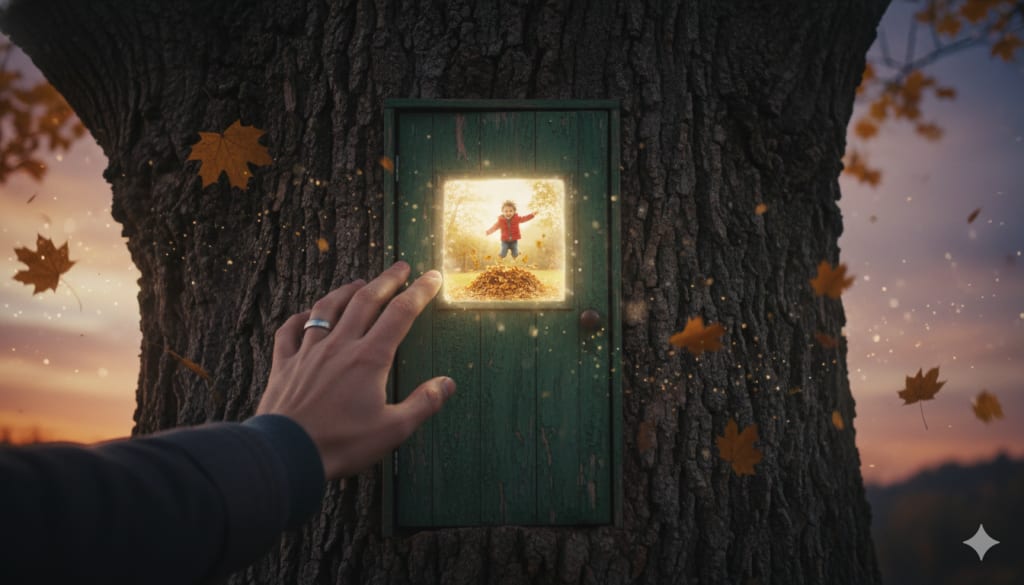
Elara found the door on a day when her present felt particularly thin. The maple tree at the edge of her property was ancient, its bark a geography of ridges and valleys. Today, in the low, slanting light of October, she saw the lines she’d always taken for natural cracks had formed a perfect rectangle. And within that rectangle, someone had long ago painted a simple, weathered green door, complete with a tiny brass knob that was just flecks of ochre paint.
It was whimsical, silly. Yet, feeling foolish and alone, she reached out and touched the painted knob.
Her fingers met not rough bark, but cold, solid metal. She gasped, and the door swung inward.
Instead of the tree’s heartwood, she saw her grandmother’s backyard, thirty years past. The light was the same golden-hour gold, but the air smelled of burning leaves—a scent banned for decades. She saw herself, age seven, a tiny tornado of joy, racing her old dog, Barnaby, toward a pyramid of raked maple leaves. She heard her grandmother’s laugh, a sound she’d forgotten. The memory was so vivid she could feel the crisp air of that long-ago October. She stepped back, pulling the door shut. The vision vanished, leaving only paint on bark.
Her heart hammered. The next day, she returned. This time, when she opened the door, she saw herself at seventeen, sitting on a stone wall in a state park, shoulder-to-shoulder with her high school sweetheart, Sam. They were sharing headphones, listening to a single discman, saying nothing as the scarlet leaves of sumac burned around them. She remembered that specific peace, the feeling of a future infinitely spacious and bright. She closed the door before she could see her younger self turn and smile at him.
The door became an addiction. Each opening was a different autumn, a frozen slice of her personal history. She visited the frantic, happy autumn of her first job in the city, watching her past-self stride down a sidewalk crunching with ginkgo leaves. She saw the quiet, sorrowful autumn after her mother’s death, where she’d sat on a porch swing for hours, just watching the leaves fall.
She was a ghost at her own feast, forever looking in on a life that seemed, in retrospect, more vivid, more real—whether in its joy or its pain—than the quiet, solitary autumn she was currently living.
One day, driven by a new, desperate impulse, she tried to step through. She wanted to feel those leaves, not just see them. But as she crossed the threshold, the scene dissolved like smoke, resetting to a different memory. The door only allowed observation, not participation. It was a museum of her life, and she was the sole, lonely patron.
The realization crushed her. She was using the door to hide, to live anywhere but in the diminishing present. She decided to open it one last time, to say goodbye to the ghosts.
This time, the scene was unfamiliar. It showed her own street, her own house, but the trees were younger. A woman with grey hair—herself, but older—was on the porch, laughing. A man she didn’t recognize was handing her a mug, his hand resting gently on her shoulder. Children played in the pile of leaves in the yard—not her children, but perhaps grandchildren or neighborhood kids. The future-self looked up, her eyes crinkling with a deep, contented joy Elara hadn’t felt in years. This wasn’t a memory. It was a possibility.
The door swung shut on its own.
Elara stood trembling before the tree. The painted door seemed to glow faintly. She understood now. The door wasn’t just a window to the past. It was a mirror. It showed her what she clung to, what she regretted, and finally, what she could still become. It showed her that every autumn she had visited was a foundation, not a cage. The love, the loss, the joy—they weren’t lost countries; they were the soil from which her present grew.
She never opened the door again. She didn’t need to.
The next morning, she woke to the real, present-day autumn light in her own kitchen. She made coffee and, on a whim, carried it out to her own porch. She watched the real leaves fall from the real, younger maples on her street. The air smelled of damp earth and chrysanthemums.
She noticed her neighbor, a quiet man named Leo who gardened down the street, raking his lawn. On an impulse she didn’t question, she called out, “Need help with that pile? It looks perfect for jumping in.”
He looked up, surprised, then smiled. “I was just thinking it’s a shame to bag it all.”
As she walked down her steps into the crisp, present-tense air, she didn’t look back at the old maple. The most important door was the one she was walking through right now, into a season that was still being written.
About the Creator
Habibullah
Storyteller of worlds seen & unseen ✨ From real-life moments to pure imagination, I share tales that spark thought, wonder, and smiles daily
Keep reading
More stories from Habibullah and writers in Fiction and other communities.
The Letting Go
Arthur believed in lines. Straight edges, trimmed hedges, and clear, clean spaces. His garden was a testament to control, a green chessboard where every plant knew its place. So, when autumn arrived, he saw it not as a season, but as a prolonged act of vandalism.
By Habibullah3 months ago in Fiction
What the Dark Does First
The porch light had been out for three weeks. Delia had written it on the notepad by the coffeepot — bulb, porch — and then she'd written it again when the first note got buried under Ray's truck-payment reminder and the vet appointment for a dog they'd had to put down in October and a list of things she'd needed from town that she'd eventually just done without. The bulb stayed dark. She stopped writing it down.
By Leslie L. Stevens Writer | Marfa, Texas2 days ago in Fiction



Comments
There are no comments for this story
Be the first to respond and start the conversation.