
The Terrible Circular Motion
Be good at breaking conventions, overcoming the herd mentality, and daring to innovate.

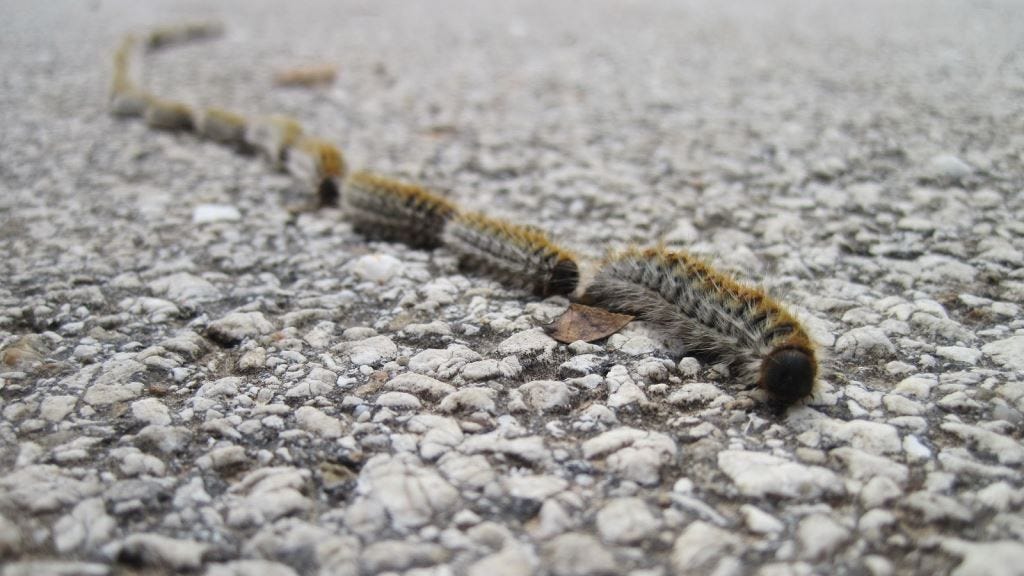
The Collective Behavior of Caterpillars
Caterpillars have an innate habit: once the first one arrives at a location, the rest will follow in sequence. They line up in a row, with each caterpillar mimicking the one in front, regardless of how the lead caterpillar turns or walks crookedly. The followers will copy the actions exactly. This is because the first caterpillar lays down a fine silk thread as it walks, and the following caterpillars’ step on this thread and lay down another one on top, creating what can be called a "caterpillar highway." In every group of caterpillars, there is always one that acts as the leader, and the emergence of this leadership is entirely random, without any election or designated process.
The Biologist's Experiment
A biologist conducted an interesting experiment. He placed more than a dozen caterpillars at the edge of a flowerpot, which was surrounded by leaves and had a blooming flower at its center. The caterpillars formed a closed loop, automatically distributing themselves at equal distances, moving at the same speed and pace, like well-trained soldiers marching in a uniform circular motion around the edge of the flowerpot.
Analysis of Caterpillar Behavior
As time passed, the caterpillar formation remained tight, with no caterpillar falling behind or deviating from the path. Their actions were so consistent that they were astonishing to watch. However, when they became tired or the weather cooled down, the formation began to stop and start. At night, hungry and thirsty, the caterpillars stopped and curled up to sleep.
Results and Insights
The next day, as the temperature rose, the caterpillars slowly awakened, automatically lined up, and continued to circle. Day after day, they repeated this simple motion, with no caterpillar realizing the mistake. Eventually, they died exhausted at the edge of the flowerpot, with none of them discovering that by turning inward, they could eat the tender green leaves and flowers, or by turning outward, they could eat the abundant leaves, thus escaping the tragic ending.
Insights
This passage, through the collective behavior of caterpillars, raises some deep-level reflections:
1. The Emergence of Leadership: The emergence of leadership may be random, without a clear election or designated process.
2. The Importance of Following Rules: Individuals in collective behavior often follow established rules, which may limit their freedom to explore.
3. The Limitations of Groups: Individuals in a group may be unable to break out of established patterns due to physiological reasons or intellectual limitations, even when better solutions exist.
4. Reflection on Human Behavior: There is also a phenomenon of rule-following and blind conformity in human society, which is worth pondering. Especially when facing complex problems, should we encourage innovation and independent thinking?
This passage, through the collective behavior of caterpillars, reminds us to pay attention to the role of individuals in groups, the mechanism of leadership emergence, and the ability to freely explore in the face of rules. At the same time, it reflects on the group behavior in human society, encouraging us to maintain independent thinking and a spirit of innovation when facing problems.
About the Creator
Grace
Hello everyone, thank you for taking time to read my story. Your interest and engagement with my work mean the world to me. Thank you again for your support and being a part of my writing journey.
9:52
by Leslie L. Stevens 9:52 PM. Jessica bounced into the kitchen like she owned it. Ponytail swinging, sneakers squeaking, still high off sixty bucks in tips and a full week of crushing it. Her tables were clean. Her section was empty. Her stomach was growling.
By Leslie L. Stevens Writer | Marfa, Texasabout 7 hours ago in Fiction




Comments (1)
Amazing writes