
The Tell-Tale Heart
A Descent into Madness and Guilt"

Introduction
• Edgar Allan Poe’s short story "The Tell-Tale Heart," first published in 1843, is one of the most notable examples of Gothic literature and psychological horror in American fiction. This story, compact yet rich in meaning, delves into the intricacies of the human psyche through an unnamed narrator who tries to convince the reader of his sanity while describing the calculated murder of an old man. With its central themes of madness, guilt, and obsession, and its use of first-person narrative and symbolism, the story has fascinated readers and critics for nearly two centuries. This comprehensive explanation will analyze the story in detail, broken into thematic, structural, and interpretive sections to uncover its full meaning and significance.
1. Plot Summary
• "The Tell-Tale Heart" begins with an unnamed narrator insisting that he is not mad, even though he confesses to having killed an old man. He claims that the motive for the murder was not hatred or desire for money, but rather the old man’s eye, which he describes as a "vulture eye." Over the course of eight nights, the narrator carefully and stealthily enters the old man’s room while he sleeps, waiting for the moment when the eye is open. On the eighth night, the narrator finally sees the eye open and smothers the old man with his bed. He then dismembers the body and hides it beneath the floorboards. When the police arrive, having been alerted by a neighbor who heard a scream, the narrator confidently welcomes them and converses with them in the room where the body is hidden. However, he soon becomes overwhelmed by a sound he perceives as the old man's heart still beating beneath the floorboards. Driven mad by the sound, he confesses to the crime
2. Characters
2.1. The Narrator
• The narrator is the central character and the only character whose thoughts and feelings the reader experiences directly.
• His reliability is questionable from the outset, as he insists on his sanity while describing a horrific murder committed without a rational motive. The narrator's descent in to madness is the story's central arc.
2.2. The Old Man
• The old man is the victim of the narrator's obsession and violence. He is described as kind and having done nothing to provoke the narrator, other than possessing a disturbing "vulture eye." The old man's physical and psychological presence is minimal, yet he plays a critical symbolic role.
2.3. The Police Officers
• The police appear briefly near the story’s end. They are polite, calm, and unaware of the crime. Their presence is crucial to the narrator's psychological unraveling, as their visit becomes the catalyst for his confession.
3. Themes
3.1. Madness vs. Sanity
• The conflict between madness and sanity is the story's primary theme. The narrator’s repeated assertions that he is sane only reinforce the reader’s perception of his instability.
• His detailed description of the murder, his heightened sensory eventual breakdown all point to perception, and his unhinged mind.
3.2. Guilt and Conscience
• The story is a study of guilt’s psychological impact. Even after meticulously hiding the body, the narrator cannot escape his own conscience. The imagined sound of the heartbeat represents the inescapable nature of guilt.
3.3. Obsession
• The narrator’s fixation on the old man’s eye is irrational and obsessive. This obsession grows to the point that it justifies, in his mind, an act of murder. Poe uses this obsession to explore how a singular focus can distort perception and morality.
3.4. The Unreliable Narrator
• The unreliable narrator is a hall mark of Poe's work. In this story, the narrator's in sanity contradicts his assertions of rationality.
• This narrative technique draws the reader into a deeper engagement with the text, requiring them to interpret the events independently.
4. Symbolism
4.1. The Eye
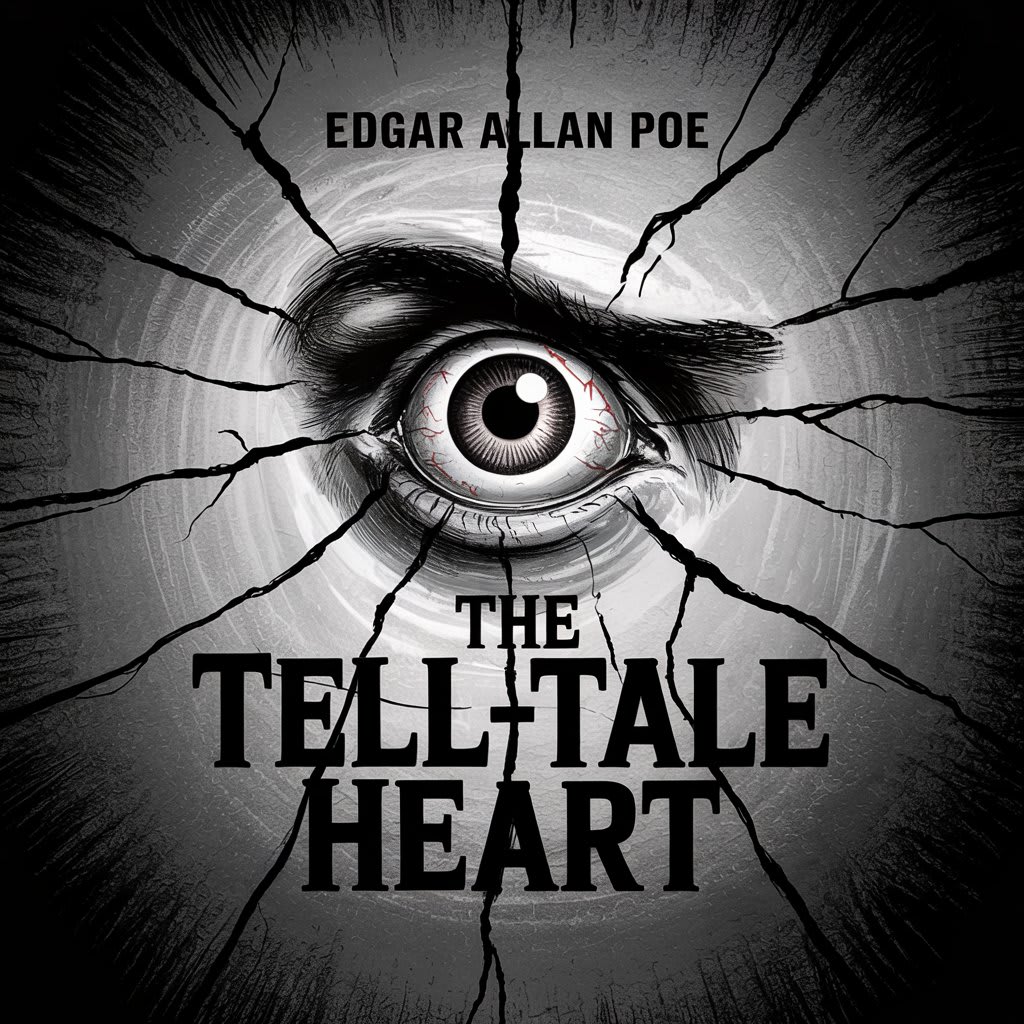
• The old man’s eye is central to the narrator’s obsession and symbolizes perception, truth, and perhaps divine judgment.
• The narrator may see the eye as watching or judging him, which heightens his paranoia.
4.2. The Heart beat
• The imagined heartbeat symbolizes the narrator’s guilt and descent into madness. As it grows louder, it represents the inescapability of conscience and truth, regardless of how deeply one tries to bury them.
4.3. Darkness and Time
• Most of the story takes place at night, symbolizing concealment, fear, and the subconscious. The use of midnight—often associated with the supernatural—emphasizes the eerie and suspenseful mood.
5. Narrative Style and Literary Devices
5.1. First-Person Perspective
• The use of the first-person narrative draws readers directly into the narrator’s thoughts.
• This perspective intensifies the psychological aspect of the story, allowing readers to experience the narrator’s inner turmoil.
5.2. Tone and Language
• The tone is anxious, intense, and erratic, mirroring the narrator’s disturbed mental state. Poe’s use of repetition, dashes, and exclamatory sentences contributes to the frantic pacing and psychological realism.
5.3. Irony
• There is dramatic irony in the narrator’s attempt to prove his sanity while clearly revealing his madness.
• His calm demeanor in the presence of the police contrasts with his internal breakdown, showcasing Poe’s mastery of ironic tension.
5.4. Sound Imagery
• Sound plays a crucial role in the story, especially through the heart beat. Poe uses auditory imagery to externalize the narrator’s guilt, making the psychological torment physically manifest.
6. Psychological Interpretation
• Poe’s story is often interpreted through a psychological lens. The narrator exhibits characteristics of paranoid schizophrenia: delusions, auditory hallucinations, and disorganized thinking.
• His obsessive focus on the eye and the imagined heart beat are manifestations of internal psychological conflict. From a Freudian perspective, the narrator’s actions reflect a battle between the id (instinctual desires), ego (rational thought), and superego (moral conscience).
• The murder is driven by the id, concealed by the ego, and ultimately punished by the superego through guilt.
7. Gothic Elements
7.1. Setting and Atmosphere
• The story’s dark, claustrophobic setting enhances its Gothic atmosphere. The focus on death, decay, and madness aligns with classic Gothic tropes.
7.2. Psychological Horror
• Rather than relying on external monsters, Poe creates horror through the inner workings of the human mind.
• The narrator’s unraveling creates an intense, personal terror that is more disturbing than supernatural horror.
7.3. Supernatural Suggestion
• Although the story has no overt supernatural elements, the heartbeat serves as a supernatural suggestion.
• It blurs the line between reality and delusion, which is a common feature of Gothic fiction.
8. Critical Reception and Influence
8.1. Contemporary Reactions
• When first published, "The Tell Tale Heart" did not gain immediate widespread acclaim. However, it was recognized for its originality and psychological depth.
8.2. Legacy
• Today, the story is a staple of American literature and a quintessential example of psychological horror. It has influenced countless writers and is frequently anthologized and studied.
8.3. Adaptations
• The story has been adapted into numerous films, television episodes, radio plays, and theatrical productions. Each adaptation brings new interpretations, emphasizing its timeless appeal.
9. Comparative Analysis
9.1. Similar Works by Poe
• "The Tell-Tale Heart" shares thematic similarities with Poe’s other stories such as "The Black Cat" and “The Cask of Amontillado," which also feature unreliable narrators and themes of guilt and revenge.
9.2. Influences on Later Literature
• The psychological depth of Poe’s narrator paved the way for modern psychological thrillers. Writers like Fyodor Dostoevsky, Franz Kafka, and William Faulkner explored similar themes in their work.
Conclusion
Edgar Allan Poe’s "The Tell-Tale Heart" remains a master class in psychological horror and Gothic fiction. Through its unreliable narrator, vivid imagery, and profound themes, the story explores the darkest recesses of the human mind. Poe's genius lies in his ability to depict madness from the inside, making the reader question not just the narrator’s sanity, but the nature of guilt, obsession, and moral responsibility.
More than just a tale of murder, "The Tell-Tale Heart" is a haunting exploration of conscience and the inescapable weight of truth, earning its place as one of the most enduring works of American literature.
About the author Edgar Allan Poe (1809–1849)
Edgar Allan Poe was an American writer, poet, editor, and literary critic best known for his works of Gothic fiction and pioneering contributions to the genres of horror and detective fiction. Born in Boston in 1809, Poe faced a troubled life marked by the early death of his parents, financial struggles, and personal losses. Poe is renowned for exploring themes of madness, death, and the macabre. His unique style blends psychological insight with dark romanticism, often delving into the human mind's most disturbing corners."The Tell-Tale Heart," published in 1843, exemplifies Poe’s mastery of psychological horror. The story reflects his fascination with insanity, guilt, and the blurred line between reality and delusion. It also showcases his signature use of the unreliable narrator, a literary device that adds depth and ambiguity to his tales. Poe's influence is still felt today in literature, film, and pop culture, cementing his legacy as one of America’s most important and haunting literary voices.
Rewrite by Dr Ali khan
About the Creator
Sarwar Zeb
I am a professional Writer and Photographer
Keep reading
More stories from Sarwar Zeb and writers in Fiction and other communities.
The Great Sermon Handicap
I. The Fateful Weekend at Twing Hall Bertie's Boredom and Bingo Little's Proposition: The story opens with Bertie Wooster enduring a typically dull weekend at Twing Hall, the country estate of his Uncle Willoughby and Aunt Caroline. Bertie is yearning for some excitement when his friend Bingo Little arrives, bursting with a peculiar proposition. The Genesis of the Handicap: Bingo explains that the local village is holding its annual fête. A key event is the competition between the vicars of two neighboring parishes – Reverend Rupert Pringle of Upper Bingley and Reverend Aubrey Upjohn of Lower Bingley–to deliver the longest sermon. Bingo's Betting Instinct: Ever the gambler (and usually unlucky one), Bingo sees an opportunity for a "bit of sport" by organizing a sweepstake, or "handicap," on the length of these sermons. He intends to assign handicaps (in minutes) to each vicar based on their past preaching tendencies.
By Sarwar Zeb11 months ago in Fiction
Menthe
Did I deserve it? The punishment? Perhaps. But the reputation? Absolutely not. It’s too neat, too pat. Show me a storyteller who glides easily over an important part of the story, and I’ll show you a person who didn’t bother to investigate any further than their tiny mind can fathom.
By Meredith Harmon5 days ago in Fiction



Comments
There are no comments for this story
Be the first to respond and start the conversation.