

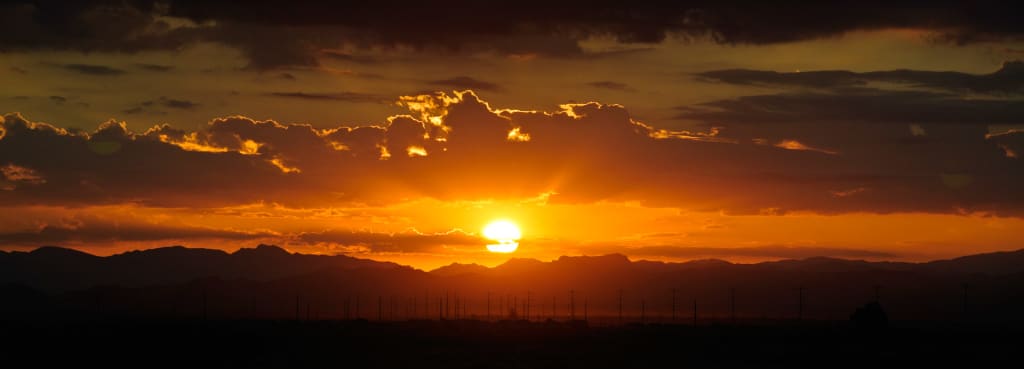
September 5 – 6:45 PM
The UV warning lights that line the shore and crawl along the cabling of the bay bridge are still red as we turn and make our way south across the water. In the west, the sun is withdrawing its rays like long fingers that crown the whitecaps below with a burnt-orange hue. Off in the east, a few of the brightest stars already glitter like celestial diamonds over the mountain ridges.
Once upon a time, in a world I remember now like a steadily fading dream, sundown was the time when people headed home, served dinner, finished projects for school, and spent time with loved ones, until sleep finally whispered something sufficiently persuasive in their ears and drew them to their beds. Then, three years ago, Mother Nature played a little joke on the human race. It was as though, after all the millennia of our existence, she had grown weary of this monotony and determined on a reset. A virus accommodated her wishes, introducing a genetic shift that, for roughly ninety-five percent of the world’s population, transformed the sun from friend to foe. Within the space of a few months, humans became children of the moon and stars.
The few of us who remain unaffected are referred to by a number of names, some of which are unrepeatable in polite conversation. “Daytimers” is the most common of the least insulting. From dawn until dusk, the world rests in our hands.
Just before we reach the shore, the bright crown of the sun slips below the waves. Almost instantly, the red lights strung along the bridge cabling and scattered throughout neighborhoods in the surrounding hillsides turn green.
In the driver’s seat, Roger remarks dryly, “Ladies and gentlemen, you are now free to move about the cabin area.”
“And we are officially off-shift,” I reply.
As I say this, I can almost hear the alarm tone of my wife’s cell phone. In my mind, I can see her sliding out of bed, pulling on her housecoat and cinching it carefully above the baby bump—she’s six months along now—and walking out into the hallway in her slippers, stifling a yawn with the back of her hand. I can see her waking the kids and reminding them that the bus will come in less than an hour, so if they want breakfast they better get a move on. Only Tommy will really find this an incentive; at age eleven, he’ll eat whatever and whenever he can. By contrast, seven-year-old Heather may nibble on a piece of toast with a little marmalade spread, but likely won’t eat much of anything until lunch—meaning around 10:30 tonight. It’s still hard for me to wrap my mind around that: kids in a school cafeteria eating lunch while it’s pitch-black outside, and then running around for recess under stadium lights.
Speaking of lights, they’re on everywhere now, and in every form imaginable. The departure of the sun from ordinary human life has inspired some interesting substitutionary innovations. From dusk to dawn, it’s like Christmas—or maybe Las Vegas—all year round in virtually every city and town the world over. There’s a distinctly melancholy, rather desperate, aspect to this celebration of light, to be sure, but also a delicate and compelling sort of beauty.
“You going to the play tonight?” Roger asks as we reach my house.
“Have to,” I say. “Heather’s in it.”
“That’s right,” he says with a nod. “I forgot.” Then the nod becomes a shake. “Midnight school plays. Whoever would have thought it?”
“Whoever would have imagined any of this?” I say. How many times have we had these sorts of conversations in our work? Almost daily, I’d guess. “But it’s a good thing all around. A lot of people who don’t even have kids come to these programs. It makes them feel good.”
“True. Well, maybe Helen and I will see you there. Get some sleep while you can.”
I have enough time to get in a few words with the kids before the bus comes, although they mostly mumble sleepily at me in reply, and then I see them off.
“Remember, Daddy, the play starts at midnight,” Heather reminds me as she steps onto the bus, pigtails bouncing. “Don’t sleep too long!”
I blow her a kiss and promise I’ll be there.
Back inside, I find Rachel dressed and running a brush through her auburn hair. “How was work?” she asks.
“Busy,” I say, and I’m struck by how weary I sound. This is my long week: four straight days of twelve-hour shifts. One day to go.
She gives me a sympathetic look.
“Bad morning on the beach?”
“No, thank God. Not today.”
I get changed and ready for bed while Rachel packs her lunch. Then I get a quick kiss and the same admonition Pigtails gave me on her way to the bus: “Don’t oversleep. I know you’re really tired, but Heather’s so anxious for you to see her in the play.”
I smile and hold up my phone. “Got my alarm set.”
“Well,” she says with a skeptical look, “I’ll call you just to be sure you’re up.”
“Good idea,” I reply with a yawn. Then she’s off and I head up the stairs to bed. I fall asleep almost immediately, but I dream too much to make it a really restful sleep. I guess it was Rachel’s mention of the beach… I keep dreaming about faces, filling out reports, and making calls to relatives.
When my alarm finally goes off at 11:00, it takes a lot of effort to get moving, and even more to sound pleasant when Rachel’s wake-up call comes five minutes later, but I’m looking and feeling reasonably human when I get to the school at 11:39. Rachel and I find one another and go to our seats in the family section. As I expected, the gym is packed. School plays have become community events.
The play is being put on by the first and second grades. It’s based on a children’s book—The Sun Thief—written by Heather’s teacher, Evelyn Lambert, who taught both Rachel and I in the third grade. The book was published about eight months ago, and is already a Children’s Book Club main selection. The whole town is immensely proud of her.
The lights dim, children file on stage, and the play begins.
It seems that, over thousands of years, the moon and stars grew jealous of the glory of the sun and how much people loved her. So they conspired and imprisoned her “behind bars of night, so that no one would ever again enjoy her warmth and light.” A boy named Joshua made a perilous journey and, at long last, found the prison of the sun; but the spell of the moon and stars was too powerful, and he could not free her. The sun wept glowing tears as Joshua told her how the world missed her so, and he noticed that when her tears fell they became gems that shone with a brilliant golden luster. Joshua took these “sun tears” back to the world, where they delighted everyone, filling their homes with the warm colors of the lost daylight world. Joshua made many more such trips to the sun, telling her stories of how she was loved and missed, and he always brought back more sun tears. Rather than trying to travel everywhere and give them away himself, he gave them to the people of his town, who in turn passed them on to others, until the world knew light again. For this, Joshua became known as “the Sun Thief,” for he had stolen the light of the sun back from the jealous moon and stars.
At the end of the play, the lights are turned off until only a spotlight remains on the stage. The children come out and stand at the ends of the rows of chairs and hand out small, clear plastic bulbs with golden-yellow lights in them. Mrs. Lambert goes to the podium where some of the children, including Heather, had taken turns with the narration, and says: “Please pass the sun tears down the row; and as you share them with your neighbor, remember: the true light and warmth of this world dwell in our hearts and in the love we share with one another.”
The play was surprisingly moving. I see more than a few tears in the audience at the end, and there’s a standing ovation. Heather—aka Narrator #3—did well, and beams when we tell her this. She had really wanted to be the sun, but she couldn’t remember all the lines.
Afterward, Rachel goes back to work, and I go home to sleep for a couple more hours. The kids will come home on the bus around 3:30 and will almost certainly wake me up. As I lie down, I set the sun tear on Rachel’s pillow, think what my grandmother used to call “long thoughts” for a few moments, and fall asleep in its amber glow.
December 21 – 5:30 AM
We’re a family of five now. I kiss Rachel and the kids, including my newborn son, Steven, good- “night,” and leave to pick up Roger. The sky is clear, the stars are beautiful, the UV warning lights all around town are still green, and the streets are full of cars and people. I don’t know if I’ll ever get used to seeing such activity this early in the morning, even so close to Christmas.
At 5:45, the UV lights change from green to yellow, and at 6:33 they begin to flash. The streets finally start to clear and the eastern sky blushes a pale blue.
At 7:05, we’re driving along the beach, and both of us groan as we see a lone figure sitting on the sand—a woman, by all appearances.
We exchange a look.
“You’re way better at this, pal,” Roger says.
“Yeah, good for me,” I mumble as I step out of the van and think of what I’m going to say. This is the stuff of my nightmares.
The woman hears me coming, turns, and gives me a smile.
“Hello, Thomas. Come to talk me out of it?”
“Mrs. Lambert?” I’m still for a moment, unable to speak further. She looks up at me with an expectant, and, frankly, amused expression, and I give up whatever I was planning to say and sit down beside her.
She pats my knee. “So, how long will it take?”
I swallow heavily. “At your age, about twenty minutes before irreversible neurological failure.” As if on cue, the UV lights around us turn red. The pre-dawn sky is now quite bright and I can see every line in my old teacher’s face. “Can I ask why?”
She smiles again as a cold wind gust stirs her gray bangs. “You just did.”
“You’ve given hope to so many. Why do this now?”
Her eyes glitter as she looks to the east, toward the sunrise that will kill her.
“What did Joshua do when he realized he couldn’t take the sun tears to the whole world by him-self?” she asks quietly.
“He gave them to others to share for him.”
“I’ve passed on my light, Thomas. I’ve been the Sun Thief for others. Now I’m going to steal a little for myself.” She nods at me and winks as only grandmothers can.
I cover her hand with mine and try to smile.
We wait in silence together.
“You found me at home, Thomas,” she says as molten gold forms along the mountain ridges. You and your friend there. Please. It needs to be that way.”
“At home,” I murmur.
A moment later, the sun crests the mountains and shines down on us. Her silver hair seems to blaze like a white flame at its touch. Her fingers entwine with mine and squeeze.
“Glorious,” she breathes. “Glorious.”
About the Creator
Robert Hawes
I'm 48 years old, married, and the father of three. I've been a fanatical reader all of my life, and especially enjoy science-fiction. Originally from Northern Virginia, I now reside in the steamy jungles of South Carolina.
Keep reading
More stories from Robert Hawes and writers in Fiction and other communities.
A Touch of the Ruthless
“You again,” Ellen said. About sixty yards away, in a tall pine to her right, perched on a white, gnarled branch that poked out like a broken bone, a hawk sat watching her. The bird was a beautiful bronze color, with tinges of blue in the tips of its wings. It stared fixedly at her in the morning quiet.
By Robert Hawes5 years ago in Fiction



Comments
There are no comments for this story
Be the first to respond and start the conversation.