

The plan was simple, sketched out on a damp napkin in a late-night diner back in April. It was a holy trinity of summer ambitions, consecrated in coffee stains and the giddy optimism that only comes from being nineteen and believing the world is a roadmap waiting for you to choose a destination.
🗺️ The Plan:
June: Work double shifts at “The Salty Siren,” the greasiest fish-and-chips joint on the pier, saving every penny.
July: Buy a beat-up, unreliable van with Leo. Name it “The Albatross.”
August: Drive west. No map, no destination. Just follow the sun until we ran out of road or money, whichever came first.
It was supposed to be the summer. The one we’d mythologize for the rest of our lives. The Summer of Leo and Me. The summer we finally escaped the suffocating dampness of our seaside town, a place that clung to you like wet sand.
The first part of the plan went off without a hitch. June was a blur of sizzling fryers, the sting of salt in the air, and the rhythmic clang of the cash register. I worked until my feet were numb and my hair smelled permanently of vinegar. Every night, I’d pedal home, my pockets heavy with crumpled bills and coins, and stuff the money into a large mason jar labeled “Westward.”
Leo did his part, too. He was a lifeguard, his skin turning the color of toasted honey under the weak British sun. He’d meet me after my shifts, smelling of sunscreen and chlorine, a stark contrast to my greasy aroma. We’d sit on the cold, pebbled beach, the grey waves sighing at our feet, and count the money in the jar.
"That's another hundred," he’d say, his voice full of the same giddy hope from the diner. "The Albatross is getting closer."
We found her in mid-July, rusting peacefully in a farmer’s field. She was a 1980s Ford Transit, painted a faded, apologetic shade of baby blue. She was perfect. We paid the farmer in cash from the Westward jar, the notes still smelling faintly of fried fish.
“She’s not an Albatross,” I said, running my hand over a patch of rust that looked like a birthmark. “She’s more of a… a Seagull.”
Leo laughed, a sound like stones skipping across calm water. “The Seagull it is.”
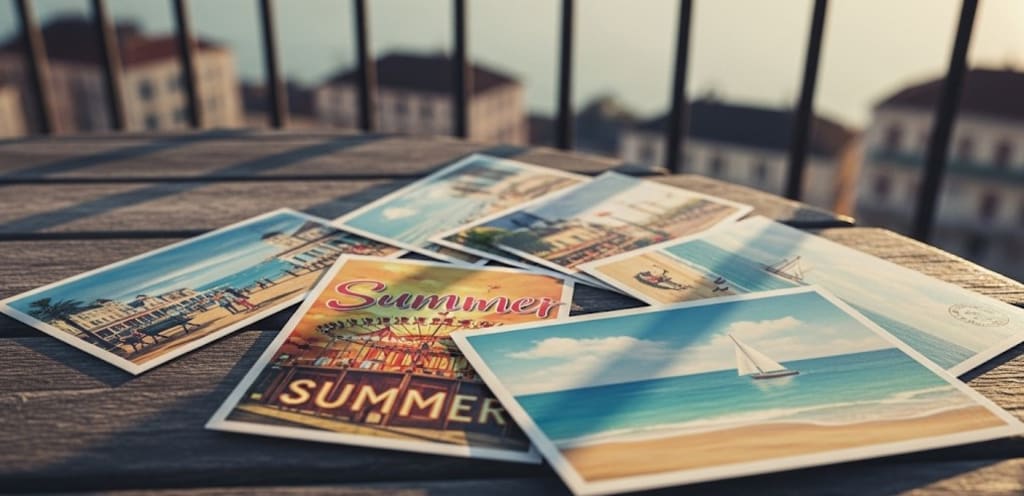
That evening, we sat inside her, the doors wide open to the setting sun. The interior smelled of dust and forgotten things. Leo had brought a box of postcards he’d bought from a tourist shop. They were glossy and cheap, showing idealized versions of our own town—sun-drenched beaches we’d never seen, a pier without a single chip-stained wrapper.
“We’ll send these back,” he said, fanning them out on the dashboard. “From everywhere we go. We’ll write things like, ‘Wish you were here, but not really!’”
I picked one up. A picture of the lighthouse at dusk. On the back, I wrote the date: July 18th. Then I hesitated. What do you write on a postcard from a journey that hasn't begun? I left it blank, tucking it into the glove compartment. The first of our unsent postcards.
That was the peak. The highest point of the rollercoaster, right before the gut-wrenching drop.
The drop came in the form of a phone call two days later. It was Leo’s mum. Her voice was thin and frayed, like a rope stretched too tight. Leo’s dad had collapsed at work. A stroke. A bad one.
Summer, as we had planned it, evaporated in that single phone call.
August was not a month of sun-drenched highways and nameless towns. It was a month of hospital corridors that smelled of antiseptic and quiet despair. It was a month of watching Leo, my sun-kissed lifeguard, slowly fade. The tan on his skin couldn't hide the grey exhaustion under his eyes. The easy laugh was gone, replaced by a tense, fragile silence.
Our world shrank to the size of that hospital room. The road west was replaced by the linoleum path from the waiting area to the ICU. The sunsets we were supposed to watch from the back of The Seagull were replaced by the flickering fluorescent lights overhead.
I tried to be the anchor. I kept working at The Salty Siren, bringing Leo and his mum greasy parcels of fish and chips that they rarely touched. I’d sit with them, trying to fill the heavy silence with small talk about town gossip, about the weather, about anything other than the rhythmic, mechanical breathing of the man in the bed.
One sweltering afternoon, I found Leo sitting alone in The Seagull, which was still parked in his driveway. The box of postcards was open on his lap.
“We were supposed to be in… I don’t know, Cornwall by now,” he said, his voice hollow. He picked up a postcard of a ridiculously cheerful-looking donkey. “Maybe even Wales.”
“We’ll still go,” I said, the words feeling like a lie in my mouth. “When things are… better.”
He didn’t answer. He just stared at the donkey, his thumb tracing its cartoonish smile. The space between us, once filled with shared dreams and easy laughter, was now a chasm of unspoken grief. I wanted to reach across it, to tell him that I wasn’t going anywhere, that his pain was my pain. But the words wouldn’t come. It felt like trying to describe the color blue to someone who had never seen the sky.
The unspoken hurdle between us was this: his tragedy was not mine. I was a tourist in his grief, a well-meaning visitor who could, at any point, just go home. And we both knew it. My presence was a constant, painful reminder of the summer that wasn't happening.
So I started to pull away. Not consciously, but in small, cowardly increments. I stopped bringing food. I made excuses about being tired after work. I’d see his car in the hospital parking lot and drive past, my heart a cold, heavy stone in my chest. Each time, I told myself it was for him, to give him space. But I knew it was for me. I was protecting myself from the shrapnel of his life falling apart.
The last time I saw him that summer was the final Friday in August. I was closing up The Salty Siren, mopping the greasy floor, when he appeared at the door. He looked like a ghost of the boy I knew. Thinner. Paler.
“He’s being moved to a long-term care facility next week,” he said, not meeting my eyes. “He’s… stable. But he won’t be coming home.”
“Leo, I’m so sorry.”
“We’re selling the van,” he said, the words coming out in a rush, as if saying them quickly would make them hurt less. “Mum needs the money. For… everything.”
My heart cracked. The Seagull. Our Albatross. The vessel of our great escape, now just another asset to be liquidated in the face of grim reality.
“Of course,” I managed to say. “That makes sense.”
An awkward, cavernous silence fell between us. The only sound was the hum of the deep fryers cooling down. This was the moment. The moment to say all the things I hadn't said all month. The moment to apologize for my absence, to tell him I loved him, to bridge the chasm.
But I didn’t. I just stood there, clutching a greasy mop, a coward in a world of someone else’s pain.
“Well,” he said, stuffing his hands in his pockets. “I’ll see you around.”
And he left. He walked out into the cool night air, and with him went the last ghost of our summer.
I found an envelope on my doorstep the next morning. Inside was half the cash from the sale of the van, and a single, blank postcard. The one of the lighthouse at dusk that I had held on that first day.
I never spent the money. It sits in the same mason jar, now labeled with nothing at all. Sometimes, late at night, I take out that postcard. I imagine all the things we could have written on it.
“August 1st. Drove 300 miles. The Seagull broke down outside of Bristol. Met a mechanic with one eye. Best burger of my life.”
“August 10th. We’re in Wales. It rains every day, just like home, but the green is a different color. Leo is learning to play the harmonica. Badly.”
“August 25th. We made it to the sea. The other sea. The one at the end of the road. It looks just like ours, but it feels like a different world. Wish you were here. But not really.”
The summer that wasn’t lives in that blank space on the back of the postcard. It’s a season of silence, a road trip of regret. It’s the quiet, persistent ache of what almost was. It wasn't a summer of golden light or unforgettable memories. It was a summer of antiseptic corridors and unspoken apologies. It was the summer that taught me that the heaviest things we carry aren’t in our suitcases, but in the words we never find the courage to say.
About the Creator
Enes Öz
Writer | Artist | BL Enthusiast. Sharing tips on online income & creative finance. Building wealth, beautifully. ✍️💸



Comments
There are no comments for this story
Be the first to respond and start the conversation.