
The story of their alliance became a symbol of how strength and honor could overcome conflict and foster unity.
A Tale of Strength, Love, and Kingdoms United
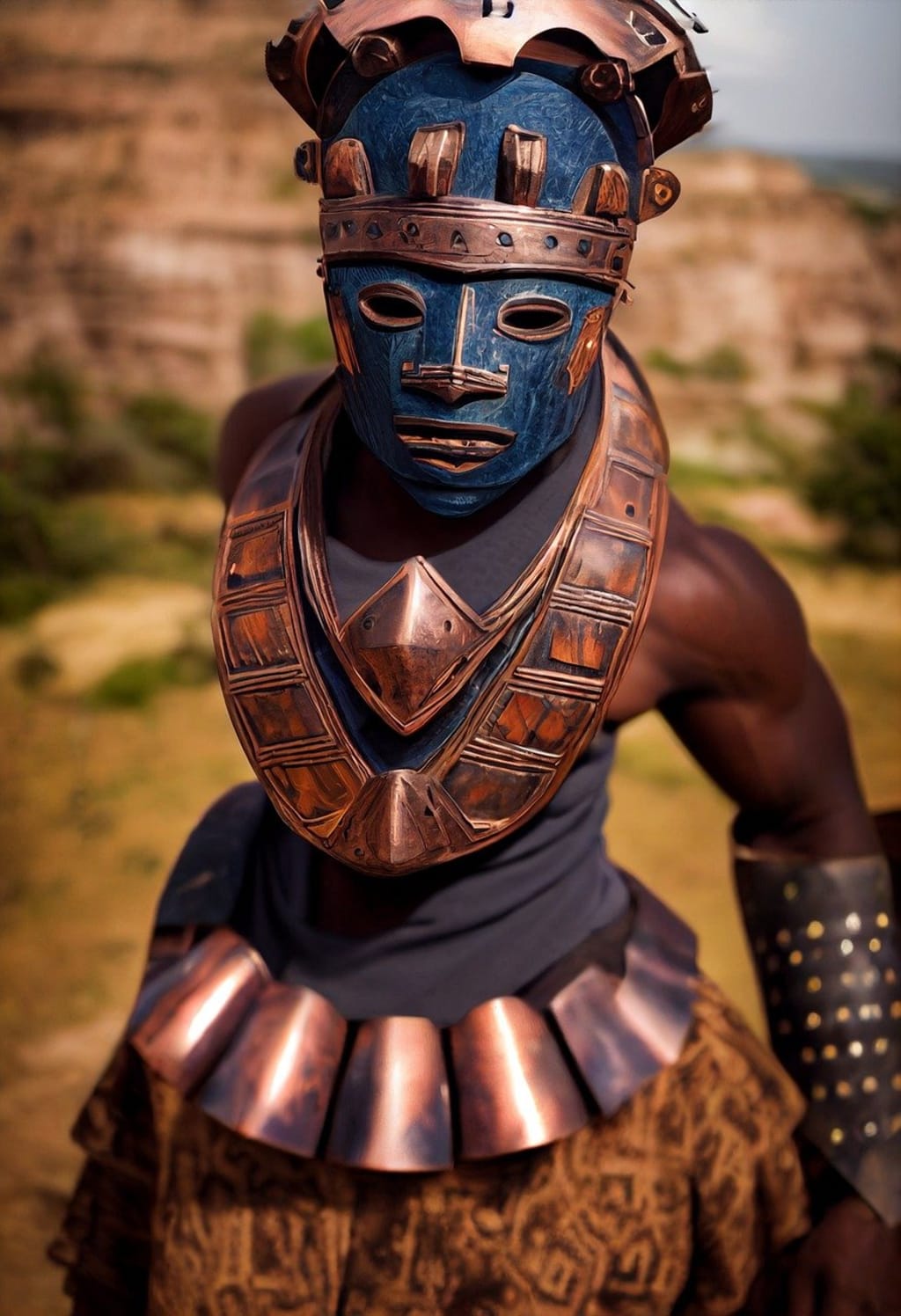
In the mystical realm of Awele, there was a formidable Giant Warrior Princess named Ireti. Renowned across the land for her unmatched strength and bravery, Princess Ireti led her army to countless victories against those who dared to threaten her people. Despite her heroic deeds, the villagers saw her only as a warrior, not as a lady. Her towering presence and martial prowess overshadowed any thoughts of romance or matrimony. Men of status who visited Awele with the hope of finding a noble bride were quickly deterred upon meeting Ireti. Her imposing stature and warrior's demeanor led many to believe she was too manly to be considered a suitable wife.
Ireti wore armor crafted from the finest materials and wielded a sword that never faltered in battle. Her presence on the battlefield was both awe-inspiring and intimidating. Yet, beneath her fierce exterior lay a deep longing for companionship and love. She yearned for someone who could see past her role as a warrior and appreciate her for who she truly was—a woman seeking affection and partnership.
Being the only child of King Adeola and Queen Amina, Princess Ireti was the sole heir to the throne. Her father, deeply devoted to his wife, had never taken another spouse despite the urging of his council. He poured all his resources into training Ireti, ensuring she could match and exceed any man's abilities in combat. While the kingdom marveled at Ireti's physical prowess, her mother, Queen Amina, viewed her stature with disdain. She sought the aid of many healers and seers, unable to reconcile her daughter's robust figure with her expectations of femininity.
The Queen's rejection of Ireti's physique as anything but a curse was a constant source of pain for the princess. Despite the King’s unwavering support, Queen Amina's disapproval was a heavy burden. Her mother's harsh comments about Ireti’s role as a warrior, rather than engaging in traditional feminine pursuits, were a constant reminder of her perceived inadequacy.
One day, news arrived of a threatening army from the neighboring land of Kaira, led by a ruthless warlord. The King called upon Princess Ireti to defend their kingdom. Without hesitation, she rallied her troops and engaged the enemy. Her skill and valor on the battlefield were unparalleled, and her final charge led to a decisive victory. The kingdom celebrated her triumph with a grand feast, but Ireti's joy was overshadowed by her mother's continued disdain.
During the feast, Queen Amina openly criticized Ireti, questioning her worth as a warrior and suggesting she should focus on more traditionally feminine tasks. The harsh words stung, and Ireti retreated to her room, battling the pain of her mother's rejection. As she reflected on her past and her role as a warrior, she struggled with doubts about her place in the world.
Just then, her father, King Adeola, visited her room. He reassured Ireti of his pride and support, reminding her of her worth beyond the kingdom's traditional expectations. His words bolstered her resolve to follow her own path, despite the challenges.
The following day, Ireti continued her training with renewed determination, joining her father's soldiers in practice. Her prowess remained a source of admiration, even if it came at the cost of her personal happiness.
In a neighboring kingdom, Prince Duro, known for his charm and intelligence, had yet to find a bride despite numerous attempts by his mother to arrange a suitable match. Prince Duro's reluctance to settle down frustrated his parents, who were eager for him to take a wife. Little did they know that the solution to their search was about to unfold in an unexpected way.
As fate would have it, the paths of Princess Ireti and Prince Duro were destined to cross. Their encounter would challenge both their beliefs and reshape their futures in ways they could never have anticipated.
In a grand kingdom, King Jide decided to take control of his son Prince Duro's future. He summoned the elders to arrange a grand dance competition to find a suitable bride for Prince Duro. The event, set to take place at the royal palace, quickly became the talk of the kingdom, generating immense excitement among the villagers.
Fifteen young maidens were selected to participate, each more enchanting than the last. They spent weeks preparing, perfecting their dance moves and choosing the most stunning outfits to captivate the prince. On the day of the competition, the palace was adorned with vibrant flowers and decorations, creating a festive and regal atmosphere. As the sun set, the maidens assembled in the grand hall, their hearts pounding with anticipation.
Prince Duro entered the room, scanning the array of beautiful women before him. The weight of his parents' expectations was palpable, urging him to make a choice and settle down. The competition commenced, with each maiden taking her turn to showcase her dancing skills and charm the Prince with her elegance and beauty. The hall was filled with lively music, and the energy was electric as the maidens twirled and danced, each trying to capture the Prince’s attention.
When it was time for Prince Duro to make his decision, he began eliminating maidens one by one. The audience was stunned when he chose to dismiss all the contestants, declaring that none met his expectations. The crowd was silent, and the King and Queen sighed in disappointment. Prince Duro thanked the maidens for their participation and praised their beauty but announced he was seeking someone truly extraordinary.
The elders suggested that each maiden present her case, explaining why she was uniquely suited to be the prince’s bride. Some promised many children, others boasted their culinary skills, while others highlighted their talents in crafting. Despite their efforts, Prince Duro remained firm in his decision, ending the event. The King and Queen were displeased with their son, and communication between them grew strained.
One evening, a report came from the border guards about a neighboring kingdom, Kingdom Awele, planting crops on disputed land. This land, long contested between Kingdom Jide and Kingdom Adeola, had been a source of ongoing tension. The King's frustration grew, and he immediately dispatched Prince Duro to deliver a message to the King of Awele
Prince Duro set out with a small entourage, determined to fulfill his duty. Upon arrival, he was met by Princess Ireti, who represented her father, the King of Awele. The tension was evident as Prince Duro relayed his father’s message. Princess Ireti responded firmly, asserting that the land rightfully belonged to Jide and warning that any interference would lead to war.
The threat of conflict loomed heavy in the air. Despite his frustration, Prince Duro proposed a peaceful solution: dividing the disputed land equally between their kingdoms. Princess Ireti was taken aback by this unexpected proposal but saw its merit. She agreed to discuss it further with her father.
Returning to his kingdom, Prince Duro presented the proposal to his father and the council of chiefs. Chief Ado, known for his stubbornness, immediately opposed the idea, arguing it was an act of cowardice. He preferred war to resolve the dispute. Despite Chief Ado’s objections, King Jide saw the wisdom in his son’s proposal and agreed to meet with King Adeola to negotiate the terms.
However, Chief Ado, unwilling to accept a peaceful resolution, ordered his men to prevent the Adeola farmers from working on the disputed land. This action led to violence and injuries, prompting King Adeola to prepare for war. Princess Ireti, enraged by the attack on her people, prepared her forces to retaliate.
As tensions escalated, Prince Duro sought to avert conflict. He approached Princess Ireti with a white flag, signaling a desire for peace. Princess Ireti, surprised by his gesture, agreed to speak with him. Prince Duro assured her that the attack was carried out by Chief Ado, who had been stripped of his title and banished from the kingdom.
Although impressed, Princess Ireti insisted that the land dispute needed resolution. Prince Duro proposed a duel between champions from each kingdom to settle the matter. Princess Ireti agreed, and a date for the duel was set.
Back in his kingdom, King Adeola gathered his chiefs to discuss who would represent them in the duel. Chief Ado’s brother, Baderu, suggested that his son, Farad, should fight Princess Ireti. However, Farad was reluctant and expressed his doubts about fighting a woman. Baderu insisted, pushing his son into the challenge.
On the day of the duel, Farad was nowhere to be found, leading to Princes Ireti being declared the winner by default. Baderu was humiliated by his son’s cowardice. A week later, the highly anticipated duel took place, with both kingdoms and their people in attendance.
The duel between Princess Ireti and Prince Duro was fierce and intense. Both displayed remarkable skill and determination, with Princess Ireti ultimately emerging victorious. The crowd erupted in cheers, recognizing her strength and bravery. The duel settled the land dispute and paved the way for reconciliation between the kingdoms.
Following the event, Princess Ireti and Prince Duro developed a close friendship, eventually falling in love. They married and had twins, uniting their kingdoms and ruling together. The story of their alliance became a symbol of how strength and honor could overcome conflict and foster unity.
About the Creator
Peter NK
Hello! I'm an adventurous person who loves exploring new places and immersing myself in different cultures. Reading is one of my passions, and I enjoy diving into books that expand my knowledge and perspective.
Dead and Wearing Green
She was wearing that green dress when I first saw her, five years ago to the day. Flowing meadow fabric draped over long legs, thick auburn hair flowing down her back. That smile. Of course, she is still beautiful now. But now she is no longer alive.
By Karen Caveabout 12 hours ago in Fiction
One Hard Thing
Stop me if you’ve heard this one before: You have the number, you know your schedule- you’ve even picked out the perfect day and time to make this appointment. Shoot, you’ve even picked out alternative days and times just in case their schedules can’t accommodate you!
By Taylor Rigsby3 days ago in Motivation



Comments
There are no comments for this story
Be the first to respond and start the conversation.