
The Stone Collector
My Grandfather Left Me a Pile of Ordinary Rocks—and a Map to the Memories They Hold

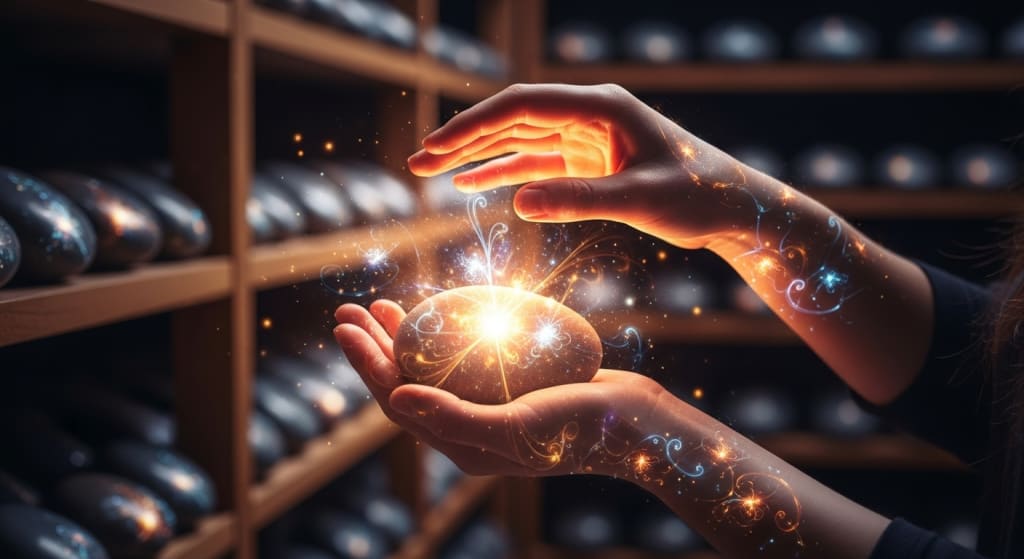
Part 1: The Inheritance of Weight
The inheritance was a joke. A cruel one.
While my cousins got the house and the savings, I got a rusty toolbox and a shed full of rocks.
My grandfather, Silas, was a geologist, a man of quiet intensity. His shed was his sanctuary. Now, it was mine: dusty shelves holding hundreds of unremarkable stones. Each was labeled in his precise script with a date and a set of coordinates. No names. No context.
Granite. 47.6062° N, 122.3321° W. 06.12.1998.
Sandstone. 34.0522° N, 118.2437° W. 11.05.1973.
Slate. 51.5074° N, 0.1278° W. 04.04.1960.
“He was losing his mind at the end,” my aunt said dismissively. “Filling his head with rocks instead of us.”
Angry and grieving, I picked up the first stone within reach—a smooth, grey river rock. Basalt. 47.6738° N, 122.1215° W. 09.15.2005.
The moment my fingers closed around it, the shed vanished.
Part 2: The First Memory
*—I am nine years old. My small hand is tucked inside Grandpa’s large, calloused one. We’re standing by a rushing river.—
*—“See that, Ellie?” he says, his voice thick with an emotion I don’t yet understand. “The water is so strong, but that rock doesn’t move. It just… endures.”—
*—He squeezes my hand. “I have to be the rock for a while, okay? For your grandma.”—
—I don’t understand, but I nod. He bends down, picks up a stone, and puts it in his pocket. The weight of the moment settles on us both.—
I gasped, dropping the rock. I was back in the shed, tears streaking through the dust on my cheeks. That was the day we learned Grandma’s cancer was terminal.
The stone wasn’t a rock. It was a bottle. And it was full of his grief.
Part 3: The Addiction of the Past
I became an archaeologist of my own family. I touched stone after stone, each a tidal wave of sensation.
A piece of black volcanic glass from Hawaii: Their honeymoon. The taste of pineapple, the feel of warm sand, my grandmother’s laughter echoing over a crater.
A chunk of white quartz from Colorado: The fierce, terrifying pride of watching my father—his son—walk away from an argument, choosing peace over rage.
A rough piece of coal from Pennsylvania: The deep, simmering shame of a professional failure he never told anyone about.
I was a ghost at a feast of memories, gorging on a past I never knew. I stopped answering calls. I stopped leaving the shed. My own life—my job, my friends, my rent—felt like a pale, insubstantial dream.
But the memories came with a price. A headache started behind my eyes, a constant, throbbing pressure. I began to forget small things—my WiFi password, a lunch date, the plot of a book I’d just read. My own memories were being crowded out, making room for his.
The stones were a feast, and I was starving to death.
Part 4: The Cracks Appear
The breaking point was a small, grey lump of limestone.
Limestone. 45.4231° N, 75.6831° W. 02.14.1982.
I touched it and was plunged into a memory so dark and cold it stole my breath.
—A hospital room. The beep of a monitor. My grandmother, younger than I’d ever known her, lies still in a bed. In Grandpa’s arms, a tiny, silent bundle. My uncle. Stillborn.—
—The sound that comes from my grandfather is not human. It is the sound of a universe collapsing inward. He stumbles outside into a freezing Canadian winter, falls to his knees, and claws at the frozen earth until his fingers bleed. He takes a piece of that cold, unfeeling ground and holds it until it warms with his agony.—
I screamed. The memory was a virus. For three days, I couldn’t get out of bed, crushed by a grief that wasn’t mine. The headache was now a permanent fissure in my skull. I knew then. If I kept this up, Silas’s memories would become my tomb. I would forget who I was entirely.
Part 5: The Unwritten Stone
I found his journal tucked under a workbench. The last entry was for me.
“Elara, if you’re reading this, you’ve discovered my curse and my gift. I never meant to burden you. I was a geologist of the heart, collecting the moments too heavy to carry but too precious to leave behind. I thought if I could just hold them outside of me, I’d be free. I was wrong. You can’t hide from the weight; you can only learn to carry it.”
He explained the rules he’d learned too late:
A memory can only be held once.
To be free of it, the stone must be returned to its exact origin.
There is one memory he never collected. The one he was too cowardly to face. His greatest regret. His coordinates were in the back of the book.
The map led me not to a remote wilderness, but to a quiet street in our own town. To the house where I grew up.
Part 6: The Return
My journey became my salvation. I used the coordinates like a reverse treasure map.
I stood in that river in Washington, the water cold around my ankles, and let the basalt stone go. The weight of his protective grief lifted from my mind, and for the first time in weeks, my headache eased.
I mailed the volcanic glass to Hawaii, addressed to no one, trusting the island to reclaim its joy. I journeyed to the exact spot in Colorado and left the quartz on a high ledge, where the wind could whistle through it and scatter the pride into something light and free.
With every stone I returned, a piece of my own mind was given back to me. I was not just returning rocks; I was laying my grandfather’s soul to rest, piece by piece.
Part 7: The Final Stone
Which left the final coordinate. My childhood home.
I stood on the sidewalk, no stone in my hand. This was the one he couldn’t collect. I had to find it myself.
And then I remembered. It was the summer I turned sixteen. A screaming match in the driveway. He’d said something cruel about my dreams of being an artist. I’d called him a cold, emotionless fossil and ran inside, slamming the door. I gave him the silent treatment for a month.
I’d never apologized. He’d never brought it up. We’d just… moved on, around the crater of that moment.
That was it. His greatest regret. Not a dramatic tragedy, but a quiet, ordinary fracture. The memory he couldn’t bear to bottle because it was inextricably linked to his love for me. To take it out would have been to remove a piece of us.
He hadn’t been collecting rocks. He’d been collecting anchors. And he’d left the most important one—forgiveness—for me to find.
I didn’t need a stone. I had carried the memory with me all along. I simply had to let it go.
I stood there on the pavement and forgave him. I forgave him for being human, for being flawed, for sometimes being a terrible rock. And in doing so, I finally set down the last stone.
Epilogue: The New Collection
The shed is empty now. Clean and bright.
I kept one stone. The first one. The river rock from 2005. I don’t keep it on a shelf. I keep it in my pocket. Its weight is no longer a burden; it’s a reminder.
I’ve started my own collection. Not of rocks, but of moments.
I press flowers from the day I got my first freelance art commission. I keep the cork from a bottle of champagne I shared with a friend after a long, hard conversation. I write down good jokes I hear and put them in a jar.
They are small, light things. They don’t hold the memory itself, just a scent, a texture, a trigger. The memory stays where it belongs: in me.
My grandfather taught me that we are all stone collectors. We spend our lives gathering the heavy and the beautiful. The trick isn’t to build a wall with them. It’s to learn which to keep in your pocket, which to build your foundation with, and which to eventually, gently, return to the sea.
New chat
Message DeepSeek
About the Creator
Habibullah
Storyteller of worlds seen & unseen ✨ From real-life moments to pure imagination, I share tales that spark thought, wonder, and smiles daily
Keep reading
More stories from Habibullah and writers in Fiction and other communities.
The Broken Umbrella
Part 1: The Inheritance of Broken Things The umbrella was the ugliest thing Elara had ever seen. It was buried in her grandmother’s attic under a mountain of heartache, its canvas faded to the color of dust, its ribs twisted, and its tip rusted into a blunt spear.
By Habibullah6 months ago in Fiction
Lightning Never Strikes Twice
The distant rumble, the sudden deluge, the crescendo of sound, the flash of light, the explosive energy — it never gets old. I became an amateur storm chaser about two years ago. My wife, Cindy suggested it. Sort of. She said, "Alex, you know this cancer is killing me. I've come to terms with that, but you're smothering me. Go join a band, write a book, or become a storm chaser, for all I care. I love you, but you need a hobby."
By Julie Lacksonenabout 2 hours ago in Fiction


Comments
There are no comments for this story
Be the first to respond and start the conversation.