
The Sound of Static
The inconsistent basis

The fluorescent gymnasium lights towered overhead like a spotlight alighting a heroic act. One by one, other players were knocked out until he was the last of his team. It was down to him and the challenger; one annoying, smiley, likable kid. Lebert was thirteen years old and completely absorbed in this game of dodgeball, loving how the environment turned his brain into an electrified super machine. The cumulative duel had just begun and Lebert fixed himself upon his opponent’s habits, sloshing around ideas on how to bring him down. He was very good, and yet, one ball after another was a miss. His bombardments were yielding vain efforts, and the shots from his nemesis, at first easily avoided, were getting more agitating and more difficult to avoid. The excitement and adrenaline to survive, which at first was a never-ending flow of energy, began to die down. The minutes of this epic event dragged on, and fatigue was setting in. It came as an all-encompassing, unavoidable, rising tide. Control over his body became indirect and request-like. His mind slowed. It was getting difficult to decide which ball to grab, when to throw, and which direction to dodge. In a moment of mindless repetition, he went to pick up another ball, and WHAM! He was struck in the head and knocked to the floor.
The next few seconds wouldn’t capture a memory for the future, but a timeless impression. Lying on the floor and staring at the fluorescent light, his mind was grasping defeat. The realization came that he would never get what he was fighting for. The comprehension that everything he was imagining would remain an imagination, never to be tangible, and never to exist. He would never see it, never feel it. As he hit the floor, he passed through a crossroads. He could have gone left, or he could have gone right, but he was thrust to the left with the inability to ever see what was down the other path. To know if what he imagined truly existed. Did he really give it is all? Did he even want it? He felt hollow.
A decade and a half had passed since that moment, and now he sat on a different floor, staring at a different light. This one was broken and long defunct. The abandoned warehouse he was in had tall, gloomy ceilings. The place was humid and smelt of rust and stale water. It reminded him of an ambivalent old man, straight-faced and void of any emotion. As he was gazing up at the fixture, he was also fiddling with a heart-shaped locket. He turned it over repeatedly, subconsciously memorizing every minute detail. The locket had a small nick. He knew precisely where it was. He knew the feeling of the smoothed-out, engraved swirls. He knew the sound of the ‘click’ as he snapped it shut. If there were a thousand similar lockets, he could identify this one just by seeing it, from the feeling he got when his eyes came across it. Though it was a necklace, it never found itself around a neck, but rather buried deep in a pocket.
The sun was shining in through the large opening of the warehouse. He walked over and stuck his hand out. He felt the intense power of the sun’s rays on his pale skin. It felt good. It was energy. It felt like he was absorbing it. Like he was touching the sun. He remembered his childhood days when the sun was consistent and steady. The graciously gifted basis of life’s survival. And yet, now, erratic and unpredictable behavior was bringing life’s assumed survivability into question. The sun’s deviation from consistency, its unexpected outburst in the form of high-energy charged particles, also called solar flares, had destroyed his normal life. Looking out upon the sunny day, his mind forced upon him another memory. A functional memory that told him to avoid the sun.
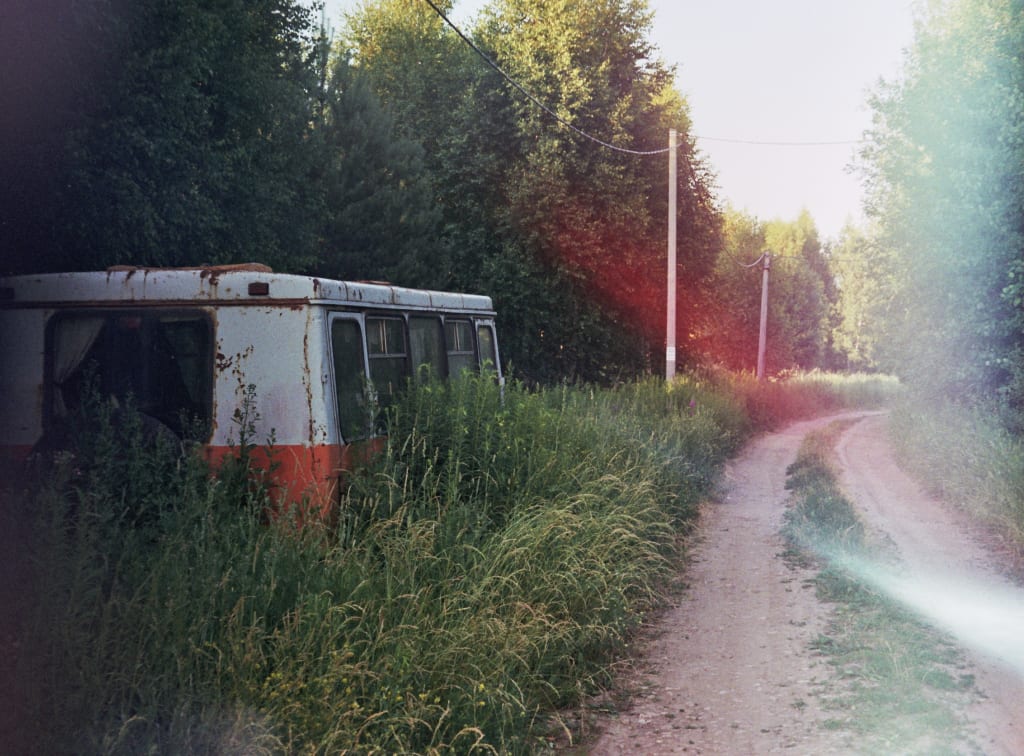
After the first massive solar flare, his family decided it was best to move to his grandparents in the countryside. Cities were in chaos from fires, power outages, plane crashes, looting and general panic. A few weeks into the move, he found himself fiddling with a broken radio while sitting inside the kid’s room. It was clear that the title ‘kid’s room’ was new. It was dark with wood-paneled walls, a single small window, and an absent/cloudy/sleepy ambiance. It was accompanied by an old person’s smell too. The only kid thing about it was the out of place bright-colored pillows and stuffed animals placed on the bed. They were a stark contrast to the dark green sheets that were on it.
As he sat on the bed, he looked over the radio. Covered in charred plastic and black dust, it seemed to have sparked and smoked itself to death. It was fascinating. How did a radio even work? And how could it just blow up? His grandpa had told him something about magnets and ultra-waves. He was told it was junk, never to work again. And yet, suddenly, just as he was holding it, it started to crackle and buzz. At first, it was so quiet it seemed he was only imagining it. Maybe he so closely aligned the sound of static and radios that his mind was playing tricks. But then it grew louder. Loud enough it startled him, and he threw it across the room. He sat on the bed in bewilderment, wondering why it would do that. Then, a shrill crept across his body as he heard a scream from outside. He was frozen by the sound. It was an unrestrained sound of distress. Once he regained control of his body, he rushed to the living room to see what was happening. Just then, his dad rushed through the front door carrying his sobbing sister. Their skins were glistening bright red with horrendous sunburn.
That memory evoked an immature hope from which he was achingly disenchanted. At that time, Lebert thought things would normalize, and that there would be only that initial flare. But one event after another, one flare worse than the first, the dream he had of returning to a normal life remained a separate, unrealistic world. The normalcy of burdens, losses, and struggles to survive forcibly settled themselves in like brazen jackals. He would lose his sister, brother, and both parents to cancer. Each loss was painful, but after each one, it seemed a nerve was singed, and he actually felt less.
He walked out into the intense heat of the sun. There was a grassy area and he felt like lying down. The exhaustion was heavy, and as he hit the ground, he felt the weight of gravity would keep him there. It was like a heavy blanket covering his entire body, and, oddly enough, it was comforting. In that moment, the sun ceased to be his enemy and entered a neutral territory of simple existence. It was an unexpected moment of contentedness. The only other times he felt this was in the presence of a companion, and a connection gave him access to a different world. The timeless moment of a soft and electric touch of a woman, or a crafty joke between friends explained there was some silent mystical energy that could connect separate beings. He thought of the moments he’d shared with others. He thought about how they had all fallen away for one reason or another. His own residual presence a result of uncompromisable differences in values, people turning out to be deceitful and selfish, or even his own lapses of judgment and urge to prioritize himself.
He again took out the locket. He felt it, stared at it, turned it over in his hand, and finally clicked it open. Inside, typically reserved for something cherished, there was only empty space. As he was gazing at it, a subdued crackling sound began to emanate from his highly valued mini radio, which he always kept with him. It was indicating that another inundation of dangerous radiation was imminent. It was like an alarm clock waking him up from an easy slumber. He was completely lost in thought about how strange it was he clung to such an object. The empty locket was a void. A reminder of empty space. And yet, the nothingness was recognized and lived on as something. The empty space existed, protected by the locket.
The crackling of the radio slowly increased in volume. He snapped the locket shut but remained laying on the ground, the relaxing pull of gravity acting as a chain. The sun was a delight, and he had no desire to return to the emptiness of the warehouse. For a second, this momentary intoxication seemed to be worth any cost, but he quickly eradicated the thought. He was being presented with another crossroads. Nothing could outbid his desire to see what was down his path. He hopped up from his place, put the locket back in his pocket, and hastily made his way back.
About the Creator
Wencer Spoods
Hello! I like how language can be used in infinite ways to organize thought and feeling.
Keep reading
More stories from Wencer Spoods and writers in Fiction and other communities.
Sally
Sally was the mysterious old lady that lived across the street. That name, Sally, carried the interesting connotation of belonging to an elderly person. Many names carry weight to them, sometimes particular to the person that hears them, and yet others carry a more universal weight, or in this case, age. She fit in with people like my grandparents. Her garb was typically adorned in gray, light pink and blue, her nose strenuously supported oversized glasses, her thin, gravity defying hair floated in some invisible aqueous environment, and her wrinkles convincingly accentuated a lifetime of movements. Such a person occasionally captures my attention, if only for a moment, and a strange (as in foreign and confusing) feeling comes over me. This feeling that the world I accepted and the people I knew to inhabit it were cracking and falling apart, and that the ownership of my place in the world, which I believed in with a subconscious self-entitlement, was blatantly temporary. Strange? Maybe. However, to be frank, the elderly can seem drastically different with their sense of humor, their way of talking, their smells, etc. Is such my fate? Oh no! It’s almost as if they themselves are a different type of human. It’s as if they grew up in some completely different environment. It’s almost as if... they’re from a different planet.
By Wencer Spoods3 years ago in Fiction
Top tipple tricks
Been thinking a lot about drinking, lately. Not least because of a recent episode of over-indulgence and the inevitable after effects. Some readers may recall the earlier articles I wrote about beating the booze. Here I set out an experiment in techniques for cutting down on my alcohol intake. The experiment was successful, the techniques worked, and I have armed myself with an arsenal of weapons in the war against the demon drink. I have yet to fire the first round however. It's all a question of timing (perhaps procrastination).
By Raymond G. Taylora day ago in Psyche




Comments
There are no comments for this story
Be the first to respond and start the conversation.