
The Soul River Flows
A Timeless Journey of Love and Fatherhood

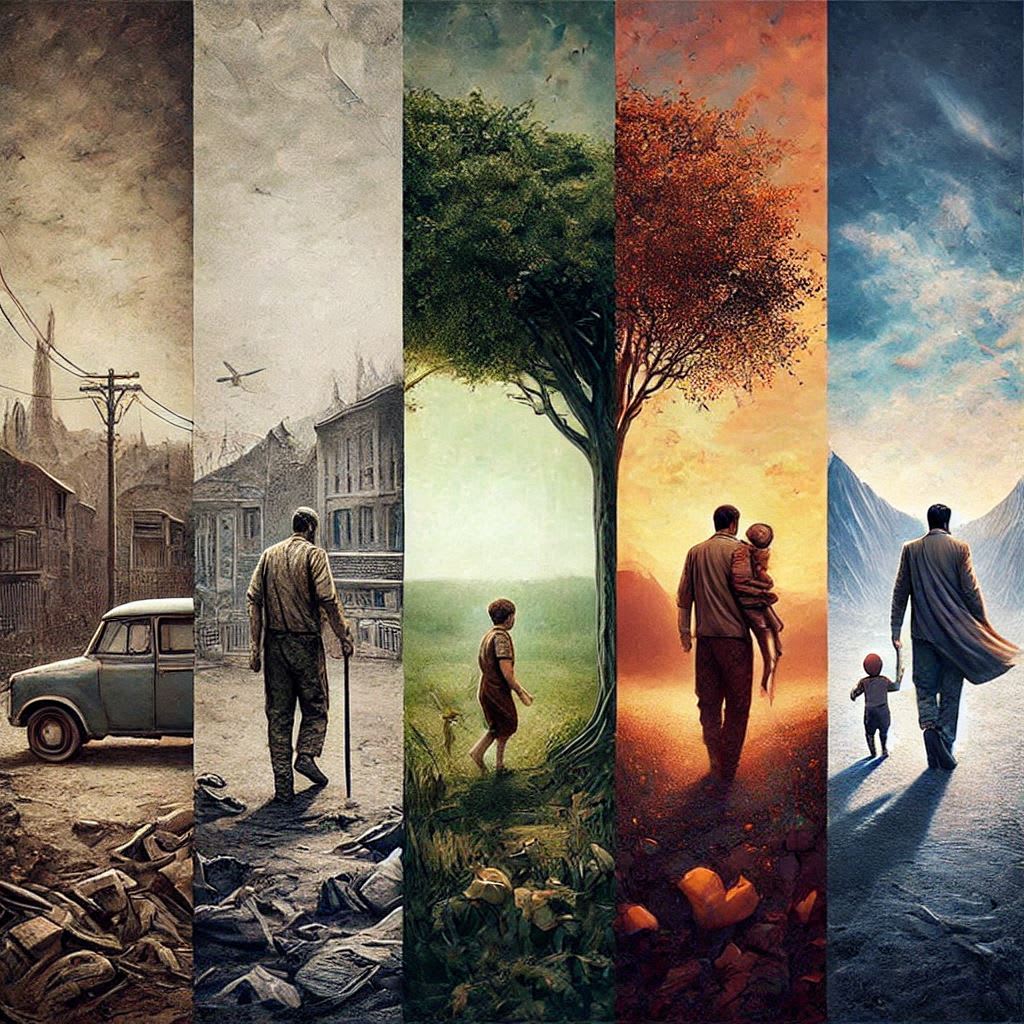
Part 1 : "Light" (2023)
A gentle warmth spread through Kenji’s chest, a feeling of lightness he hadn’t experienced in years. The pain, the struggle, the weight of his earthly existence, all began to recede, like the tide pulling back from the shore.
He felt himself floating, drifting, yet strangely aware of a faint, persistent light drawing him upwards. “Is this it?” he thought, his mind strangely calm. “Is this how it ends?” It wasn’t a harsh light, but a soft, inviting golden glow, like the first rays of dawn after a long night. There was no fear, only a profound sense of peace, an acceptance of what was to come.
A single image crystallised in his consciousness, sharp and vivid, a tiny face, framed by wisps of dark hair, eyes wide with innocent wonder.
The scent of cherry blossoms, usually so intoxicating in late March, was muted this year, trapped behind closed windows and the pervasive anxiety of the lockdown. Tokyo, usually a symphony of vibrant noise, was eerily quiet. For Kenji, the silence was deafening. He paced the small apartment in Shibuya, the rhythmic creak of the wooden floorboards a counterpoint to the frantic beat of his own heart. His wife, Hana, was due any day.
Kenji, a freelance graphic designer, had always been a man of routine, his life neatly compartmentalized between work, late-night ramen runs with friends, and the occasional impulsive trip to the mountains. He was, by his own admission, a creature of comfort, his world revolving firmly around “me.” But now, a tiny, unknown force was about to disrupt everything, and the uncertainty of the pandemic amplified his anxieties tenfold.
Hana’s pregnancy had been a surprise, a joyous one, she stood in the doorway, clutching a small white stick. Her hands trembled, and her voice was barely a whisper. “Kenji … I’m pregnant” The teacup slipped from his fingers, spilling onto the tatami mat.
For a moment, the world seemed to stop. Then, Kenji leapt to his feet, his heart pounding like a taiko drum. He wrapped Hana in a tight embrace, spinning her around until they both laughed breathlessly. “We’re going to be parents,” he whispered, his voice cracking with emotion, but the lockdown had cast a long shadow over it. The bustling maternity clinics, usually filled with the excited chatter of expectant parents, were now shrouded in a sterile, almost forbidding atmosphere.
Kenji wasn’t allowed to accompany Hana to her check-ups. He’d wait outside, pacing the pavement, his phone clutched in his hand, desperate for any news. He missed the sonograms, the chance to see the grainy image of his child, to hear the rhythmic thump-thump of their tiny heart. He felt like he was missing out on the most important story of his life.
Then, one rainy April morning, Hana’s text arrived: “It’s time.”
The hospital, usually a place of healing, felt like a fortress, its doors guarded by masked figures. Kenji was only allowed to drop Hana off at the entrance, a brief, hurried goodbye exchanged through a haze of fear and anticipation.
He spent the next twelve hours in the small apartment, his mind a whirlwind of worry. He replayed every conversation with Hana, every shared dream for their child. He imagined holding his baby, the tiny weight in his arms, the soft touch of their skin against his.
Finally, the call came. A nurse’s voice, calm and reassuring, announced the arrival of his daughter. He was allowed a brief visit, masked and gowned, a fleeting glimpse of Hana, exhausted but radiant, and a tiny bundle wrapped in a white blanket. He couldn’t hold her, couldn’t even touch her properly, but he saw her eyes, dark and wide, staring up at him with an unnerving intensity. They named her Akari “light.”
The weeks that followed were a blur of sleepless nights and hesitant first steps into fatherhood. The lockdown restrictions meant no visits from family, no traditional celebrations. It was just the three of them, navigating this new world together, within the confines of their small apartment.
Kenji, the man who once thought only of “me,” found himself utterly consumed by “we.” He became a master of the midnight feeds, his clumsy attempts at changing nappies gradually becoming more proficient. He learned the subtle nuances of Akari’s cries, each one a different language he was determined to master. He’d sing old Japanese folk songs his grandmother used to sing to him, his voice rough and hesitant at first, but growing stronger with each passing day. He even invented a silly dance, a clumsy jig that involved flapping his arms and making exaggerated frog noises, which never failed to bring a smile to Akari's face. Hana would record these moments, the shaky videos a testament to his transformation.
There were hard days, of course. Days when the isolation felt overwhelming and the anxiety about the future crept in. There were arguments with Hana, fuelled by exhaustion and the pressure of the situation. But through it all, Akari was their constant anchor, a tiny beacon of light in the darkness.
One evening, as the setting sun cast long shadows across the Shibuya skyline, Kenji sat by the window, Akari nestled in his arms. He was humming a lullaby, his fingers gently stroking her soft hair. She looked up at him, her dark eyes wide with trust and affection.
In that moment, something shifted within him. It wasn't just the overwhelming love he felt for her, but a deep sense of responsibility, a desire to be a better man, a better father. He realised that Akari wasn't just a part of his life; she was his life. His only regret in this life was that he had not been more present during Hana's pregnancy, that he had allowed his anxieties to overshadow the joy of anticipation. He wished he had been there for every appointment, every sonogram, every flutter of her tiny heart.
Kenji felt drifting again, the golden light grew warm and inviting, but now it pulsed with a new energy. The image of Akari began to fade, replaced by a sense of gentle swirling, a feeling of being drawn deeper into himself. And then, a profound understanding washed over him. He was not just Kenji.
He was something more, something eternal, a consciousness that had inhabited countless forms throughout time. Each life, each identity, was like a single frame in a vast, unending film. The light pulsed, a gentle reminder that he was part of something much larger than himself.
A voice, not external but from within, resonated in his being “You are not the vessel, but the water within. You are the river, ever flowing, ever changing, yet always the same.” Another memory surfaced, this one older, deeper. He was no longer Kenji. He was Hiroki, in another time, another place.
Part 2 : “Ocean” (1973)
The roar of Osaka’s industrial heart echoed through the cramped apartment building in the working-class district of Shinsekai. A warm echo in the vastness of his consciousness, but he was now Hiroki, a man of this time, this place. The clang of machinery from the nearby factory was the soundtrack of his life, a constant reminder of the long hours and the relentless pressure to provide.
It was 1973, Japan was booming, and Hiroki, a diligent factory worker, was determined to carve out a better future for his family. He wore dark blue work pants and a faded blue shirt, typical attire for factory workers of the time. His hair was short and neatly parted, reflecting the prevailing fashion.
His life before had been simple, focused on work and the occasional night out with his colleagues, drinking sake and singing karaoke in the smoky bars of Dotonbori. He was a man of few words, his emotions kept close to his chest, a trait common among men of his generation.
The popular songs of the time, often played on the radio in the factory, were enka ballads, melancholic and romantic. The recent oil shock had brought a sense of economic uncertainty, a stark contrast to the previous years of rapid growth. Smoking was common, and Hiroki often shared a cigarette with his colleagues during breaks, a brief respite from the noise and grime.
Then came Kiyomi, his wife, a woman with a gentle smile and a quiet strength. They had met at a miai (arranged meeting), as the custom was prevalent at the time. She wore simple but elegant kimonos in everyday life, reserving her more elaborate ones for special occasions. The news that would change everything, they were expecting a child.
The initial joy was quickly tempered by the realities of their situation. Their small apartment, barely enough space for two, would now have to accommodate three. Hiroki worked long shifts at the factory, often six days a week, leaving Kiyomi alone for most of the day. The traditional expectation was clear, he was the breadwinner, and she was the caregiver. But Hiroki felt a growing unease, a sense of disconnect from the pregnancy, a longing to be more involved.
Kiyomi’s pregnancies were difficult. The local clinic, while clean and efficient, lacked the advanced technology of modern hospitals. Hiroki wasn’t allowed in the examination rooms during the check-ups. He’d wait anxiously in the crowded waiting area, the smell of disinfectant mingling with the nervous chatter of other expectant fathers. He longed to hear his baby’s heartbeat, to see the blurry image on the ultrasound screen, but those experiences were reserved for Kiyomi alone. He felt like a bystander in his own life.
Then, one humid August evening, Kiyomi went into labour. The news reached Hiroki at the factory, interrupting the rhythmic clang of the machines. He raced home, his heart pounding in his chest, the Osaka heat pressing down on him like a physical weight.
The birth was long and arduous. Hiroki paced outside their apartment, the sounds of Kiyomi’s labour echoing through the thin walls. He remembered his own father, a stoic man who rarely expressed his emotions, but whose love was evident in his tireless dedication to his family. Hiroki felt a surge of respect for his father, a newfound understanding of the sacrifices he had made.
Finally, a cry, thin and fragile, but full of life, filled the air. A baby boy. They named him Kaito “ocean.”
Hiroki’s first glimpse of Kaito, tiny and swaddled in a simple cotton ubugi (baby kimono), was a revelation. He held him carefully, his hands trembled as he took the baby, his son’s tiny face scrunched up in a frown. His eyes, dark and inquisitive, stared up at him, and a wave of emotion, unlike anything he had ever experienced, washed over him. It was a love that transcended words, a fierce protectiveness that settled deep in his soul.
Kiyomi lay pale and still, her breathing shallow. Hiroki knelt beside her, his son in his arms. “Kiyomi” he whispered, his voice choked with emotion. “Look at him. He’s perfect.” Kiyomi's eyes fluttered open, a faint smile touching her lips. “He has your eyes,” she said weakly.
The weeks that followed were a whirlwind of new experiences. Hiroki learned to change 'nunome', reusable cloth nappies folded in specific ways, a skill passed down through generations of mothers. He would sit by his crib, when Kaito cried, Hiroki would gently rock him, humming a lullaby his own mother had sung to him and navigating the delicate balance between his demanding work schedule and his new role as a father. He would rush home from the factory each evening, eager to hold Kaito in his arms, to feel the soft weight of his body against his chest.
Hiroki would describe Kaito in detail to his parents during their weekly phone calls, his voice softening with pride as he recounted his latest milestones. He even bought a small, portable cassette player and recorded Kiyomi singing lullabies to Kaito, listening to the tapes during his lunch breaks at the factory, a small piece of his family close to him amidst the noise and grime.
As the months passed, Hiroki found himself working longer hours, his boss demanding more as the company expanded. He left before dawn and returned long after dark, he missed many of Kaito’s firsts, his first steps, his first words. He felt the guilt gnawing at him, the conflict between his desire to provide for his family and his longing to be more present in their lives.
There were also unspoken tensions with Kiyomi. While she never directly complained, Hiroki could sense her weariness, the weight of the traditional expectations placed upon her. He felt a deep regret that he couldn’t have shared more of the burden of childcare, that he had been so bound by the social norms of the time. He wished he had been braver, had challenged those expectations, and had been a more present father.
One night, after a particularly long shift, Hiroki arrived home to find Kiyomi asleep, Kaito nestled in her arms, wailed inconsolably, he picked him up and carried him to the balcony. The city lights stretched out before them, a sea of neon and steel. “Look, Kaito” he whispered, pointing to the lights. “This is where you’ll grow up.”
Kaito ’s cries softened, his dark eyes wide as he stared at the lights. Hiroki felt a lump rise in his throat. “I don’t know how to be a father,” he admitted, his voice trembling. “But I’ll learn. For you.” In the soft glow of the lamp, he saw a reflection of himself in Kaito’s tiny features. He realised that his world had irrevocably changed.
He was no longer just Hiroki, the factory worker. He was Hiroki, the father, a man whose heart had been opened by the love of his son. He understood now that providing for his family wasn’t just about bringing home a paycheck, it was about being present, about sharing the joys and burdens of their lives.
He gently kissed Kaito’s forehead, a silent promise to be a better father, a better husband, a better man. The roar of the factory outside still echoed through the apartment, but now, it was accompanied by a new sound, the quiet rhythm of his own heart, beating in time with the love for his son.
The sounds of Osaka faded, replaced by a deeper, more resonant silence. The image of Kaito, now a young man, blurred and dissolved, replaced by a sense of swirling colours, a feeling of drifting once more further back, into the very fabric of time itself. The golden light pulsed brighter now.
The voice echoed again, clearer this time: “The river flows, the forms change. You are the current, the life force, the eternal witness.” Another memory surfaced, ancient and profound. He was no longer Hiroki. He was Taro, in another time, another place.
Part 3 : "Firefly" (1923)
The earthy coolness of the previous memory settled around him, a stark contrast to the industrial heat of Osaka. The sounds of machinery were replaced by the rustling of leaves and the distant murmur of a mountain stream. The morning sun filtered through the paper screens of the small farmhouse, casting a soft golden light on the tatami mats.
He was Taro, a man of this time, this place. He wore simple, indigo-dyed cotton clothing, his hands calloused from years of working the land. The Taisho era was drawing to a close, and a sense of unease hung in the air, a premonition of the changes that were to come.
Rural life was still deeply rooted in tradition, with strong family ties and a close connection to the land. Entertainment consisted of local festivals, storytelling around the fire, and perhaps the occasional travelling theatre troupe. The radio was still a novelty, and news travelled slowly.
For Taro, the end of a long day’s work in the fields meant returning to the warmth of his small house and sharing a simple meal with his wife, Aiko. Aiko wore traditional kimonos and her hair was styled in a simple bun. Their meals were eaten sitting on tatami mats, using simple lacquerware bowls and chopsticks. But this autumn, the familiar scent was tinged with a different kind of anticipation, a nervous energy that settled deep in his gut. Aiko was due any day.
Taro, a young farmer, had always been a man of the land, his life dictated by the rhythm of the seasons. He was content with his simple existence, his days filled with the physical labour of tilling the soil and tending to the rice fields. He rarely thought beyond the immediate needs of the present, his world defined by the boundaries of his village and the traditions passed down through generations.
The news of Aiko’s pregnancy had been met with quiet joy from their families. In Yoshino, children were seen as a blessing, a continuation of the family line, a vital part of the village’s future. But for Taro, the prospect of fatherhood brought a mix of excitement and unease. He had never been one for children, preferring the quiet solitude of the fields to the boisterous energy of the village’s younger inhabitants.
The autumn harvest had been particularly difficult this year. Typhoons had ravaged the region, leaving many fields flooded and crops damaged. The village was struggling, and the added pressure of providing for a new family weighed heavily on Taro’s shoulders. Taro’s father, a stern man with a face like weathered bark, reminded him daily. “A man’s duty is to provide, not to coddle.”
He worked from dawn till dusk, his body aching, his mind preoccupied with worries about the future. The prevailing belief system was a blend of Shinto and Buddhist traditions, with a strong emphasis on ancestor worship and respect for nature.
One crisp October evening, as the first frost painted the rice paddies white, Aiko’s labour began. In Yoshino, births usually took place at home, attended by the village midwife, an elderly woman named Hanae-baasan, whose hands were as weathered as the ancient trees that surrounded the village.
Taro paced nervously outside the small house, her pregnancy was difficult the flickering light from the paper windows casting long shadows on the earthen path. He could hear Aiko’s muffled cries and the low murmur of Hanae-baasan’s voice, each sound a hammer blow against his anxious heart.
The hours stretched into an eternity. His father sat in the corner, smoking a pipe, his expression unreadable. Taro thought of his own father, a stern but loving man who had taught him everything he knew about farming. He remembered the stories his father told him about his own birth, a difficult labour that had lasted for days.
A wave of guilt washed over him. He had been so focused on his own worries, so preoccupied with the harvest, that he had barely given a thought to the pain Aiko was enduring. He wanted to comfort her, to hold her hand and tell her everything would be alright, but tradition dictated otherwise. Men did not involve themselves in such matters.
When the midwife called for hot water, he rushed to the hearth, his hands shaking as he poured the boiling liquid into a basin. As he handed it to her, their eyes met, and for the first time, he saw fear in the midwife’s gaze. “It’s not going well,” she whispered. “Pray for your wife, Taro .”
His stomach churned as he knelt outside the door, his forehead pressed against the wooden frame. “Please,” he whispered, his voice breaking. “Please let them be alright.”
Finally, as the first rays of dawn touched the horizon, a cry pierced the stillness of the morning. A baby’s cry, small and fragile, yet filled with a life force that resonated through the entire village. Taro’s heart leapt to his throat. He rushed inside, his heart pounding in his chest.
Aiko lay exhausted on the futon, her face pale but radiant. In her arms, wrapped in a worn cotton komuso (a type of swaddling cloth), was a tiny baby girl. Hanae-baasan smiled at Taro, her wrinkled face etched with years of experience. “You have a strong daughter,” she said, her voice gentle.
Taro approached hesitantly, his hands trembling as he reached out to touch his daughter’s tiny hand. Her skin was soft and warm, her fingers curled into a tight fist. Her eyes, dark and wide, opened and looked directly at him. In that moment, something shifted within Taro. It wasn't just the overwhelming love he felt for her, but a profound sense of responsibility, a fierce protectiveness that he had never experienced before.
They named her Hotaru “firefly.” The name felt fitting, a small spark of light in a world that often felt dark and uncertain. The next few weeks were a steep learning curve for Taro.
He learned to change omutsu (reusable cloth nappies), to soothe Hotaru’s cries with gentle rocking and humming, and to navigate the delicate balance between work in the fields and caring for his new family. The village community rallied around them, offering support and advice, sharing what little food they had to spare.
The hardships of the time were ever-present. Food was scarce, and the fear of further typhoons loomed large. But within the walls of their small house, a new kind of warmth had taken root. Taro, the man who had once lived only for himself, now found his world revolving around his daughter.
He would rush home from the fields each evening, eager to hold Hotaru in his arms, to watch her tiny face light up with a smile. He would carry her on his back as he worked in the fields, her laughter ringing out like music. He would tell her stories of the land, of the changing seasons, of the traditions of their village, his voice filled with a newfound tenderness.
He felt a pang of regret for his earlier self-absorption, for the times he had prioritised his own comfort over Aiko’s needs. He wished he had been more attentive, more supportive during her pregnancy.
One evening, as the first snow of winter began to fall, Taro sat by the fire, Hotaru nestled asleep in his arms. He watched the flickering flames dance in her dark eyes, a small spark of light in the deepening twilight. He realised that his world had expanded, that his life had found a new purpose.
He was no longer just Taro, the farmer. He was Taro, the father, a protector, a provider, a man whose heart had been irrevocably changed by the love of his daughter. The scent of woodsmoke filled the air, now carrying a new meaning, a promise of warmth, of family, of a love that would endure, even through the harshest of winters.
The image of the small house dissolved, the scent of woodsmoke fading into the vastness of his consciousness. The golden light was brighter now, almost blinding becoming a vortex of pure, radiant light. The voice, now clear and resonant, spoke “The river returns to the ocean. The journey is complete.”
With a sense of profound peace and acceptance he let go, the essence that had once been Kenji, Hiroki, and Taro, merged with the light, becoming one with the boundless ocean of existence.
There were no more memories, no more pain, no more longing. There was only peace.
About the Creator
Tales by J.J.
Weaving tales of love, heartbreak, and connection, I explore the beauty of human emotions.
My stories aim to resonate with every heart, reminding us of love’s power to transform and heal.
Join me on a journey where words connect us all.
Keep reading
More stories from Tales by J.J. and writers in Fiction and other communities.
A Hundred Years in Seven Lives
The aroma of cardamom and sandalwood hung heavy in the air, mingling with the nervous energy that crackled between the two families. In the Sharma household, Mrs. Sharma paced the polished marble floors, adjusting the pleats of her silk saree for the tenth time. Her son, Mohan, was finally settling down, and the weight of tradition, the unspoken pressure of ensuring his happiness, pressed heavily on her. Across town, in the Iyer residence, similar anxieties played out. Mrs. Iyer fretted over the arrangements, ensuring every detail of the impending roka ceremony was perfect. Her daughter, Shalini, was a gem, and they wanted only the best for her.
By Tales by J.J.about a year ago in Fiction
Veil of Subconscious Awakening
Images slide behind my eyelids like film cadres, bursting with meanings. In one moment, I’m speeding down the highway, making the speedometer swing wildly like a frantic pendulum. The next moment, I’m plunging from a falling plane, slowly crashing earthward. At home, I meet black cat’s green, googly eyes staring at me from the cavernous hollowness of the kitchen. When I turn for a moment, it disappears, and all I can see is a pair of blue suede shoes set up against the wall. I pick them up and put them on. When I glimpse at them again, they’ve become black as night, making me blink and flinch.
By Moon Desert6 days ago in Fiction




Comments (8)
Good
Awesome to read
This was interesting
As a reader, The Soul River really touched me, especially with how it shows fatherhood. The way Kenji, Hiroki, and Taro grow over time, learning to balance their personal dreams with the responsibilities and love of being fathers, is really beautiful. Their stories are full of emotion, with moments of doubt and sacrifice that feel so real. What I loved most was how the book shows that, whether in busy Tokyo or peaceful rural Japan, the themes of love, growth, and family are universal. It’s a reminder that fatherhood isn’t just about raising kids—it’s a journey of personal growth and transformation. Truly a heartfelt and inspiring read!
Very interesting 😎
The thought of us living more than one life, reincarnated into others is fascinating. I wish I could remember my other lives. Great story.
Three stories of fatherhood and the love they all shared for their child. Good job.
Truly a masterpiece. Compelling, beautifully descriptive. You have captured the deep parent-child connection in radiant words.