
The Snows of Serein
Silent but deadly
Nobody can hear a scream in the vacuum of space, or so they say.
On the surface of the planet on which the survey team now stood, all sound was completely swallowed, absorbed by the snow-like substance that covered its surface in drifts and danced through the air in flakes of shimmering white. Vintner squinted through the reflective lenses of the goggles that protected her eyes against snow blindness. She had never seen anything like this— Shining motes floating softly all around, the particles sending off light like minuscule stars, or delicate shavings of diamond dust. They could not be true snow or ice, not being composed of water, and they were not cold in temperature at all. They were a phenomenon unique to this planet, a fact that struck a spark of excitement in Vintner, the team’s environmental researcher.
In space, she knew, the silence was due to the lack of air, meaning that sound had no molecules to travel through. This planet had air and an atmosphere breathable to humans, but the strange “snow” muffled sound in a way that bathed the entire world in quiet tranquility. Through a telescope thousands of miles away this planet appeared as a tiny spark, a glimmer of silver brighter than the rest of the stars scattered against the inky expanse of space. This unexplored, so-called “second sun” of the Scopuli system was in fact not a star at all, but a small planet which for unknown reasons reflected the light of its nearby sun. Now that the survey team had landed, these reasons had revealed themselves in the form of this brilliant snow, which seemed to mirror and throw the light around it.
It was Vintner’s job to uncover these mysteries of the planet’s natural environment, and to make them profitable for her employers. Having long since drained our own home planet to a withered wasteland, humanity had begun its exodus to new worlds they could slowly siphon the life from. Argonautics Space Tourism (“Your ticket to the stars!”) specialized in commercial spaceflight, striving to discover habitable worlds for human beings and sell them as desirable vacation destinations, offering pleasure starcruises at cutthroat rates. It was the survey crew’s task to investigate new planets and see if they had the right conditions for the company’s next big tourist trap. As an innate scientist, rather than a salesman, this chaffed at Vintner.
Throughout her years of training, Vintner had dreamed of exploring fascinating new planets, discovering biological marvels of flora and fauna which had never before been dreamed of by humanity. She had hoped to be employed by an organization interested in the biodiversity and environments of worlds for their scientific value. But space exploration was an overcrowded job market these days. The only position she could find was working for some sleazy tourist agency that cared nothing for science or exploration and everything for profit and exploitation. They looked for worlds with no intelligent life at all, those deemed to be safe for humans.
Vintner was given a checklist of the company’s ideal conditions for a planet: Oxygen, water, no dangerous environmental conditions, no predators capable of harming humans. Humanity's previous expeditions into space had turned up a number of fearsome alien species, but nothing that humans had been unable to tame as they had the biologically superior lions, bears, and other beasts of their home planet. Vintner knew that humans, biologically speaking, were weak: meat bags with soft puncturable skin, unpointed teeth and brittle, weak nails besides the tough hides, sharp fangs, and lethal claws of the large animals which once inhabited our home planet. Yet we still became the most dominant species at the top of the food chain, hunting not with our bodies, but with our minds. We had trapped and conquered stronger creatures with our inferior forms but superior intellect, and put them in cages and zoos for our children to point and coo at.
And in the youthful dawning era of space exploration, we had yet to encounter our intellectual equal. For this, we were beyond fortunate. The galaxies spilled boundless and unnumbered before us. Statistically, life far more intelligent than us was, without a shred of doubt, out there, waiting—we just hadn’t blundered into it yet. Even at the point at which we had left our home planet to its desolation, we had still not plundered the full depths of its oceans, seen what terrifying life lay at the darkest bottom of its seas. Vintner knew humanity’s inability to stop meddling was bound to one day uncover a sleeping beast that could conquer us for good. And, like the poor Homo sapien but excellent scientist she was, this idea somewhat thrilled her.
Practical, analytical Vintner with her scientific mind and unemotional way of thinking that had earned her top marks but few friends in university. She had heard the things they whispered behind their hands about her: Cold and unfeeling, no different from an android. In truth, as she stood on the glittering surface of this planet, the other members of her crew staring slack-jawed at its breathtaking beauty, she thought to herself that this entire operation was typical of human stupidity. Typical of the species that had deemed gleaming gold the most valuable resource of the now-defunct earth, despite iron and steel being stronger. Humans admired what was aesthetically beautiful yet functionally useless. The company’s initial bioscan had turned up nothing: this world was utterly devoid of life, offered no promise of biodiversity, no new discoveries about the nature of existence. It was pretty. It would make a nice postcard. You could have a good photoshoot here. It was not the kind of planet she had naively dreamed she might get to explore when she had been in training. But it was the kind of planet that some corporation would pay her to go to, and even stalwart scientists had to eat. Maybe, if she was lucky, the planet’s bioscan would be wrong and she would get to see one of her irritating crewmates from the tourism agency eaten by an undetected new life form.
So she had boarded the ship.
—
And here she was now, trudging through the snow drifts alongside the rest of the survey team, freshly disembarked from the shuttle. Their suits were a gaudy reflective orange, so that they would not lose each other in the white expanse of the snow-dusted planet. Three figures stood looking up at the sky, their eyes and mouths opened wide in awe. The fourth, Vintner, stood studying her crewmates.
She could read it on their faces. We found it: A miracle.
Inside, she thought to herself, Another dud.
Since all sound was swallowed on the planet, human speech was useless. For a species who communicated largely through sounds, other ways had to be found for the team to converse. Cruft, the pilot, held up his electronic tablet now with a message for the others to read: Return to ship. The rest of the members nodded their understanding, turning back towards the area where they had landed just a few short hours prior.
Reeves stumbled clumsily through the airlock, tugging at the collar of his space suit. He was a company man, used to padded office chairs and Italian leather loafers. The tourism agency had sent him along to assess the marketability of the planet, the best angle from which to reel in the customers. It was easy to see on his face what he thought of it: His ruddy cheeks were awash with glowing enthusiasm. Already winded from even that short expedition outside, he collapsed in a chair around the shuttle’s kitchen table.
The pilot Cruft immediately went to the coffee machine and began brewing a pot of the terrible stuff supplied onboard, which he could not live without. His grizzled gray beard, roughened face, thick eyebrows, and gruff disposition gave him the image of a sea captain. The dead silence of this planet was not new to him: Cruft was deaf and mute, and communicated through sign language. Vintner, the only other crewmember with previous knowledge of sign, had studied more during the flight over to be able to communicate with and interpret for him. The others, from the lofty upper offices of the company, had not bothered; they hadn’t seen any reason why they might want to talk to what was essentially, in their minds, the glorified chauffeur. Vintner had learned over the course of their journey that Cruft was old and brusque, but they had a friendly mutual and unspoken agreement to leave one another be. She appreciated how succinct he was, compared to Reeves—she wished the agent, who never shut up, would take a note. Unfortunately, even on this silent planet, at least within the airtight pressure of the shuttle away from the sound-absorbing snow, they could still speak with one another.
Even now Reeves had gotten up and was pacing back and forth in front of the kitchen table like an anxious rodent. Just watching him made Vintner feel a twinge of irritation.
“I can’t believe it.” He was rambling. “This planet is a one-in-a-million find.”
Vintner slid the hood of her padded suit from her head, shaking out her short dark hair. One of the flakes of snow caught in her fingers. She studied it, turning it around in her hand. It was more of a crystal of white fluff than true snow, and must be composed of a foreign material, as it was definitely not made of water. It did not melt like ice under the warmth of her fingertips, but held its shape and structure. She was itching to get it under a microscope.
“Well, the natural pattern of these snowflakes is definitely fascinating.” She said.
Reeves waved her away.
“Never mind that! I’m talking about tourism!” He snapped his fingers. “Here’s how we’ll pitch it: It’s like the diamond rain on Uranus and Neptune, but you can breathe here, and you won’t freeze to death. We’ll call the stuff, let’s say, diamond dust. No, how’s this: star snow. Think about it. The merchandising potential is limitless! We can make crystals and souvenirs of this crud and ship it outworld. Star snow globes, snow crystal jewelry. And we’ll build ski lodges. We can make this place the Vail of the cosmos.”
He spread his arms in front of him, grinning wide. “And we’re the lucky bastards who get to scout it first. Think of the commission!”
“Yes, so right, Mr. Reeves, so right.” The final member of the crew nodded enthusiastically beside him: stuttering, bespectacled Welles, who Vintner had almost forgotten was even present. A small pale-faced man with sandy hair who faded into the background of whatever environment he found himself in, he was also from the main office of the company and made it a point to agree with whatever Reeves was saying. He was the surveyor, whose job it was to take measurements and plot out the best sites for future buildings and colonies, to decide where to put the photo-ops and the gift shops.
Vintner made eye contact with Cruft, as if to ask, Are these guys serious? He blinked at her silently over his steaming mug of acidic garbage and shrugged.
This was the all-star survey team Argonautics had hastily thrown together in a bid to claim this planet before any other tourism agency could snatch it up. Vintner resented them. Cheap, reckless company with their eye on a quick buck. Sending them out here in the middle of nowhere with this barebones skeleton crew in this tin can of a ship.
Well, they were here now and they’d managed to make it in one piece, somehow. There was nothing to do but get to work.
—
It took them only seven days to walk around the circumference of the small planet and return to their ship at their starting point.
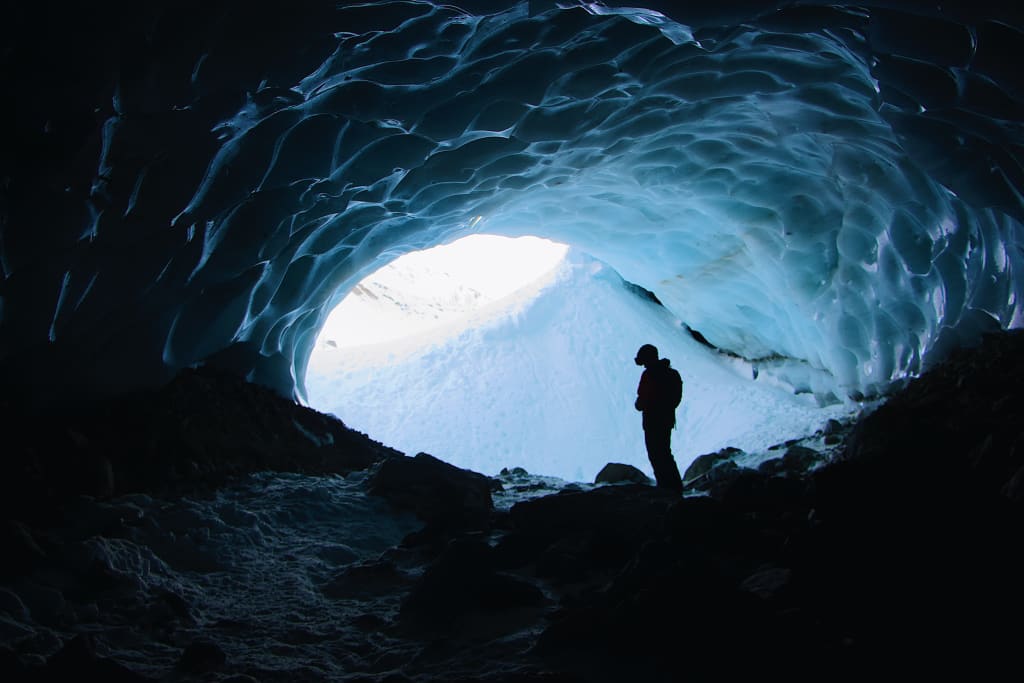
Besides the soft hills of snow, the world was studded with shimmering crystal caves and shallow silver seas dotted with bioluminescent algae. A planet of absolute quiet and calm. Despite its wintery appearance, the planet was not cold, with a temperate climate pleasant to humans wearing a few layers of clothing. The water was a safe PH for human consumption, and the atmosphere was perfectly breathable. There were no lifeforms to be found.
In short, it was perfect.
And we found it first! Reeves pointed zealously to his tablet, on the eighth day of exploration. Vintner could see visions of profits swimming through his mind. They were in a crystal ice cave, a river of clear water running along the ground, splashing lightly as they walked through it. White glittering patches of snowy frost covered the walls like glimmering moss. Reeves had come up with the idea of selling cave tours, so the team had come to investigate their depths.
He was rambling again, making everyone read his ideas on his tablet, overladen with text. Vintner felt glad for the hundredth time since they had come to this planet that he could not talk here; his overloud voice echoing through the caverns would have driven her to the point of madness.
We can give the kiddies little picks to mine crystals with, and they can take home whatever they mine, say, twenty bucks per pouch? His tablet screen flashed obnoxiously. Welles nodded effusively at his side like a bobblehead.
One day his head is going to pop off and roll onto the floor. Vintner signed to Cruft, who raised his bushy eyebrows and snorted.
Let’s split his part of the commission, then. Cruft signed back.
But at the end of the cavern, a sight made them all stop dead in their tracks.
The walls and ceiling were covered in images and words scratched into the stone, dozens of different alien languages in letters they could not read. Images of worlds and star-shaped objects, like depictions of snowflakes, were scrawled everywhere. They put their hands to the etchings, running their fingers along the words as if it could help them understand.
What in the hell? Cruft’s tablet blinked.
Vintner crouched to brush dust from an area of the carvings. When she saw the words that she had uncovered, her blood ran cold in her veins.
She gestured to draw their attention to the letters, scratched over and over in jagged English in the stone:
Run.
Run.
Run.
Vintner’s fingers shook slightly as she tapped out a message on her tablet. I thought this place was uninhabited. There are no signs of anyone stepping foot on this planet. But people must have come here before—people of many different species. Including humans.
Reeves shook his head vehemently. How do you know that? This could be fake. These languages, they’re probably not even real. Just someone trying to scare away competition. Another agency trying to steal this place for their own. Look.
Under a rough illustration of a world surrounded by star-like snowflakes was a word in human letters. Reeves jabbed his finger at it.
See, they even gave this planet a name: Serein. That’s, from what, Greek, or French or something, right? For serene. They knew this place was perfect. They just want to keep it for themselves.
Vintner typed impatiently. Then where is everyone? Why hasn't this planet been claimed yet?
Reeves’ face was turning redder with exertion. They wanted to hide that it had been discovered so they could come back for it later, probably. But we found it before then. Do you blame them? This place is a gold mine.
Welles’ head swiveled nervously between the two arguing crew members, afraid to intervene. Cruft scratched his chin thoughtfully and slowly wrote out a message.
If this warning is true, what is it trying to say? What is it telling us to run from? This planet has no life. Maybe the threat's extinct now.
Vintner had no answer for that. I don’t know. She shook her head. I guess it might have been written by environmentalists. Conservation efforts. She thought of the tranquility, the soft and perfect quiet of this uninhabited place, and pictured how it would be when overrun by human colonists: The tracks of their construction vehicles running through the snow, the factory smog turning the white fluff to a dull, sooty, polluted gray slush. The calm seas dammed and drained, oil spills leaking a sickly rainbow sludge into the silver waters. She could see why people would want others to stay away.
Cruft cut the tension with a brief message. Look, we’ve surveyed most of the planet by now. Let’s go back to the ship and talk things through.
—
Reeves smacked his hands on the ship’s kitchen table. “I say we give them the go ahead. Start sending over the shuttles of colonists.”
Vintner crossed her arms. “Absolutely not.”
Space tourism was still in its relative infancy. Once things had been commercialized, they had gotten out of hand, spun out of control. How could proper safety restrictions be reliably imposed on those acting independently thousands of miles away? Unscrupulous companies like Argonautics became reckless and hasty in the face of a promising new prospect. Vintner would not stand for it. Not when they were all too happy to send shiploads of tourists at the first sign of approval, trigger-happy fingers hanging over their switchboards.
“Are you crazy? This place is a lotto ticket. Someone else could come snatch it up at any minute! Poof! There goes our commission!” Reeves was burning red with impatience.
“Will you shut up about your damned commission? People might have gone missing. We don’t know the truth about the writing on those cave walls and we won’t know until we get them to send more researchers out here who can decipher them!”
Reeves pulled at his hair in frustration. “Damn it, you can’t do that! It’ll take too long! We’ll have it all stolen away before they even land here!”
“As our environmental researcher, I have the last word on whether colonization is okayed or not. We need to do more tests and see if any threats reveal themselves over time. I’m not going to throw safety protocols out the window so you can collect your check and take your vacation on some nice tropical planet.”
Still fuming, Reeves stormed off to his sleep chamber. The rest of the crew dispersed to mull over the implications of what they’d seen.
Vintner, unable to sleep that night, wandered into the kitchen for a glass of water. There, Cruft was lying on the floor, tied to a handrail, his ankles bound with rope and his mouth taped shut. His wrists were untied, red and raw from struggling out of his bonds. With his freed hands, he frantically signaled at Vintner.
Behind.
You.
She felt a sharp pain at the back of her head as the sound of her skull splitting resounded with a crack. Her body thudded as it hit the ground.
Vintner awoke on the floor with a splitting headache. Blood smeared on her fingers when she touched the back of her head. Cruft was shaking her, having untied the ropes around his ankles. Seeing she was awake, he pulled her towards the comms room, where she saw that the messaging system had been smashed in and was inoperable. Before that, it had been accessed.
Red text blinked on the screen. TRANSMISSION SENT:
SAFETY INSPECTION COMPLETE. PLANET SAFE FOR HUMAN OCCUPATION. SUBMIT REQUEST TO SEND COLONY. SIGNED VINTNER, AUTHORIZATION CODE 86-G-53-RT.
“That slippery piece of—! How in the hell did he get my code? He’s going to be spending that damned commission of his bailing himself out of prison for reckless endangerment of human life, if I have anything to say about it.”
Welles and Reeves were nowhere to be found onboard. The researcher and pilot hastened off the ship in pursuit. Outside, a fierce snow storm was brewing, disturbing the previous calm of the planet.
This is strange. Vintner signed. The meteorology patterns didn’t indicate there was any upcoming intense weather.
Cruft scratched his neck, shrugging.
The two struggled through the storm in search of the other half of their crew. But Vintner turned around when Cruft suddenly collapsed, coughing and hacking harshly. At first, she couldn’t see what was wrong with him. He was clawing at his throat, as if he was choking on something. Blood began to spill from his mouth, crimson drops splattering the silver snow.
He signed something, the movement of his hands frenzied.
Snow.
Alive.
He was choking on the snow! As he gasped desperately for air, he only breathed more of the white spores into his throat and lungs. Vintner knelt to the ground in front of him, but she didn't know what to do. In his panic to get air into his lungs, he was clawing his own throat open, raw and ripping, his blood staining the undersides of his fingernails crimson. The snow was suffocating him from within, a parasite that could not be attacked without harming oneself along with it. His throat muscles quivered as he tried to scream, but the air whistled out of the gash he had torn in himself. The sound faded into the air, silenced by the blankets of silver snow. Vintner pressed the palms of her violently shaking hands to the opening in his throat, trying the close the gap so air could make it to his lungs. But the hole was too large, and seemed to be widening every second, as if it were expanding on its own before her eyes.
When she lifted her hands, they were coated in his blood. Flakes of snow clung to her palms. When she wiped them against her suit pants, they did not slough off like before—they latched onto her skin and would not let go. Her hands started to sting, like with chemical snow after radiation, burning away her flesh. Cruft’s chest had ceased to rise and fall. In a panic, Vintner stumbled to her feet and began to run.
Her mind was a racing blur. She had to find shelter. How much of the planet’s environment was toxic? The caves, too? She had to get back to the ship. She covered her exposed face from the whipping winds with the hood and sleeves of her suit and ran.
Everything was white, white. Then: The bright orange of Welles’ reflective suit emerged on a nearby snowdrift. Vintner waved her arms to him, drawing his attention. He started to struggle towards her.
In a blink, massive spikes of ice shot from the ground, running cleanly through Welles’ body. They retracted, dragging him with them towards the snow. Vintner rushed to grab onto his arm, trying to pull him back, but he was being sucked rapidly into the ground. His legs disappeared into the snowdrift, then his chest as he flailed, eyes wide with terror. Welles’ arm was ripped out of her grip by the pull of the snow until only his neck and head remained above ground. His mouth was opened in a silent scream, mouthing, Help! Help! Help! No! No! No! His entire body went under. There was a thrashing, sending up tufts of white, then stillness. The snow began to turn pink and then bleed red, the color spreading in a wide stain beneath Vintner’s feet. She stumbled back. After a few moments, all of the red that remained of Welles was soon covered by new snow. And all was again white.
Because they could do nothing else, Vintner’s legs began again to run.
As she reached near where their ship was stationed, she found Reeves at last, thrashing around in the snow, having what appeared to be a seizure. He looked like a man gone mad, seeming to be attacking some invisible assailant. He was clutching his body and his mouth was opening and closing in silence as he screamed mutely in agony. He was completely covered in white: his body was being eaten alive by the particles. Then he lifted his head.
The left half of his face, which had been buried in the snow, had already been eaten away. The other side was full of pockmarks ringed in pure white particles. Vintner watched in abject horror as the holes began growing larger and larger, as if invisible parasites were boring into his skin. The spores were feasting on his flesh like a mold, and moving with a terrifying hunger and quickness, erasing all traces of his body, eating away even at the bone.
When it was finished with him, the snows devoured the fibers of his suit, his goggles, his boots, until no trace of his existence remained.
Vintner’s mind pulsed with fear and understanding. Each and every particle drifting through the air around her was sentient. The planet itself was a living organism, each flake a piece of a hive mind. They clung to her skin, smarting where the particles had begun to infiltrate after eating through her clothing. Where they touched, they burned holes into her flesh. And the holes began to grow. It burned, everything burned. Every inch of her body screamed. She opened her mouth to scream, too, but nothing emerged. Even her voice was consumed by this frozen hell.
She had to take shelter, get away from the particles, get back to the ship—but all of a sudden she understood. The ship should have been right here, she knew. Welles and Reeves had been trying to make it back when she found them on her way. It had been here. But it was not anymore.
It consumes inorganic material too, Vintner thought, and sunk to her knees. Fascinating.
She collapsed on the ground, and began to die.
Why, she wondered, as her throat began to close, why had the snow not devoured them the moment they stepped off their ship? Because it knew if it kept them alive, they might draw more of their kind. Just as Reeves had. In the wild, intelligent predators will draw larger prey with smaller creatures as bait. She thought of an entire fleet’s worth of colonists, families with children to help populate. The planet was hunting and would devour them. If it was truly smart, the snow would wait for the tourists to come, for its shining flakes to be sent offworld as souvenirs to find new prey, to lodge in the throats and burn the flesh of creatures far away. She had finally found it: The predator who could outsmart humans. The new top of the food chain. And how perfect an organism it was: Harmless-looking body, deadly mind. Humanity had been watching for hulking beasts and sharp teeth, pointed claws and spiked hides. They had overlooked what had been waiting to pounce all along. The downy tufts floated all around her. White and fluffy. Small and harmless. So her theory had been proven correct, after all. It was the species with the superior intelligence, the greater mind, that won in the end.
With the knowledge that she was dying, a sudden clarity came to Vintner. It was only now that she understood the true meaning of the name someone had given this planet before they, too, had succumbed to its silent and deadly machinations. Serein. Not for serene, as Reeves had assumed—for Siren. She pictured an image she had once learned of from human mythology: the beautiful woman-like creatures calling out in silver-throated voices to sailors, songs filling their heads with visions of their greatest desires. The promise of profit, or the tantalizing hope of new discovery. And the glittering golden sands of the shores they sang from, littered with the bones of the men they had lured and devoured.
And to think, Vintner thought to the world, I wanted to keep you a secret. To protect you. To keep people away. So they wouldn’t muck up your surface and destroy your beauty. But you wanted them to come, didn’t you?
And we have, drawn to your light. Like ships following a beacon in the darkness, only to be dashed against the rocks. Swarming to our deaths, like moths to the flame. Us and whoever left those languages from who knows what planets we’ve yet to discover. You lured them and you’ve swallowed them all. Oh, clever thing. I see now, I finally understand—
You are beautiful.
She clutched flakes of the snow in her disintegrating palm, staring at them with a kind of detached scientific admiration. Was it not only right? Did humans not seek to colonize this planet? Would they not have drained its rivers and polluted its seas? Uprooted its mountains and shipped its snow out as souvenirs to foreign planets? Was it not only defending against an invasive species? She could not help but admire it, in the end. She had taken this career path because she was fascinated by nature, by the unique ways that life sought to preserve itself. She had longed to discover something truly incredible. And here, far-flung amongst the stars, stranded and breathing her last, she had found what she had been searching for.
Good for you, she thought, as she watched the twinkling flakes dance before her eyes. You’re alive. Fight to live.
She smiled until she could no longer do so, until her mouth had been eaten from her face.
When the last cell of her body had been devoured and every trace of humanity had been erased from the white, snow-covered world, the storm settled, and calm returned to the surface of the planet. Somewhere distant in the universe, a ship full of colonists plotted course for the shining second sun of Serein.
In silence, it waited.
About the Creator
The Last Letter on the Shelf
I never meant to leave it there. The old wooden shelf in the corner of the living room, stacked with books that smelled faintly of dust and sunlight, had always been my mother’s domain. She used it like a shrine—little trinkets, half-finished novels, pressed flowers, and, most importantly, letters. So many letters. Some she’d kept from decades ago, tied with ribbon, their paper edges soft and worn. Others were more recent, hastily scribbled notes of gratitude, apology, or love.
By Salman Writes4 days ago in Fiction



Comments (4)
Beautiful! Your way of painting such a clear picture is really impressive. And to get access to Vinter’s thoughts the whole way through - the commentary - was excellent. Very very good, Ivy!
Gripping story with a great environmentalist slant too. Really captivating read!
Great combination of the classic pulpy Alien-type story, creative SF work, and environmental messaging.
awesome story! I love the description for the throat ripping! :)