
The Smoke That Whispers
A girl. A vanished fire. A forgotten truth
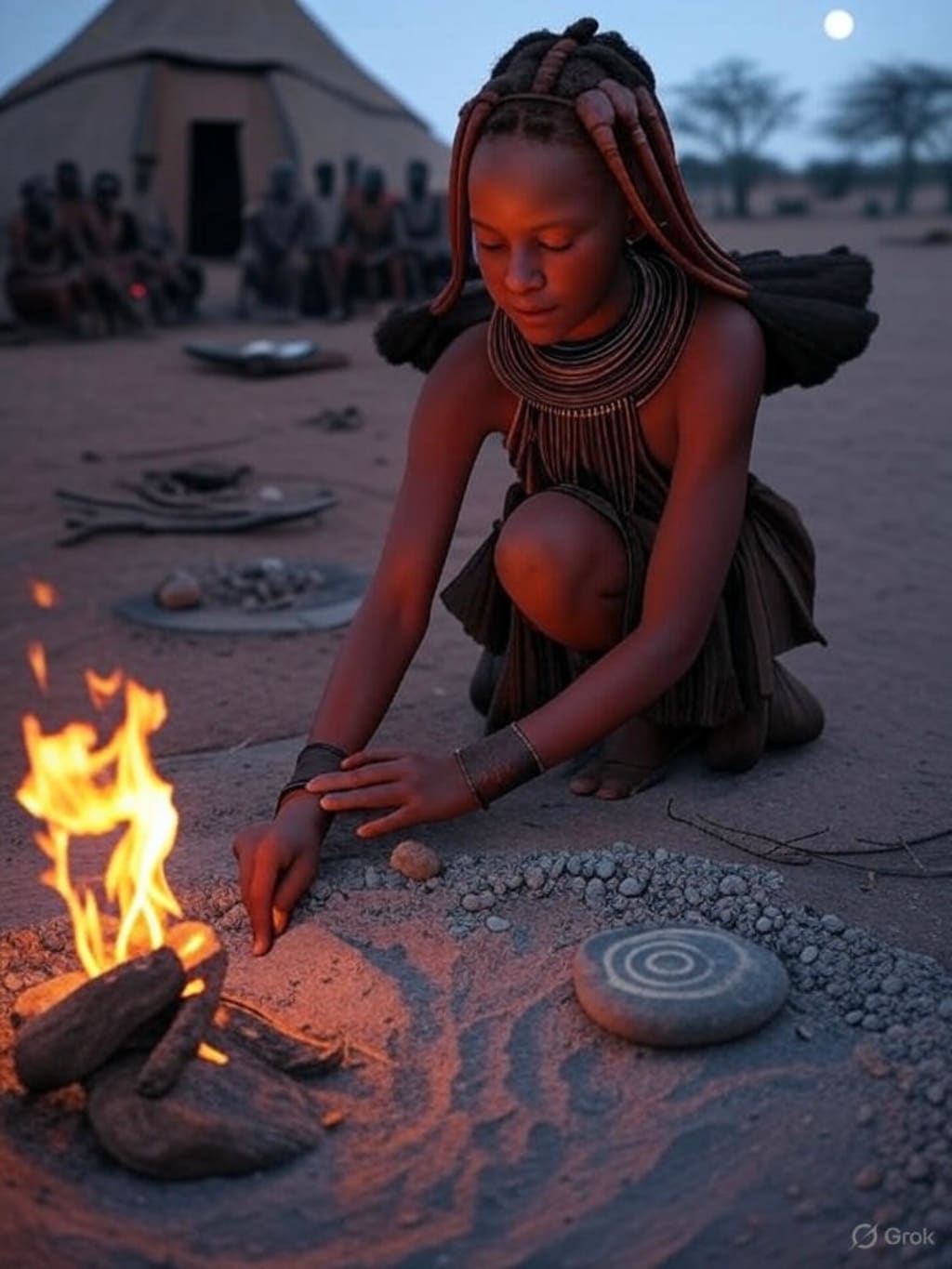
In the Himba village of Otjimanongombe, where the earth is rust-red and the wind carries the scent of cattle and ochre, the holy fire had gone out.
It had burned for generations—tended day and night, linking the living to the ancestors in the sky—but now the ash lay cold. The fire’s breath, the lifeline of the people, had vanished like morning mist. Naita stood at the edge of the kraal, barefoot in the dust, her hands stained from the day's work of milking goats. Her father, the village firekeeper, had died two moons ago, and though her uncle Kalundu had taken his place, the flame refused to stay lit. Every spark he conjured guttered into smoke.
"Perhaps the ancestors are silent because they no longer hear us," Kalundu had muttered just that morning, sweat running down his red-painted temples. He hadn’t looked at Naita when he said it. No one did lately. But Naita knew something the others didn't. The fire hadn’t died by accident. The Himba elders had gathered that evening in the ceremonial hut, its walls perfumed with myrrh and wood smoke. Naita wasn’t allowed inside, but she lingered near the entrance, her younger cousin Mue whispering updates as he peeked through a crack.
“They’re saying we angered the ancestors by mixing traditions,” Mue murmured. “Something about the new borehole and that cell phone tower the government men brought.”Naita bit her lip. Change had crept in on tire tracks and signal bars. Her best friend Itatu had gone to school in Opuwo and come back speaking English and dreams of university. Some villagers had welcomed the borehole’s clear water; others still walked to the spring out of respect for ancestral ways. But this—this silence from the fire—was more than change. It was a warning. And Naita had seen the omen with her own eyes. Three nights after her father’s burial, when the wails had quieted and the goats had stopped bleating at the emptiness of his absence, Naita had wandered to the shrine at the edge of the mopane grove. It was there, under the swaying branches, that she found the stone.
Flat, palm-sized, blackened at the edges. Carved with a spiral symbol she’d never seen in any village cloth or carving. The centre shimmered faintly, as if light pulsed beneath the surface. She'd brought it to Kalundu. He stared, flinched, then thrust it back at her. "Burn it," he spat. "Such things carry curses. "But she hadn’t.
Something about the stone whispered not fear—but memory. It felt familiar. Alive. Now, with the village murmuring about droughts and disobedience, with babies falling sick and milk turning sour, Naita felt the weight of the stone pressing in her pouch, hot like a secret. Late that night, Naita stole away. She walked past the sleeping cattle, past the clay huts shaped like anthills in the dark, past the cooling bones of the fire that should never have died. At the shrine, moonlight silvered the red earth. She knelt, placing the stone in the centre of a circle drawn in ash.
"Who are you?" she whispered. And the wind answered. It came as a hush—then a howl—circling the grove, stirring the branches until they seemed to speak in clicks and sighs. From the centre of the stone, a tendril of smoke rose, curling like a question. Then she saw him. Not in body—but in flame. Her father. His face formed in the rising smoke, blurred but unmistakable. His eyes were calm, but sad. "You are the key," his voice whispered, not with lips, but through the bones of the night. "Not Kalundu. You." “But I am not firekeeper,” she whispered back, her throat dry. “I’m a girl.” “You are your mother’s daughter.” Naita’s breath caught. No one spoke of her mother. She had been Himba—but different. A healer, born in Angola, who walked into their lives like rain during drought. Some called her a witch. Others called her Omuhoko—a bridge between spirits. When she died in childbirth, the elders buried her far from the holy fire.
Her name was never said aloud again.The next morning, Naita entered the fire hut alone.Kalundu had gone to the kraal, cursing the cows for giving less milk. The embers still slept.She knelt and drew a circle in the dust. Into it, she placed the stone. Around it, she laid herbs her mother had once taught her to pick: mopane leaves for cleansing, omumborombonga bark for strength. Then she sang. A lullaby. Not Himba, but from her mother’s tongue—soft and winding, like a river’s hum.
As she sang, she struck flint. Once. Twice. On the third, the flame caught.It didn’t roar. It bloomed—soft and steady, curling up toward the sky. The air in the hut warmed, then hummed, as if the earth itself exhaled. Kalundu burst in. He stared, eyes wide. “What did you do?” “I listened,” Naita said, standing tall. Outside, a drizzle began to fall—the first rain in four months. That evening, the elders assembled again.
Naita stood before them, the stone in one hand, the flame behind her. Her ochre-painted braids were streaked with ash, her skirt stiff from kneeling in the dust.“I do not come to challenge,” she said. “But the ancestors have chosen me.” “Fire keeping is a man’s role,” one elder began. “Then why did the fire refuse him?” she asked, gaze steady. They fell silent.
She knelt, placing the stone between them. “This was buried. Hidden. But it remembers.” The elder woman, Mutambo, the oldest in the village, stepped forward. She reached for the stone. Her fingers trembled.“I’ve seen this before,” she whispered. “When I was a girl, before the missionaries came. They said it was dangerous. But it is not.” She turned to the others. “It is older than danger. It is truth.” In the weeks that followed, things began to change.
Naita was named Firekeeper—an honour never before given to a woman in her village. Some resisted, but none could deny the flame stayed bright under her care. The cows began to birth strong calves again. The spring near the grove flowed sweeter. But more than that—the people listened.
Not just to Naita, but to each other. They began to speak of balance. Of holding tradition in one hand, and change in the other. Itatu, fresh from school, helped write down old songs before they vanished. Mue taught the elders how to use the borehole without shame. And once a moon, the whole village gathered at the mopane shrine, where Naita lit a fire from the ancient stone, and told the story of the night the wind whispered.
END
Author’s Note (for Vocal Readers):
This story is rooted in the cultural richness of the Himba people of Namibia—a semi-nomadic community known for their deep spiritual ties to the land, ancestral fire rituals, and iconic ochre-covered appearance. While fictional, the story draws respectfully from authentic traditions and explores themes of identity, ancestral memory, and the delicate dance between tradition and transformation.
About the Creator
Keep reading
More stories from Ogola Peter and writers in Fiction and other communities.
The Whispers of Simbi Nyaima
The sun hung low over Lake Victoria, its golden rays dancing on the water’s surface like the flicker of a thousand fireflies. The air was thick with the scent of wet earth and the distant hum of cicadas. On the shores of the lake, a young fisherman named Omondi sat in his wooden canoe, his hands calloused from years of pulling nets heavy with tilapia and Nile perch. But today, the lake was silent. The fish had vanished, and the waters, once teeming with life, now lay still and lifeless.
By Ogola Peter11 months ago in Fiction
Captain Michael and the Horn of Logan
“I am King David the Magnificent. The Great and Powerful. Ruler over all that is in front of me, all that is behind me. All that is to the north, south, east, and west of me. Why have you come before my great presence? Make your request now. If it sounds pleasant to my ears, I might consider granting you your request. If not, you will be fed to the lions.”
By David E. Perryabout 23 hours ago in Fiction


Comments (1)
This story really makes you think about how traditions collide with change. I can imagine how hard it must be for the Himba village. It's like when new tech comes into a small town where old ways are strong. The idea that the fire going out is a warning because of mixing traditions is fascinating. Have you ever seen a similar clash between old and new in your own life? It makes you wonder what the right balance is between holding onto the past and embracing progress.