
The Sirens Didn’t Kill Them
The Untold Cost of the Wax in Odysseus’s Famous Escape

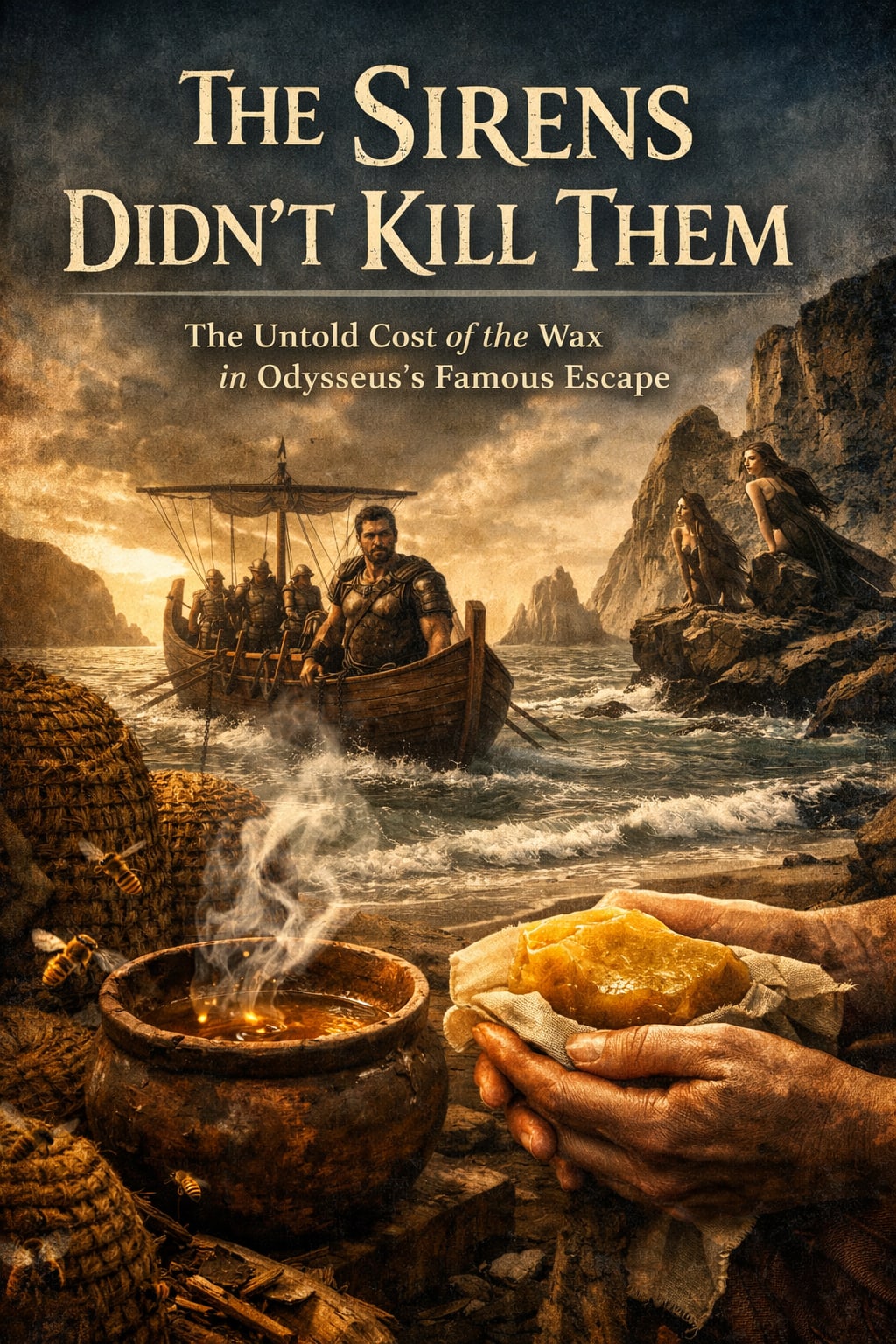
People still tell it like it was simple.
“They stopped their ears with wax,” the storytellers say, as if wax is a thing you find lying around on the shore like driftwood. As if it does not come from mouths and bodies and seasons. As if it does not have a smell that clings to your hands for days. As if it does not remember the warmth that made it soft.
They say it with a laugh sometimes—clever Odysseus!—as if the idea arrived clean and perfect and whole, as if it did not pass through anyone else’s life on its way to becoming a myth.
But I remember the wax before it became a line.
I remember it as comb, as labor, as prayer. I remember the bees.
My name is Melantho. I kept hives on the thin strip of land where salt wind presses the olive trees sideways. My father called it a foolish place to farm anything delicate. My mother called it a blessed place for bees—because they love the stubborn blossoms that grow where nothing else will.
The bees were mine before I was a woman, before my braids were thick enough to tie back. My father died under a roof beam, sudden as a snapped string, and my brothers sailed away with other men’s wars. I stayed. Not because I was brave, but because somebody had to feed the living.
So I learned the language of the hives.
The warning pitch of angry wings. The heavy hum of a queen settling. The quiet days, when the air tastes like thyme and the hive breathes slow as sleep. The days they swarm, when the world seems to split open and pour itself into the sky.
Wax is not a thing. Wax is the shape a community makes when it believes the future is possible.
It is architecture built from hunger and sunlight. It is a promise made visible.
That is what the myth forgets.
On the day the stranger came, I was rendering the last of summer’s comb in a clay pot over a low fire. The smoke was thin and sweet. I had been skimming the impurities—bits of bee leg, flecks of pollen, the little dark things that remind you the world is not made of symbols but of bodies.
A boat grounded in the shallows. Men stepped out like they were used to stepping out of danger. Their skin had that ocean-worn look—salt-cracked, sun-browned, scarred in the casual places. They were not fishermen. They moved like people who had made vows and broken them and made new ones out of whatever was left.
Their leader was not the tallest, but he held attention the way a hook holds cloth. His eyes moved constantly, taking inventory: the shore, the trees, the path to my house, my hands, the pot.
He did not smile when he greeted me. He did not insult me either. He spoke like someone who had learned that words should spend carefully.
“Woman,” he said. “I’m told you have wax.”
I wiped my hands on my apron. Honey scent rose from my palms no matter how much I rubbed.
“I have what my bees make,” I said. “Wax, honey, propolis. A little venom, if you anger them.”
One of his men laughed, quickly swallowed it. The leader’s gaze flicked to him and back to me.
“I’m Odysseus,” he said, as if that name had currency here.
I had heard it. Everyone had heard it, the way you hear of storms forming far out at sea—news you cannot stop but must respect.
“The one who…” I began, then stopped. There are too many endings to a man like that. Too many versions.
He nodded like he knew what I was about to say and had already decided not to carry it.
“We need wax,” he said. “Soft enough to shape. Enough for all of us.”
“For what?” I asked, though I knew better than to ask questions of strangers who arrived with that kind of purpose.
He did not answer at once. His eyes drifted over my hives—stacked boxes of woven reeds and clay caps. He listened to the low, steady sound of thousands of wings working at being alive.
“We’re going past the Sirens,” he said finally.
The word made the air colder.
Even people who pretended not to believe in monsters lowered their voices around that name. The Sirens were not merely creatures; they were a warning. A place where attention becomes death. A song that makes men forget the difference between longing and drowning.
“And wax stops their song?” I asked.
“It stops us from hearing it,” he corrected. “Stops the part of us that runs toward it.”
That answer sat in me, heavy and true. Not magical. Not brave. Just practical. The kind of truth that never survives retelling because it has no sparkle.
“You’re asking for my winter,” I said.
He looked at my pot again. The wax was turning clear, golden as late afternoon.
“You sell wax,” he said, as if the matter were already settled. “I will pay.”
He reached into a pouch at his belt and poured out small coins—bright, stamped, foreign. Wealth that had traveled. Wealth that could buy grain, oil, cloth. Wealth that could keep a house standing.
And yet my throat tightened.
Because money does not replace bees.
Wax is their labor, their structure, their future. Without enough wax, they cannot build comb. Without comb, there is nowhere to lay eggs, nowhere to store honey. Without honey, they starve when the flowers die.
He had not asked for honey, which meant he did not understand. Or he understood too well and had chosen the thing that would hurt least now and most later.
“You’ll leave and call it clever,” I said before I could stop myself.
Odysseus’s face didn’t change, but his eyes sharpened.
“You think I’m stealing,” he said.
“I think you’re asking in a way that leaves me no room to refuse,” I said. My voice surprised me. It had the steadiness of someone who has had to bargain with life itself.
One of his men shifted forward, offended on his leader’s behalf. Odysseus lifted a hand and the man stopped.
“Name your price,” Odysseus said.
I shook my head.
“It’s not a price problem,” I said. “It’s a consequence problem.”
He studied me then, as if he hadn’t expected thought from a woman standing over a pot.
“What do you want?” he asked, quieter.
The question was a door. I did not know if it led to mercy or simply a different kind of taking.
I looked at my hives. The bees moved in and out of the entrance slits, indifferent to gods and heroes, faithful only to work.
“If I give you wax,” I said, “you tell the story right.”
The men behind him made soft noises—amused, confused.
Odysseus blinked, as if I’d asked for a strange treasure.
“What story?” he asked.
“The one you will tell about this,” I said. “You’ll make it clean. You’ll turn it into a trick. You’ll say you stopped your ears with wax like the wax appeared because you thought of it.”
I stepped closer to the pot, dipped my finger into the edge where it cooled, lifted it. A thread of wax stretched, then snapped.
“This came from bodies,” I said. “From thousands of mouths feeding larvae. From flowers that opened and died. From summer heat. From my hands. If you live, if you return, if your name keeps traveling—tell them that the wax was not nothing.”
Odysseus’s gaze held mine. Something moved behind his eyes—recognition, maybe. Or calculation.
“And if I don’t?” he asked.
“Then you can take it,” I said, and surprised myself again, “but you will carry a theft in your mouth every time you boast.”
Silence. Even the surf seemed to hush for a beat, listening.
Odysseus did not smile, but his shoulders eased, the smallest release.
“You think I boast,” he said, almost gently.
“I think people turn survival into boasting,” I replied. “Because it’s easier than admitting what it costs.”
He looked down at the coins, then back at me.
“Very well,” he said. “I will tell them.”
I did not know if he meant it. But I had asked for the only payment that could not be stolen from my house: a shape placed in the future.
I went inside and brought out what I had stored—blocks of wax wrapped in cloth, the best of the season. I added the rendered wax from the pot, poured it into shallow trays to cool enough to handle.
His men watched like boys near a magic trick, still wanting the world to be simple.
When the wax was ready, I handed it over. It was warm through the cloth, like a living thing.
Odysseus weighed it with his hands.
“How do you shape it?” he asked.
“Warm it,” I said. “Not too much. Press it like you’re sealing a jar. It should fit the ear, but not enter deep. You want silence, not injury.”
He nodded, taking the instruction the way a man takes a weapon: without gratitude, but with respect.
Then he hesitated.
“You said winter,” he said, glancing toward the hives again.
I didn’t answer. I didn’t have to.
He took a breath, and for a moment he looked less like a hero and more like a tired man who had been given too many choices that all bled.
“You have my word,” he said. “If a story is told, I will place you in it.”
He turned to go, then paused at the edge of the path.
“What will you do?” he asked.
It was such a strange question from someone like him—someone used to leaving ruin in his wake and calling it fate.
“I will pray the bees forgive me,” I said. “And I will build what I can with what remains.”
He held my gaze one more time, then walked back toward the sea.
The boat pushed off. Sails caught wind. The men became silhouettes, then specks, then nothing.
After they left, my hands smelled wrong. Not honey-warm. Not wax-sweet. Like emptiness warmed over a fire.
That autumn the hives grew restless early. The comb felt thin. The bees crowded in places they shouldn’t, as if the house had shrunk around them.
When the first cold nights came, I wrapped the boxes with cloth and packed clay around cracks. I set out sugar water to supplement what little honey remained. I whispered to them like they were children I had failed.
Some survived. Some didn’t.
And when winter bit hard, when wind came off the sea like a knife, I woke at night imagining a ship drifting near rocks, men with ears full of my wax, held safe from a song that would have killed them.
I imagined the wax softening in sun. I imagined it being pressed in, the last barrier between a man and his own hunger for meaning.
I imagined Odysseus lashed to the mast, screaming to be released, and I understood something the myth never says:
It wasn’t the Sirens alone that were dangerous.
It was the part of a person that wants to drown in a beautiful story.
Spring came—slow, stubborn. Flowers returned like forgiveness offered cautiously. The hives that lived began to build again, drawing new comb from their own bodies, as if the past had not happened.
Life always does this. It continues, even after betrayal. Even after myth.
Years later, in the market, I heard a traveling singer perform the tale.
He sang of Odysseus and the Sirens—how the hero outwitted them, how he stopped his crew’s ears with wax, how he alone heard their song and survived, bound to the mast like a man stronger than desire.
The crowd cheered in all the right places.
I stood behind a stall of dried herbs and listened, waiting for my part—waiting for even a whisper of bees, of women, of consequence.
The singer never said my name.
He never mentioned the hives. He never spoke of winter. He never spoke of the cost of taking wax from a small shoreline life.
When the song ended, people tossed coins. Someone said, “Clever, clever Odysseus.”
I felt something then—not rage, not grief. Something steadier. A kind of clarity that comes when you stop expecting myths to carry truth.
The singer packed up his lyre and passed near my stall. He was young, hungry-eyed.
“Where did he get the wax?” I asked him casually, as if I were only curious.
He shrugged. “From a temple, I think. Or he had it. Wax is wax.”
“Wax is wax,” I repeated, tasting the lie in the simplicity.
The singer moved on, already forgetting my face.
I went home before dusk and sat by my hives. I watched the bees return with pollen on their legs like gold dust. I listened to their hum—the original music, the one that doesn’t ask you to drown.
And I told the story out loud, to no one important.
I said my name into the air. I said the bees’ labor mattered. I said the wax did not appear. I said cleverness is often just borrowing from someone else’s winter.
The bees did not answer. They never do. They simply kept building, cell by cell, the architecture of the future.
That is how truth survives when myths won’t hold it:
not by correcting the song,
but by tending the detail
until it becomes a world.
—Flower InBloom
About the Creator
Flower InBloom
I write from lived truth, where healing meets awareness and spirituality stays grounded in real life. These words are an offering, not instruction — a mirror for those returning to themselves.
— Flower InBloom
Keep reading
More stories from Flower InBloom and writers in Fiction and other communities.
The Baby in the Break Room
At 9:00 a.m., the siren sang its polite two notes—ding, ding—and the building returned its practiced silence. Mara set her mug on the corner of her desk where the ring stain had been carefully outlined with a thin strip of tape. She’d done it on her first day, back when she thought it mattered.
By Flower InBloomabout 16 hours ago in Fiction
A Quandary in Quarantine
Chapter Fifteen It was finally Saturday. I usually used my days off to center myself. I would sometimes read for pleasure, or maybe do some journalling. But all of that seemed so secondary. I was definitely looking forward to whatever Drew had planned for that evening, but when my eyes first opened Saturday morning, my first thoughts were focused on Irene. I knew it in my gut that Eliisa had had a hand in her murder. All the clues I had found pointed to Eliisa being Irene’s killer, but I just could not figure out why.
By Erin Lorandos7 days ago in Fiction



Comments
There are no comments for this story
Be the first to respond and start the conversation.