
The Silence After The Shot
From Reaper To Guardian

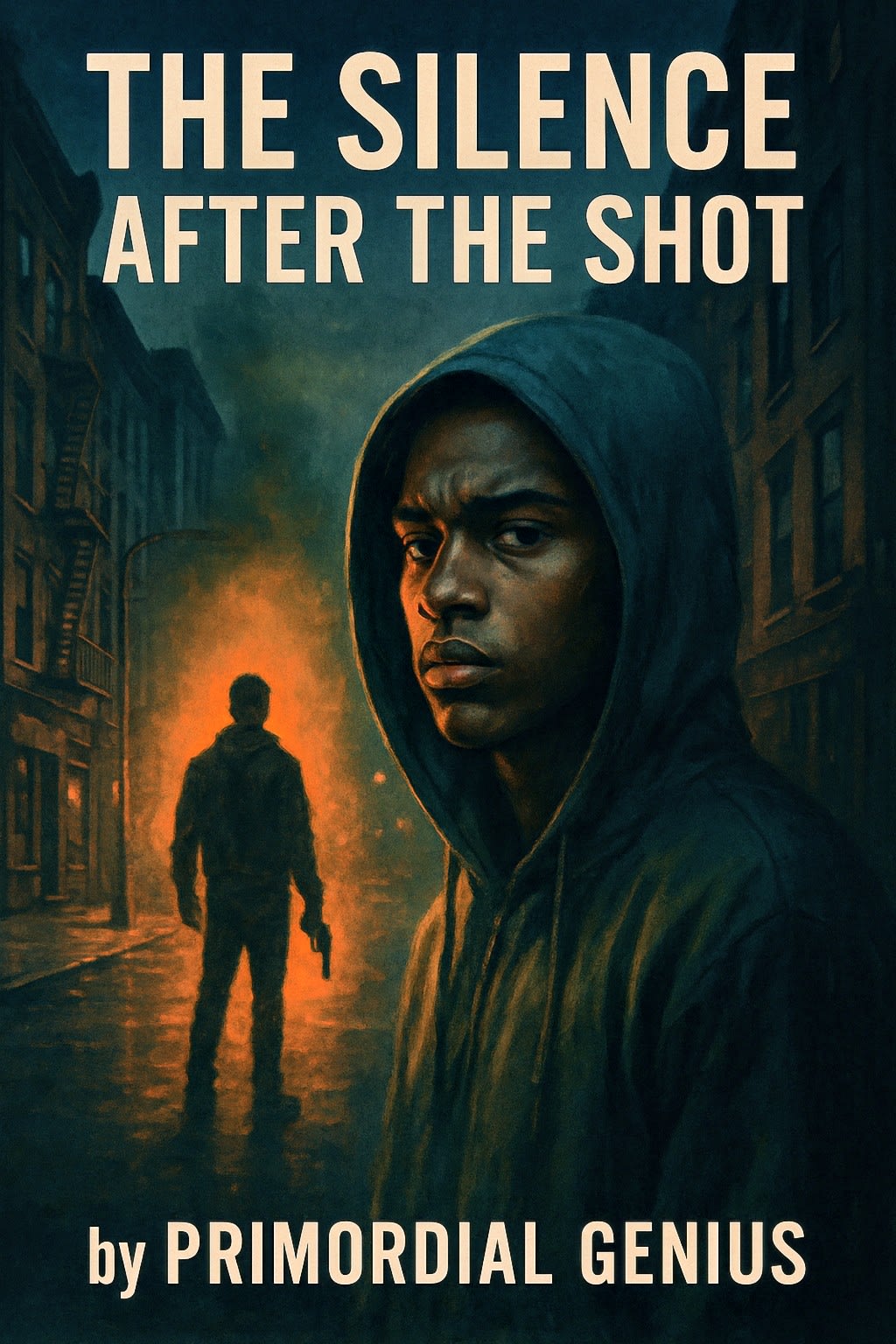
The Silence After the Shot
by Primordial Genius
The gunshot was a full stop, a period punched into the world that ended a sentence Marcus had been reading his whole life. The sound didn’t fade; it sank, a stone dropped into the deep well of him, and the echo began its work, a vibration in the marrow of his bones that felt older than he was. He stood over the gang member from the Jordan Park set, and felt a terrifying nothing. The absence was a presence in itself, a hollow hum behind his sternum. He was Reaper. The name was a tattoo, a promise, a sigil inked over his heart. He had earned it. The warm, heavy steel in his hand felt like the only real thing. He was a harvester. But in that humming void, he understood he was also the crop.
Later, in the suffocating stillness of his grandmother’s apartment, the hum grew louder. The air was thick with the scent of cayenne and thyme, a fragrance that clung to Mama Ayo like a second skin. She moved in the kitchen, a slow, deliberate current in the dim room. Her silence was a heavier judgment than any shout. She was from a place where the ocean touched the sky, and she carried the weight of that crossing in the slope of her shoulders. When she looked at him, her eyes, the colour of dark river stones, seemed to see past him, to the long, pained line of men who stood at his back—a spectral genealogy of clenched jaws and extinguished fires.
That night, he dreamed of drowning. Not in water, but in a thick, cloying mud that smelled of rust and saltwater. Chains of a weight he could not comprehend locked his ankles, and a scream was trapped in his throat, a silent bubble of terror that had no beginning and no end. He woke up gasping, the taste of the dream still on his tongue, a metallic tang of fear that was not his own.
“The body keeps the score,” Mama Ayo said the next morning, her back to him as she stirred a pot of grits. She hadn’t heard him cry out, but she knew. She always knew. “The bones remember what the mind works to forget. The pain is a song, Marcus. And you have been humming the chorus your whole life.”
He shrugged her off, a familiar gesture of dismissal that felt flimsy, paper-thin. He returned to the set, to the brothers who were his fortress. But the hollowness had followed him. The complex handshakes were empty calisthenics. The boasts of vengeance were rote incantations, spells they chanted to keep the cold out. He watched the young ones, the twelve-year-olds with eyes like shattered windows, and he saw the reflection of his own past, and the ghost of his future. He saw the loop. And for the first time, he felt its teeth on the back of his neck.
The trigger came a week later. His little brother, Ray, sixteen and all sharp angles and fragile pride, got jumped. It wasn't serious, just a message written in bruises and split skin. But the rage that erupted in Marcus was a tectonic shift. It was hot, chaotic, a volcanic surge that felt *good*. It filled the hollow space with a glorious, burning purpose. It had a voice, a sibilant whisper that coiled in his brainstem: **Never be powerless again. Make them ash.**
He found a stolen Glock, his hands moving with a muscle-memory that felt both intimate and alien. He would erase the whole corner, scrub it from the map with lead and fire. It was the code. It was the only grammar of justice he knew. But as his thumb found the safety, he saw Mama Ayo’s face—not as she was now, but as a young woman on a distant shore, her eyes holding a sorrow so vast it could swallow history.
He stopped. The gun was a dead weight, a blasphemous object. The rage was still there, a furnace in his gut, but it felt… borrowed. Ill-fitting. And beneath its roar, he heard it clearly now: a parasitic whisper, a thing that was not him, feasting on the heat of his anger. **They deserve it. They disrespected your blood. Do it. Feed us.**
He dropped the gun. The clatter on the concrete was a small, shameful sound. He ran, not from any enemy on the street, but from the enemy that had taken up residence inside his own skull. He burst into Mama Ayo’s apartment, his chest a bellows, his breath ragged.
“Something’s in me, Mama,” he gasped, collapsing into a chair. “It’s… not me.”
She turned, her gaze a steady anchor in his storm. “I know, child,” she said, her voice low and weathered. “It has been a tenant in this family for a long time. It came over on the ship. It worked in the fields. It knows our name.”
That night, she did not offer him prayers from a book. She offered him a technology. “To disarm a trap,” she said, “you must first see its mechanism.”
She sat him on the worn floorboards, a single white candle flame dancing between them. “Close your eyes, Marcus. Breathe. See your blood not as a list of names, but as a river of light flowing back through time.”
He resisted, the cynicism of the street, a hard shell around his spirit. Then, he let go. Darkness. Then, flickers. He saw his father, a photograph come to life, a man whose eyes were always looking for an exit. He saw his grandfather, a monument of bitterness sitting in a stale room, the air sour with wine and regret. Then, further back, a man he did not know—his great-grandfather, Elijah. He stood on the porch of a shack, his powerful hands, meant for building and nurturing, were clenched into useless fists at his sides. The air around him vibrated with a profound, impotent shame. A protector who could not protect. A provider who could not provide. The man’s head was bowed, not in prayer, but under a weight that was meant to break him.
“I see you,” Marcus whispered, the words a fracture in his own armour. “I acknowledge your pain.”
The vision tore open. He was no longer an observer; he was *in* it. The stench of vomit and despair, the groaning of a ship’s timbers, the cold press of naked bodies. A lash cracked against his back, and the pain was a white-hot brand of humiliation. He was running, his heart a frantic drum, the baying of hounds a promise of death at his heels. The terror was not his, the rage was not his, but they lived in him, coded into the very helix of his being, a frequency of pain passed down like a cursed inheritance. He saw the dormant oath, a vow signed in the blood of the un-mourned: **I will never be powerless again.** And he saw, with horrifying clarity, that every fight, every act of dominance, every bullet he’d ever fired, was not his own will, but the compulsive reenactment of that ancient, unhealed script. He was not a man making choices. He was an echo.
He opened his eyes, tears carving clean paths through the grime of the street on his face. “It’s a loop,” he rasped, his voice raw. “A wheel. We’re all just… spinning.”
Mama Ayo’s nod was a slow, deep current. “The ritual was broken. The death was never made sacred. The spirit was never given water to guide it home. So it stays, a hungry ghost, and it finds a new throat to scream through. Your throat.”
She led him in the Bloodline Re-Tuning Ritual. With a bowl of sea salt, sharp and clean, and a glass of clear water, he stood as a bridge between the wound and the healing. “I revoke the dormant oaths,” he declared, his voice finding a timber of sovereignty he did not know he possessed. He sprinkled the salt in a circle, a boundary of his new intention. “I dissolve the contracts of shame and rage. I cancel the debts I did not incur.” As he spoke, he felt a subtle, profound unclenching in his spirit, a chain he had carried since birth falling away, link by rusted link.
But the sickness was not only within. The land itself was wounded. Mama Ayo took him to the corner where he had taken a life. The air was a stagnant pool, heavy with a grief that was decades old. She called it a necromantic vein, a ley line of unresolved anguish running beneath the city’s concrete skin.
“This ground is a ledger,” she murmured, handing him a bottle of clean water. “It remembers every cry, every drop of blood. It is thirsty for a different kind of prayer.”
He walked the perimeter of the vacant lot, a cemetery of broken glass and discarded futures. As he poured the water onto the cracked, thirsty concrete, he spoke to the spirits of the place, his voice a low murmur. “I honor your presence. I acknowledge your pain. I offer this cleansing to soothe the memory of blood.” He visualized the water not as liquid, but as a wave of brilliant, high-frequency blue light, washing through the dark, tangled energies, dissolving the old curses. For a single, suspended moment, the oppressive weight lifted, and the air felt lighter, almost breathable.
His metamorphosis was a disturbance in the ecosystem of the street. His set called him a ghost, a traitor. The whispers in his mind became screams, the astral parasites frantic as their food source dwindled. They showed him vivid nightmares, taunted him with his brother’s potential death, whispered that his new peace was a weakness that would get them all killed. It was a war for the deed to his soul.
He built his Inner Temple. In the quiet of his room, he would close his eyes and construct a sanctuary behind his brow: a forest glade where sunlight fell in dappled coins on soft moss, and a clear stream sang over smooth stones. It was a place the Echo could not penetrate. Here, he met his Inner Council: the steady, silent presence of his great-grandfather Elijah, now standing tall, his hands open and relaxed; and a panther, sleek and powerful, its golden eyes holding the redeemed fire of his own warrior nature.
He was no longer Reaper. He was not yet Marcus. He was in the void, the terrifying, fertile space between identities. The boredom was an ache. The pull of the old drama was a siren song.
So, he began the work of soul architecture, building a new self upon the four pillars.
He became the Scholar, reclaiming his mind from the propaganda of the block. He haunted the library, consuming books on the true history of his people, on epigenetics, on Hermetic philosophy. He learned that the gang’s hierarchy was a distorted reflection of a sacred mystery school, its initiations a demonic inversion of rites of passage. Knowledge became a sword.
He became the Healer, reclaiming his heart from the numbness. He cleared a small patch of hard-packed earth behind his building, his hands learning the language of the soil. Planting seeds, nursing sprouts—these acts of creation were a balm. He learned to sit with Ray’s anger, to listen to a friend’s pain without reaching for the solvent of violence.
He became the Guardian, reclaiming his power. He practiced the Solar Body meditation, standing like a pillar, drawing a golden, stable light up from the earth’s core, letting it pool and solidify in his solar plexus. “My fire is Solar and Sovereign,” he affirmed, the words vibrating truth in his bones. “I defend life. I protect the vulnerable.” He began to walk the younger children to the bus stop, his mere presence a quiet shield.
He became the Visionary, reclaiming his spirit. His sketchbook filled not with gang tags, but with designs for a community garden, for murals of soaring ancestors and geometric patterns of cosmic order. He saw a future, not as a fantasy, but as a destination he was already walking toward.
The final test arrived on a sweltering night when the air itself felt like a held breath. Ray, seventeen and vibrating with a desperate need to belong, was on the corner, his posture a challenge. A low-slung car from Jordan Park rolled by, slow as a predator. Deon was in the passenger seat, his face a mask of hardened grief. Marcus knew that look; it was the one he used to wear.
The Blood Echo rose to a deafening crescendo in the street, a psychic pressure cooker begging for release. Marcus could see the ghost of the event unfold: the shouted slur, the quick draw, the body falling, the new name on the wall, the fresh seed of vengeance planted.
But this time, he stepped out of the narrative.
He moved between Ray and the car, his hands open and empty at his sides.
“It ends here,” he said. His voice was calm, but it carried a new frequency, a resonant authority that cut through the tension. “The echo stops with me.”
Deon’s eyes locked onto his, a flicker of confusion in their hardened depths. His hand twitched near his waistband. The hungry spirit of the crossroads, the entity that fed on this specific drama, pressed in, a cold shadow demanding its tribute.
“You turnin’ preacher, Reaper?” Deon sneered, but the insult lacked conviction. He was looking at a man who was no longer Reaper. He was looking at a stillness that was more formidable than any threat.
“The war you want to fight,” Marcus said, his gaze unwavering, “was over before our grandfathers were born. We’re just feeding the ghost that started it. Our anger is its favorite food. It doesn’t care which of us dies, so long as the meal continues.”
He saw the words land, saw a crack in the armor, a flicker of the lost boy behind the gangster’s mask. Deon’s jaw worked. The moment hung, suspended between the pull of the past and the possibility of a future. Then, with a sharp, guttural sound of frustration, Deon jerked his chin at the driver. The car engine roared, and the vehicle sped away, its tires leaving a black scar of frustration on the asphalt.
Ray stared at Marcus, his chest heaving, the fight draining out of him, replaced by a dawning, awe-struck shame. The block was utterly quiet. Not the silence of absence, but the silence of a spell being broken. It was a new sound, profound and healing.
Marcus looked out at his neighborhood—the scarred bricks, the weary faces at the windows, the very land groaning under the weight of its history. He saw the ghost grid, the necromantic veins, but he also saw himself now as a conscious node within it, a transformer taking in the dark, chaotic energy of the past and converting it, moment by moment, into the steady, sovereign current of a different future.
He was no longer a soldier in a hidden war. He was a guardian of the gate. The pain of the past ended its reign with him. The future began its slow, sure unfurling from him. He stood on the corner, under the pale, indifferent eye of the city moon, and listened. He heard the distant sirens, the hum of a distant freeway, the soft rustle of a breeze stirring a discarded bag. And beneath it all, he heard it, not an echo, but the deep, resonant, and utterly sovereign sound of his own silence. It was a silence that was not empty, but full. It was the sound of a new covenant. It was the sound of a world waiting to be born.
Copyright 2025 Primordial Genius. All Rights Reserved
About the Creator
Keep reading
More stories from writers in Fiction and other communities.
The Lesions of Devotion
Every day I set myself down on the freshly cut lawn and strip myself bare. I take my guitar and finger the frets and pick at the strings, listening for dissonance. My life is dissonance. I twist the tuning pegs until each string sounds bright. Then I kneel, calves pointing behind me, kneecaps facing forward. All exposed to the breeze. I close my eyes and play the melody.
By Paul Stewart6 days ago in Fiction
Where the Water Moves One Way and the Truth Moves Another
The river had always flowed uphill, though no one in Bellmere ever said it that way. They said instead that the town was “cleverly engineered,” or that the water simply “knew where it needed to go.” Children were taught in school that Bellmere sat on a rare but perfectly respectable incline that confused outsiders more than locals. On field trip days, Mrs. Carrow would line the class up along the iron railing and point toward the water climbing, slow and patient, toward the distant hills.
By Lawrence Lease8 days ago in Fiction
Foot Bindings
I asked my grandmother how she knew she'd fallen in love. I am not sure I ever did love him, she said. This was before I met my husband. I was naive, a naked spring, a raw nerve of a thing. That cannot ever be me, I knew. Sadness swept in gently like a Moscow thaw. It is no simple thing, looking into a woman's vast soul and seeing its foot bindings. Now, in Italy divorced with my skin singed off, when I say I don't love him mean: I have succeeded at feeling nothing most days and it mostly works. Do you want the comfort of Nothing? Do you want Nothing, too? Be warned: you'll never be free, even when you are nothing. Here is what doesn't work: Accepting the stages of grief. Talking about it. Sitting with the feeling. Missing him—no, the person you were when you believed in death do us part. Writing poetry. That, too. When I say I don't love him I mean: I feel capsized in an endless, starved tide. What sometimes works: selective memory. You must forget ripe tomatoes and his beard and feeling perfectly sheltered in a big blue world. Forget coffee in bed, laughter watching TV, blowing out the candles on the birthday cake and the quiet all-encompassing knowledge that you are chosen. Remember only how love turned to a banal everyday survival act, a trapeze act unsure whether he will catch you, how the warmth stagnated and became sour, remember the foot bindings and remember the resentment boiling in your veins as you stick it out for the kids. Six-hour Netflix binges help, too. A man's fingers tracing your spine. Frozen pizza at 2 a.m. Random trips to the museum just to stand near things that last a while. The realization that crying won’t change anything. Seeing that life is just a dream, and refusing to participate in your own suffering. Bite your fist. Walk on eggshells around joy. When I say I don't love him, I mean he didn’t break my heart, he just stopped touching it and it forgot how to beat right.
By Ella Bogdanova4 days ago in Poets


Comments
There are no comments for this story
Be the first to respond and start the conversation.