
The Shifting Stage:A Life in and out of the Frame
The Inextricable Connection Between Directors and Prostitutes
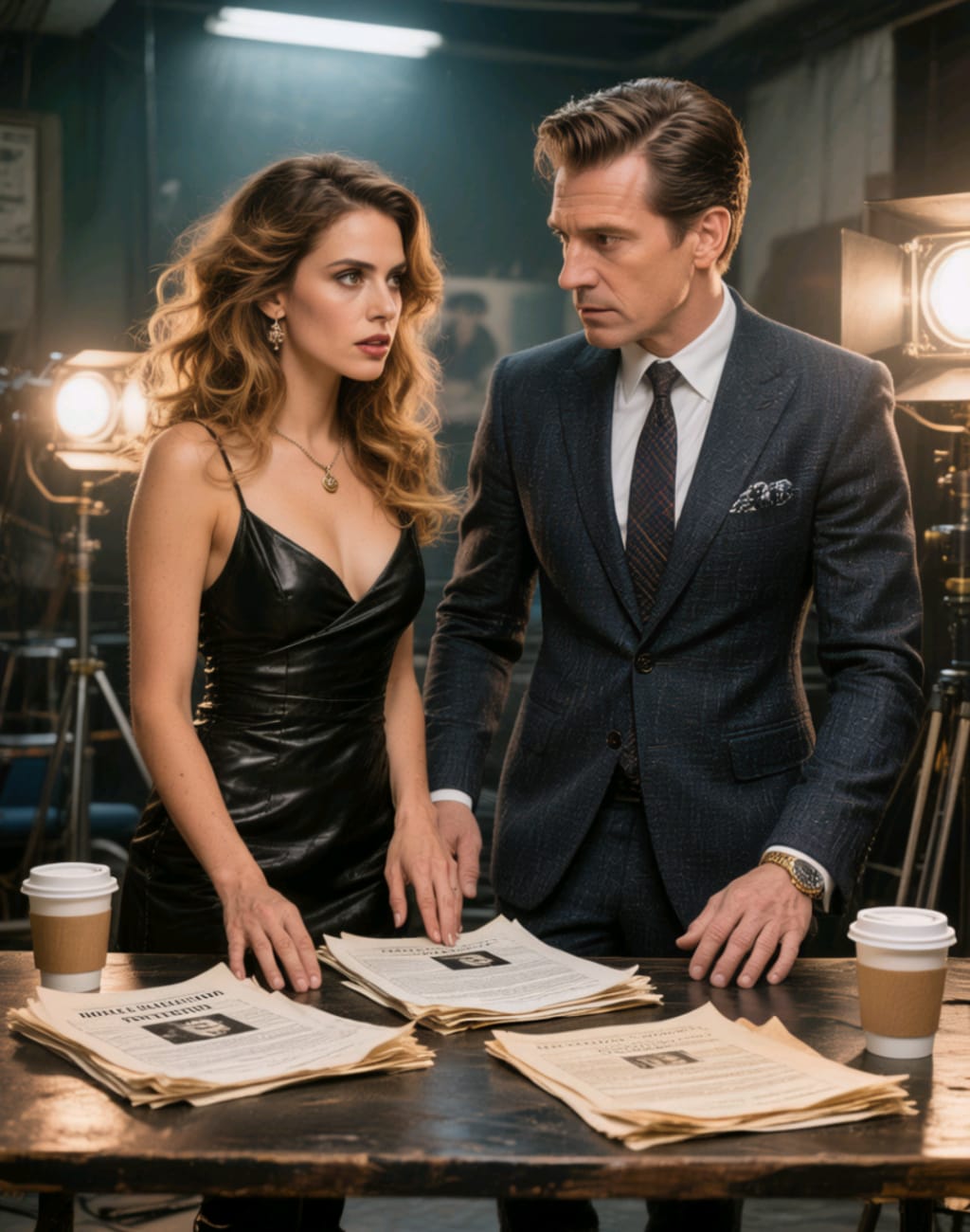
A girl once told me: "Every guy I've met just wants to sleep with me.
I asked: "Why do you think that is?
She shrugged: "I don't know… Maybe because I'm pretty?"
I said: "I see.
She looked at me: "You're different."
I asked: "How so?"
She replied: "You're the first one who only wants to talk to me."
I said: "That sounds like a compliment to me."
She whispered: "But to me, it feels like an insult."
I was confused: "How is notwanting to sleep with you an insult?"
She asked, "I'm pretty, right?"
I nodded.
She continued, "But you only want to talk."
I replied, "Don't you enjoy talking?"
She said, "I do... but maybe in a few minutes."
I teased, "Is thathow you insult someone?"
She played along, "Insult? How?"
I joked, "What about a few hourslater?"
She giggled, "Want to watch a movie?"
I said, "Not exactly. More like starin one."
She gasped, "You're a filmmaker? Can I have a role?"
She took my hand.
I smiled, "Just a role? You're already the lead."
Later, I actually cast her in a film. She played the female lead, a woman of the demimonde.
After the dailies, the producer, Mark, pulled me aside and asked, "Where did you find her? She's not only stunning but a damn good actress."
I noticed his unwavering gaze and said, "You're interested?"
Mark lit a cigar. "I'd like to have a chat with her."
I relayed the message to her, emphasizing, "You have every right to say no. If it's awkward, I can tell him for you."
To my surprise, she replied, "I'm willing to talk with him."
A sense of dread settled in my chest, but I simply said, "Alright. If you need anything, call for me. I'll be right next door, working on the script."
That night, I never heard my name called. Only other sounds drifted through the wall.
I sat by the hotel window, rewriting the script until dawn.
After that night, she still showed up on set punctually. But the easy rapport between us was gone, replaced by nothing but terse, professional directives.
Mark visited the set occasionally and would call her into his room.
I tried to talk to her, but she seemed to be avoiding me.
One evening after filming, I stopped her in the makeup room.
"How have you been lately?" I asked.
"I'm doing well, thank you for discovering me and giving me this opportunity," she replied politely.
I said, "I know how this works, but you don't need to trade anything for it."
She smiled faintly. "You're still such an idealist."
"I've been in this industry longer than you have," I countered.
"In my previous world, everyone knew you had to fight for things. In this world, is it any different?"
With that, she walked past me, leaving a trail of expensive perfume in the air.
That night, she entered the producer's room again.
I spent the night rewriting the script, once more.
And then, I snuffed out the heroine's last, faint hope of redemption.
She would ultimately choose degradation.
An ending more brutal, yet more true to life.
As the film neared completion, the producer, Mark, hosted an intimate dinner under the guise of a "Pre-Celebration for the Upcoming Success." Only the core creative team and a few key investors were invited.
During the meal, an investor with a pronounced paunch—the kind more likely built on vintage Cabernet than cheap beer—leaned over. His eyes glazed with drink, he clapped Mark on the shoulder and slurred, "Mark, your eye for talent is spot-on. She's stunning, and a damn fine actress. For my next project, she gets first look."
A knowing glance passed between Mark and the investor. Mark immediately raised his glass, approached the man, clinked his glass, and downed his drink in a single gulp, a gesture of solidarity and shared understanding. He then leaned in, whispering a few confidential words into the investor's ear.
I excused myself to the restroom, but instead found my way to the terrace, seeking a moment of quiet and a respite from the stifling atmosphere of deal-making and implied transactions.
It wasn't long before she joined me outside. The city lights glittered in the distance, a stark contrast to the shadowy tension that had settled between us.
She stood about five feet away, lighting a slender cigarette.
"The air in there was suffocating," she said.
I nodded.
Suddenly, she asked, "You changed the ending of the script, didn’t you?"
"Could you tell?"
"I felt it. Before, the character seemed to cling to some last shred of dignity. Now, it’s like she’s completely rotted into the ground." She blew a smoke ring.
"Which version feels more real to you?"
"What do you think? Clutching at that pitiful bit of defiance, or rotting into the earth and maybe blooming from it?"
I had no answer.
She stubbed out her cigarette and smiled wryly. "I think the change is better. It suits my essence more, doesn’t it?"
"You can still refuse," I said. "Even now. That investor..."
Her body went still for a fraction of a second, a faint tremor—or perhaps I imagined it.
Then, as if she hadn’t heard a word, she turned and walked back toward the private room.
I didn’t follow. I stayed on the terrace for a few more minutes, alone with the city’s distant hum.
When I returned to the private room, Mark, the producer, was already arm-in-arm with the portly investor, a man named David Wilson, their camaraderie thick enough to cut with a knife. Give it time, and they'd likely be swearing some form of brotherhood.
She sat beside them, a polished smile never leaving her face as she diligently refilled their glasses the moment they neared empty.
Mark spotted me and called out with a loud, liquor-slurred laugh, "What took you so long? Drafting your next award-winning script in there? Get over here and have a drink with Mr. Wilson!"
I picked up a glass and raised it toward David Wilson.
The investor, his face flushed from wine, squinted at me. "Director, damn... that ending change? Brilliant! That's the kind of gritty realism we need! Cheers to that!" He clinked his glass against mine with a force that threatened to shatter both. I downed the contents in one go. The liquor burned, a trail of fire from my throat to my gut.
Mark clapped Wilson on the back. "It's settled, then. David here wants her for the lead in his next project." He gestured toward her. "He's promised resources won't be a problem."
She immediately lifted her glass, leaning forward in a deliberate motion that offered a clear view of her cleavage. "Thank you for your faith, Mr. Wilson," she said, her voice softening into a practiced, gentle tone. "I won't let you down."
The investor's gaze lingered for a fraction too long before he waved a dismissive hand. "Good, good."
At the end of the night, she didn't return to the hotel. Mark and I shared a cab back.
"Worth bringing her along tonight," Mark said, staring out the window at the passing lights. "Landed us another project."
"You're okay with this?" I asked.
He shrugged, a purely pragmatic gesture. "She was never ours to hold onto. I could sense her ambition from the start."
I simply nodded.
"Anyway," he added, the finality clear in his tone. "No one's losing out here."
The film finally wrapped. Mark organized a small wrap party.
I didn't go. I was in the editing suite with the cutter, reviewing footage.
She left with Mark and David Wilson for a private club.
Post-production took less than a month.
Mark, the producer, would occasionally drop by the editing suite to offer his "suggestions." He mentioned in passing that David Wilson, the portly investor, had arranged a personal assistant for her—a detail that hung in the air, unexamined.
When the final cut was ready, Mark organized a private screening before submission, inviting a few key stakeholders from the streaming platforms. As the film played, her face filled the screen—capturing that precise blend of trepidation and fragility of a young woman stepping into a world of compromise. The final scene held on an exceptionally long take of her character walking down a narrow alley, vanishing into the shadows—a visual metaphor for her descent. When the lights came up, the room broke into applause. "Powerful," one of the platform reps remarked. "And the lead actress—perfectly cast. Compelling to watch, and strikingly photogenic." Another added, "This will definitely generate discussion."
Later, over drinks, one of the platform representatives asked me casually, "Where's the lead actress today?" I replied smoothly, "She's tied up with a minor commercial commitment." In truth, she had left earlier with David Wilson. The representative nodded, "We should meet with her sometime." "Absolutely, just say when," I said. After everyone had left, Mark clapped me on the shoulder, his voice buoyant with excitement: "We've done it. This is going to work."
The approval process went smoothly. What came next was the release strategy. As a premiering online film.
our path was straightforward: no major promotional campaign, and no prime homepage placement. However, David Wilson leveraged his connections to secure a publicity opportunity—specifically for her. It was a modest, exclusive interview. That was the first time I saw her after the wrap party.
Her style had become undeniably chic, as if an innate sense of fashion had finally been unlocked. This was especially evident after she had been with David Wilson.
In front of the cameras, we played our parts with practiced, performing a mutual admiration society. She smiled, addressing me as "Director," crediting me for discovering her—for offering her an opportunity when she was lost. She spoke of my professionalism and the immense help I'd been to a newcomer. In turn, I praised her natural freshness, her ethereal beauty, and her raw talent, portraying her as a born actress.
The host turned to her and asked, "How do you view the film's ending?"
She replied, her voice measured, "I believe it's the best possible arrangement. Sometimes, not every struggle leads to salvation. Acknowledging defeat… that, in itself, is a form of truth."
The host then probed, "I heard the ending was modified by the director later on?"
I took the cue. "Yes. To better align with the character's journey and the story's core. To make it feel more… authentic."
She glanced at me briefly but said nothing.
After the event, when only the two of us remained in the green room, I broke the silence.
"You spoke very well up there."
"Just being honest," she said.
"How's the project with Mr. Wilson going?"
"Signed." She cut me off. "It's a supporting role, the fifth female lead. Mark is still the producer on that one."
"Congratulations."
"Thank you. I've been recommending to Mr. Wilson that they still bring you on as the director."
I replied, "Really, that's not necessary."
"Are you sure it's reallynot necessary?" she asked.
I fell silent.
"Don't be so idealistic," she said.
After our film was released, the viewership numbers were decent. But, lacking A-list stars, it didn't make major waves. Still, some people discussed the ending and the character she portrayed. Comments like "Felt so real," "Her acting was superb," and "This film surprised me" popped up. She finally had a recognized work to her name.
Later, she started work on David Wilson's project. Mark, the producer, also moved over to that production.
Only I remained idle. I did not become the director of David Wilson's project. Clearly, she had overestimated her influence. Her word with David Wilson didn't carry as much weight as she might have hoped.
Later, at an obscure, almost unknown film festival, I ran into her again. She was still wearing a gown designed to make an impact, walking the red carpet with practiced ease, then surrounded by a pre-arranged circle of media, handling their questions with polished fluency.
David Wilson, the investor with the pronounced paunch, spotted me and came over. "The director for my current project... let's just say it's not your genre. And frankly, the role requires a certain... thickness I don't think you possess," he said, not unkindly, just stating a business fact.
"I never had much interest in it anyway. I suppose she was just trying to repay a favor, for discovering her back then," I replied.
Wilson gestured toward her, still holding court on the podium. "She's gaining some traction now, her schedule is tightening up. But I've told her—if your new film needs her, she'll make time. If you need investment, you let me know." He offered a smile that was part genuine, part transactional.
I simply smiled back, offering no verbal commitment.
After her interview, she descended from the stage and walked straight toward Wilson. Seeing me standing there, a flicker of surprise—or was it something else?—crossed her face, so brief it was almost imperceptible. It was gone in an instant, replaced by a neutral professionalism as she took her place naturally by Wilson's side.
Wilson gave her exposed back a familiar, proprietary pat. "We were just talking about you. The director's new project. Any interest?"
She looked at me, her expression unreadable. "I'm at the director's disposal."
"The script is still being polished," I said. "If a suitable role emerges, I'll certainly be in touch."
She nodded. "Thank you, Director." The tone was polite, but carried a new, distinct formality. Then, without missing a beat, she added, "If you'll excuse me, I have some friends to attend to." And with that, she left. David Wilson followed in her wake.
A few months later, my new script was finished. During pre-production, Mark, the producer, was still on board. He mentioned her to me, saying, "She's really made it big now. Her quote is thishigh." He gestured with his fingers. "Still planning to ask her?"
"I can't afford her," I replied.
Mark said, "You could call in a personal favor. She owes you."
I shook my head. "She doesn't owe me anything. Forget it. The budget's tight. Let's go with a newcomer."
"Suit yourself," Mark shrugged. "There's no shortage of young, pretty girls wanting a break these days."
During casting, many fresh faces auditioned. I chose a quiet one who seemed very calm. Her name was Vivian, a recent film school graduate with clear, earnest eyes.
Then, a week before filming was set to begin, Mark came to me unexpectedly. "She reached out," he said. "Asked about the new project."
"What did you say?" I asked.
"I told her the lead was cast. She said if there were any cameo roles, she'd do it as a favor—no charge."
"Why?" I asked.
Mark looked at me. "She said she wants to repay a debt."
I thought for a moment. "There's a supporting role, a teacher. Not many scenes. Was scheduled for three days."
"I'll talk to her," Mark said.
The next day, Mark told me she had agreed.
On the day she arrived on set, she drove herself in a Mini Cooper. Dressed simply, with no assistant in sight, she walked over to me. "Director," she said.
I nodded. "Thank you for coming to help."
"It's the least I could do," she replied. Then she found a quiet spot to review the script.
On the final day of shooting her scenes, we were filming the teacher walking in the rain. There were issues—the rain machine was turned on three times, and she walked through the downpour three times, but the shot still wasn't right.
On the fourth take, I saw her suddenly collapse on the monitor. I was the first to rush to her side, kneeling down to lift her up, calling her name.
She came to. As I was urging her to go to the hospital, she finally told me, "It's just my period. The chill got to me. It's fine, I can keep going."
"Why didn't you say anything?" I asked. "We could have rescheduled this."
"It's not a big deal. No need to delay. I'm a professional—I've worked through this before." No amount of persuasion could change her mind. After drinking some hot water, we did a fifth take. Even though it wasn't perfect, I called, "Cut!"
But she herself insisted: "Let's go again."
We filmed another take, and the sixth one indeed yielded the best result.
After the scene, Vivian promptly handed her a towel. "Thank you," she said, taking it. Then she walked over to me. "Director, I have an early flight tomorrow, so I'll take my leave now."
I nodded. "Head back to the hotel and get some rest. You've done great work today."
Before leaving, she turned back and added, "The new actress, Vivian... she's a good choice. There's a real... purity about her."
I didn't respond. Vivian was indeed good and hardworking. But as a film school graduate, her acting sometimes felt formulaic, lacking that raw, untamed quality shepossessed. Consequently, some scenes required numerous takes. I never lost my temper with Vivian, only asked her to try again, to search for a different feeling, to bring something unique to the performance.
One late night on set, perhaps overwhelmed by the pressure, Vivian broke down in tears. I called for a ten-minute break.
She approached me, apologizing, "Director, I'm so sorry."
"It's alright," I said. "This is what acting demands sometimes."
She then asked, her voice tentative, "Are you... very disappointed in me? That I'm not as good as shewas?"
"You can recognize the quality in her performance," I replied.
Vivian nodded. "So you aredisappointed?"
I looked at her. "I have no expectations, hence no disappointment. Just focus on being true to your character."
Vivian seemed to understand, yet not entirely. She nodded again, thoughtfully.
Later, Mark, the producer, visited the set. After reviewing the footage, he pulled me aside. "Her acting is nowhere near as compelling as the previous actress's," he remarked bluntly.
I simply said, "The price tag isn't, either."
Mark grunted in acknowledgment. "Well, we'll make do with what we have."
The next day, Vivian found me. She looked uneasy, her eyes avoiding mine. "Director," she began, her voice hesitant, "Last night, Mr. Mark... he asked me if I was 'free to discuss the script in his room'."
I looked at her, saying nothing, waiting.
She lowered her head. "I... I didn't go."
"Okay," I said.
She said, "Director, I don't think that approach is right."
I replied, "If you feel it's not right, then it's not right."
A visible wave of relief washed over her.
During the subsequent filming, Vivian seemed to have found a new key, her performance improving markedly.
Some time later, at a small industry mixer for online films, I ran into heragain.
It wasn't the quiet Vivian, but Her.
She was on the arm of a man—not the portly investor David Wilson, but a young, stylishly dressed man rumored to be a "second-generation heir" from a family with substantial mineral wealth.
She spotted me, whispered something into the young man's ear, and then walked over alone.
"Director," she began, "how's the new project going?"
"It's manageable. We nearly wrapped up Vivian's parts not long after we finished yours."
"That's good to hear."
"And Mr. Wilson...?" I started to ask.
She cut me off swiftly. "That contract was fulfilled. People must move on to higher ground, don't you think?"
"And how high is this new ground?" I asked.
She smiled. "He's very good to me. The resources are better. My next project will be on a major network. A supporting role, but it's a start."
"Congratulations."
"Thank you."
Then, she suddenly asked, "Did you end up revising the script again on this one? Last-minute changes?"
"No," I said. "I'll see how things develop."
"Don't change it too drastically. Not every newcomer can adapt on the fly like I could back then."
"You really were very good," I acknowledged.
"Was I?" she said with a light laugh. "I've fooled a lot of men."
I remained silent.
In a lower voice, almost a whisper, she added, "To be honest, most of the time, there was no real climax for me. But I always pretended there was. They never once doubted it."
"Why are you telling me this?" I asked.
She smiled faintly and said, "I've only ever told you. Thank you… for that time back then."
I was at a loss for how to respond.
"I should get back to him," she said.
"Alright," I replied.
She turned and walked back toward the second-generation heir, her figure swaying gracefully with each step.
A few days later, Mark, the producer, approached me with news. "David Wilson," he said, lowering his voice, "he's in. Locked up."
"What?" I asked, surprised. "When did that happen?"
"Last month," Mark explained. "His whole project is shut down. The payments for my investment are gone. It's a big mess,the implications are wide-reaching"
"Are you okay?" I asked him.
He gave a wry, pragmatic smile. "Just lost some time and money, that's all. Part of the business."
"And what about her?" I inquired.
Mark shrugged. "She knew about Wilson's troubles before the walls closed in. Cut her losses clean and found a new... patron. The one she's with now has even more clout and resources than Wilson ever did."
It turned out that this "new patron" was the scion from the party, the one rumored to be from a family with substantial mineral wealth.
My new film was released, but it made even smaller ripples than the previous one.
Some commented: "The female lead's performance is still a bit green."
Others wrote: "But the teacher cameo? Her acting was absolutely stunning."
A few noted: "The director's style remains consistent."
Mark, the producer, didn't lose money, but the profits were slim. He said to me, "Next time, let's work with some trending topics, something that has built-in heat."
I simply replied, "Whatever you think."
Vivian later signed with a small agency. I heard she occasionally landed minor supporting roles in web series. Once, she sent me a message saying she was quite content with how things were and thanked me for my "protection" back then.
I replied: "You just stayed true to yourself. That's good. I hope you can hold onto that."
A year passed, and I began developing a new project. It was a niche genre, and securing funding proved extremely difficult. Mark met with several investors, but they all shook their heads, saying it was "not commercial enough," "has no market," and "would be throwing money away."
He told me, "This script of yours is too artistic. You could fund it yourself as a passion project, but getting external investment will be incredibly tough."
Just as I was on the verge of giving up, my phone rang.
It was her.
She arranged to meet me at an exceptionally private club. This time, she arrived alone—no assistant, no male companion.
Her attire was understated, almost severe. "Director," she began, her voice calm, "may I see the script?"
I sent her the electronic copy. She read slowly, meticulously.
After finishing, she was silent for a long moment. Then she looked up. "I want this role."
"You should know," I cautioned, "this project has no backers yet. Without investment, it won't get made. Even if it does, the pay will be low."
"I understand that," she replied. "I'llinvest."
"The subject matter is niche," I continued. "It might not get distribution, or find an audience even if it does. There's a 90% chance you'd lose your investment."
"I know."
"Why?" I asked, genuinely perplexed. "Why this script?"
"Because I love this character," she said, her gaze steady. "She struggles, but in the end, it feels like she manages to grasp something. It reminds me of myself, back then... thinking I could hold onto you, or Mark, or David Wilson."
I shifted uncomfortably. "I see."
"My fee isn't necessary," she offered. "Or, treat it as an equity stake in the film."
I felt compelled to give a final, stark warning. "This could wipe out everything you've earned."
She smiled faintly, a complex, weary expression in her eyes. "Don't look at me like that. I can't act forever. I need to think about my future."
Her performance in the film even garnered recognition from a rather niche art-house award, and she received a nomination from an international artistic award abroad.
When the news reached back home, her profile rose noticeably. The producer, Mark, immediately reached out to several media outlets to stir up publicity. He was ecstatic: "Holy shit! We've hit the jackpot! This is a complete fluke!"
I reminded him, "The film's already finished its run online."
"Are you daft?" he shot back. "With this buzz, we can drive more views, more revenue share! But that's not the main point—it's the nextproject! The next one! I'm already talking to a few big players about your next script. We need to strike while the iron is hot! Get writing! Now they're all kicking themselves for not investing in this one."
"My next script doesn't even have a premise yet," I said.
Mark brushed it off. "Just scribble something down! Anything! As long as we can slot her in. A romance, an art-house piece, a commercial blockbuster—it doesn't matter. Youstay in touch with her. There's a genuine connection there. I've heard several major studios are already making approaches, offering terms that are downright startling."
"You should reach out more her," I suggested. "Your relation with her runs deeper than mine."
Mark waved a dismissive hand. "That? That was just a transaction. Clear-cut, squared away. What we had is different. This hinges on you."
I simply replied, "Understood."
Some time later, she called me unexpectedly. "It all feels a bit... surreal, you know?" she said, her voice contemplative.
"That's normal," I responded.
"There's a television interview tomorrow," she continued. "Will you be there?"
"Me?" I paused, searching for an excuse. "No, I... I have some things to finish up."
She sounded slightly disappointed. "Oh. Okay. Thank you anyway, Director."
"What are you thanking me for?" I asked.
"For writing that script," she said.
"Well, then I should thank you for investing in it and making the film," I countered.
"Let's not talk about that now," she replied, shifting the subject. "We'll talk more after the interview."
I ended up watching her interview. She was remarkably articulate and poised.
The host asked about her understanding of the character.
She reflected for a moment and said, "This character... she once believed that rotting into the earth was her final fate. But perhaps, even from within the earth, something new can grow."
Her words were met with appreciative applause from the audience.
After the interview, we met up. The location she chose was even more upscale than the last time—an intensely private coffee house known for its discretion.
She had lost some weight. A sharp, efficient-looking middle-aged woman accompanied her. She introduced her as her agent, Ms. Hu.
Ms. Hu was polite, but her words carried a distinct tone of appraisal. "Director, I've heard a great deal about you," she began. "Regarding future collaborations, given your unique history with her, we are certainly inclined to prioritize working with you. However, we must also give due consideration to commercial viability and project scale..."
"Thank you," I replied.
She sat quietly beside her agent, taking small, deliberate sips of her tea.
"To be honest," I added, "I don't have any other concrete projects in the pipeline at the moment."
Ms. Hu offered a professional smile. "That's perfectly acceptable. We are prepared to wait for the right opportunity."
Once the business discussion concluded, Ms. Hu excused herself, citing an important phone call, and left the room.
I turned to her and asked, "Are you... adjusting to all this?"
She set her teacup down. "I'm exhausted," she confessed. "Some days, I feel like I speak more lines in these meetings and interviews than I ever did reciting scripts on set. I never imagined that success could be this draining."
I nodded. "That's what fame often entails."
She gave a wry smile. "‘Famous’? Sometimes I wake up in the middle of the night, convinced it's all a dream. I'm terrified that I'll wake up and be back at the beginning, back when I had to offer myself just to get a fifth female lead role."
"It won't happen," I said.
"Who knows?" she replied, her voice dropping. "In this industry, they lift you to the heavens one day and grind you into the mud the next. Everything I have now feels substantial, yet it could all vanish like dust in the wind."
She looked directly at me, her gaze intense. "I don't want to go back there tonight."
I met her eyes, asked no questions, and simply nodded.
I didn't take her to a hotel. Instead, I brought her to my studio. The place was a mess—scripts, storyboard sketches, and books were piled everywhere. I cleared a space for her on the sofa.
"Got a cigarette?" she asked.
I handed her one and lit it for her.
She took a drag and said, "That agent, Ms. Hu, she's new. Very capable, but her language can be... very corporate. Don't mind it." She was referring to the shrewd middle-aged woman who now managed her career.
I didn'tt respond, simply poured her a glass of water.
"I'm successful now," she continued, watching the smoke curl. "And you... you still just want to talk?"
"Whether you're famous or not, you're still you," I said.
She exhaled slowly. "You know, that night... outside Mark's room, I was secretly hoping you'd burst in."
My hand stilled.
"But you didn't," she said, her tone matter-of-fact yet laced with a deep, old hurt. "You were rewriting the script."
I remained silent, the weight of her unspoken accusation hanging between us.
"That's when I understood," she continued. "We were never on the same path. You were always the one watching the show from outside the window. And I... I was always the performer inside the house."
"I had no right to interfere with your choices," I finally said, the words feeling inadequate.
"You're right. You had no right. So I stopped expecting anyone to ever burst in for me."
There was nothing more to say.
Later, she added, almost as a challenge, a test, or perhaps a final offering, "Now I'm in your room. You can do whatever you want."
She eventually fell asleep on the sofa. I covered her with a blanket and left her to her dreams.
The next morning, her agent, Ms. Hu, called. She answered the phone, her voice calm and practiced. "Ms. Hu, I was at a friend's place last night, discussing a potential new script. We talked late, so I just stayed over." She listened for a moment before continuing, "Yes, I know. I won't be late for today's schedule. Fine, I'll send you the address. Come pick me up."
After hanging up, she let out a quiet sigh. "Nowadays, even staying out overnight requires a formal excuse," she remarked, a hint of weariness in her tone.
Before leaving, she paused at the doorway and looked back at me. "Director," she said, "promise me you'll let me see your next script first. Okay?"
I met her gaze and gave a simple nod. "Okay."
Then she was gone.
Mark, the producer, moved with remarkable speed. He quickly secured new investment. The backer this time was a significant figure, originally in the furniture manufacturing industry, looking to diversify into film and television. He sent his son, a young man named Julian, to represent their interests. Mark arranged a dinner to introduce us.
Over the meal, Julian leaned in enthusiastically. "Director, I saw your last film. Brilliant! Especially that female lead—what's her name? Right, her! She was phenomenal. That raw energy she has is just... incredible. For this new project, you absolutely have to use her again!"
Mark, the producer, quickly chimed in with an ingratiating smile, "Absolutely, no question about it!" while subtly kicking me under the table.
I turned to the young investor, Julian, and said with measured professionalism, "The script is still in the early conceptual stage. Ultimately, casting decisions will need to consider both scheduling conflicts and, more importantly, artistic suitability for the roles."
Julian waved his hand dismissively, his enthusiasm undimmed. "Scheduling? That's not a real problem! Anything that can be solved with money isn't actually a problem! I'm telling you, she's perfect for it!"
After the dinner concluded, Mark pulled me aside. "See that? He specifically asked for her. This is perfect. The investor's checkbook is wide open. You need to get that script finalized ASAP. Let's secure this funding!"
Struggling for inspiration, I forced myself to write, only to repeatedly scrap drafts, deeply dissatisfied with the direction.
Later, I'm not sure how Mark managed the communication, but she actually took the initiative to arrange a dinner, inviting me, Mark, and Julian.
Throughout the meal, Julian's gaze barely left her, clearly captivated. She handled the attention with impeccable poise, masterfully navigating the conversation and setting perfect boundaries.
When she excused herself to the restroom, Julian leaned closer to me, the scent of wine on his breath. "Director," he said, his voice low and confident, "don't you worry. This film? I'm definitely investing. For her? Absolutely."
I simply offered a faint smile, choosing to remain silent.
After she returned to the table, the young investor, Julian, became even more attentive.
As the evening wound down, Julian offered to drive her home.
She glanced briefly in my direction, then offered him a polished smile. "That would be lovely, Julian. Thank you," she agreed.
Once his car had disappeared from view, Mark, the producer, clapped his hands together in satisfaction. " It's done!"
"Did you make it clear to her?" I asked. "That the investor specifically requested her?"
Mark shrugged, a knowing look on his face. "Did it really need spelling out? Some things never change. She understands how this game is played. Sometimes, I think she's the most clear-eyed one among us."
Back at my desk, the new script fought me every step of the way. I was trying to write about a successful woman who loses and then rediscovers herself, but the words felt hollow and untrue.
Even Mark, after reading the first draft, shook his head in disapproval. "It lacks an edge! The conflict isn't sharp enough! You need to write something grittier, more real. For her character—someone who learns to navigate the world of powerful men, using her strengths to secure resources and ultimately climb to the top. That'swhat feels authentic now."
I knew this version of "authentic" was precisely the "reality" Julian wanted to see.
I revised the script again and sent it to her.
She called me after reading it. Her voice was calm but direct. "This isn't the story you wanted to tell."
I didn't argue.
"If this puts you in a difficult position," she continued, "I can turn it down."
I started, "About the investor..."
She cut me off calmly, "Let me handle Julian. I won't perform a role that even you don't believe in."
She did talk to him, and she convinced him. Clearly, her word carried significant weight with Julian.
Instead of pulling the investment, Julian simply told Mark, the producer, "Let's proceed according to the director's and her vision. I trust their artistic judgment."
When Mark came back to me, he remarked with a mix of admiration and caution, "Her methods are becoming remarkably sophisticated."
Finally, unshackled, I wrote a story about "searching."
It was about a woman who, after achieving material comfort, begins to search for the fragments she had lost in life. The process is confusing, painful, even absurd and ridiculous. But what she finds in the end is not a definitive answer, but the courage to continue searching.
After reading the script, she texted back: "This is good."
With ample funding, the production proceeded smoothly.
Julian frequently visited the set. He even entered her trailer while she was resting.
Once, he presented her with a set of car keys to a sports car.
She accepted them with a smile and said, "Thank you, Julian. This is far too generous. I'd be too nervous to drive it. Let me keep it safe for you for now."
Mark whispered to me, "See that? That's what real skill looks like. Before, she had to bend. Now, she holds the reins."
After an emotionally draining scene, she stayed in character for a long time, sitting alone in a corner.
I walked over and handed her a bottle of water.
After taking a sip, she said, "Sometimes I feel like every character I play is just a different facet of myself. Pleasing men, using them, struggling, falling, hoping, searching... Each one feels like me, yet none of them are truly me."
"That's the actor's life," I said.
She looked up at me and asked, "And what about you? How much of the female leads in your scripts is a reflection of me?"
I paused, then replied, "All of them, and none of them. They are fictions."
She smiled faintly and said no more.
Before the film's release, Julian launched a massive promotional campaign.
Both she and I were thrust into the spotlight, pushed together onto several talk shows.
In front of the cameras, we were the mutually admiring director and actor.
During a televised interview, the host circled back to a familiar topic. "It's well-known that you and the director have collaborated multiple times and share a very close private friendship. There were even rumors at one point that you two were..."
She swiftly but gracefully interrupted with a practiced smile. "The director is someone I deeply respect—a mentor and a friend. He has witnessed my entire journey in this industry, and I am profoundly grateful to him. As for those rumors," she continued, her tone light but firm, "they are just that—rumors."
After the program wrapped up, she found a moment alone with me. "I hope you didn't mind me saying that," she said, a hint of genuine inquiry beneath her composed exterior.
"Not at all. It was the perfect response," I reassured her.
"You have to understand," she began, her voice dropping slightly. "Back then, my entire value was tied to... that. When you rejected that, it felt like you were rejecting me entirely. That's why I said it was an insult. But it's different now. I have the work—the roles, the critical acclaim, the commercial standing. No one can dismiss me anymore."
"You've done it," I said simply.
"Yes," she replied, a complex mix of triumph and weariness in her eyes. "I did. By any means necessary."
Upon its release, the film gained significant traction, with viewership soaring. Her portrayal of a woman "searching" earned particular praise, with media outlets celebrating her "complete transformation from a mere screen presence to a formidable actress."
However, the triumph was short-lived. An explosive post suddenly went viral. Its title was a gut punch: "Rising A-List Actress XXX's Sordid Past: The 'Escort' Years Exposed, with a Crescent-Moon Birthmark as Proof!"
The post was brutally detailed, alleging her involvement in the sex work industry years ago. It named cities, dates, and even aliases she was said to have used. The author claimed she had a distinctive crescent-moon-shaped birthmark on her back and vowed to release a secretly recorded video as "irrefutable proof."
The internet erupted. The comments section became a digital feeding frenzy:
"No wonder her portrayal of a sex worker was so authentic in her first film—art imitating life, I guess."
"Explains the 'great' acting—plenty of real-world experience."
"Good riddance! Actors with such a disgraceful past should be canceled!"
"A birthmark on her back? Release the video! We need proof!"
The online comments section erupted into a cesspool of vitriol and speculation. "She makes me sick! But is this tea actually legit?" one user commented, using the slang "tea" for gossip. Another added, "Maybe the director was one of her clients back in the day?"
A handful of voices rose in her defense, though they were quickly drowned out: "This has to be a smear campaign. A birthmark on her back? Could've been seen in a fitting room." Another pleaded, "Why can't we just focus on her work?" and "That so-called 'proof' video could easily be a deepfake."
But the mob had already made up its mind.
Mark, the producer, burst into my office, his face flushed with panic. "What the actual fuck?! Is this where you found her?" he yelled, not waiting for an answer. He continued his tirade, "You're out of your goddamn mind, building up a fucking whoreas our leading lady! Jesus Christ, it's over. We're finished!"
I remained silent, letting him vent.
He wasn't done. "That rich kid Julian? He's having a full-blown meltdown! He's probably on his way to get tested for every STD under the sun right now, and fuck, maybe I should too!"
I finally spoke, my voice calm. "Maybe that's why her performance was so convincing."
"Convincing?!" he shot back. "And what about this 'leaked video' they're threatening to release? How the hell do we explain that away if it surfaces? 'It's just a rumor' won't cut it then!"
I said, "It's a malicious AI-generated deepfake. A targeted smear campaign."
He cursed, "What the f**k!"
Her agent, Ms. Hu, employed a PR strategy that ironically mirrored the attack itself, using a combination of targeted leaks and counter-narratives, some arguably in the gray area of truth, to try and "cool down" the situation
. The focus was on disputing the source and highlighting potential digital manipulation.
The heat from the scandal finally began to subside, slightly.
However, a few women from her past—perhaps former acquaintances or rivals she'd outshone—seized the moment, driven by jealousy, to make vague, anonymous posts online. Their "revelations," though lacking concrete evidence, further muddied the waters and worsened the situation
.
I dialed her number. It was switched off.
A sense of dread washed over me.
Just then, my phone rang. It was Julian.
"I expect an explanation," he said, his voice cold and controlled. "Did you know about this? All along?"
I remained silent.
He gave a short, bitter laugh. "So that's a yes. I've written off this investment. But I expect her... to personally account for this."
The line went dead.
Suddenly, there was a knock at my studio door.
I opened it. She was standing there.
She stood outside my door, a face mask concealing her features. I let her in without a word.
"I turned my phone off," she said, her voice tired but steady. "The pressure on Ms. Hu became too much. I told her to stand down for now." She paused, looking directly at me. "I came to apologize."
"The apology should be mine," I replied. "Are you angry with me? I was the one who pulled you into this world."
She shook her head slowly.
"What are you going to do?" I asked.
"I don't know," she admitted, a hint of exhaustion breaking through her composure. "This scenario wasn't in any of Ms. Hu's contingency plans. The source... it's someone from that time. It's practically a verified account. I never thought it would be an 'acquaintance' from back then." She let out a short, humorless breath. "Maybe my recent success was too much, blocking someone's path. Or maybe someone just saw a chance to make some quick cash by selling me out."
"Is there anything I can do?" I asked.
Her eyes showed a flicker of surprise. "You'd still help me?"
I simply nodded.
"I won't confirm it, and I won't deny it," she stated, a new resolve hardening her tone. "That person from the past is dead. Who I am now is an actress. They can skin me alive, dissect every detail, but they can't take the roles I've played. They can't take the craft I've built. The worst they can do is strip away the accolades... force me back to the beginning."
Back to the person she was when we first met?The thought hung in the air between us.
"Director," she said, her voice softer now, "can I stay here tonight?"
I nodded again.
This time, there were no long conversations. This time, I just held her, leading her to the sofa where she finally, completely, broke down.
About the Creator
Keep reading
More stories from writers in Fiction and other communities.
Miss Persephone's Manual to a Seemingly Ordinary Life
Miss Persephone was found at the dining table, her blue eyes swollen, her tears arriving and retreating like the tides of the ocean. Earlier that day, her family had visited her in the retirement home where she had lived for eight years. It was her eightieth birthday.
By Imola Tóth6 days ago in Fiction
Center Stage with Paul Stewart
*** I'm keen to republish the interviews I did for my series with Vocal creators. It's been a few years and I thought it might be nice to revisit these wonderful conversations. I'll be releasing them one at a time for a few weeks/months.
By Heather Hubler6 days ago in Interview



Comments
There are no comments for this story
Be the first to respond and start the conversation.