
The Shepherd’s Lantern
A Beacon of Faith in the Wilderness

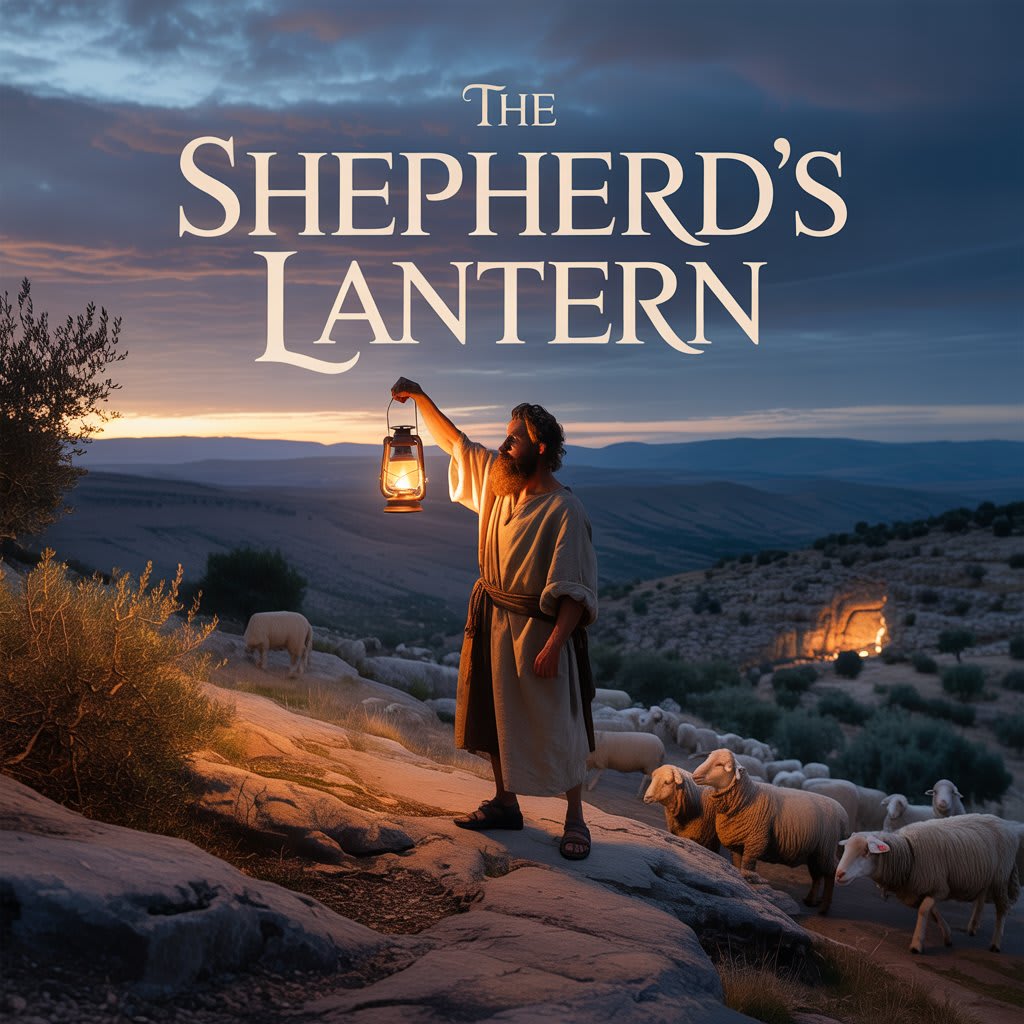
The Shepherd’s LanternIn the shadow of the Judean hills, where the sun dipped low and painted the sky with hues of amber and crimson, there lived a young shepherd named Eliam. His village, Bethar, was a cluster of stone houses nestled between olive groves and rocky slopes, a place where the people clung to the old ways, their lives shaped by the rhythms of the seasons and the words of the sacred scrolls. Eliam was no ordinary shepherd. Though his hands were calloused from guiding his flock and his tunic worn from years of toil, his heart burned with questions—questions about the God of Abraham, Isaac, and Jacob, whose name was whispered in awe during the village’s gatherings.Eliam’s father, Amos, had been a scribe before age and infirmity stole his strength. From him, Eliam learned the stories of creation, the flood, and the covenant. But one tale stirred him above all: the promise of a light that would guide the lost, a savior who would mend the brokenness of the world. Eliam longed to understand this promise, to see it with his own eyes. Yet, in Bethar, life was hard, and hope often felt like a distant star—beautiful but unreachable.One evening, as Eliam led his flock back from the high pastures, a strange wind stirred the air. It was not the cool breeze of dusk but a warm, pulsing gust that seemed to carry a voice, faint yet clear. “Eliam,” it called, “take your lantern and follow.” Startled, he looked around, but saw only the silhouettes of his sheep against the fading light. His lantern, a simple clay vessel with a wick fed by olive oil, hung from his staff. It was unlit, for he knew the paths well enough to walk them in darkness. Yet the voice persisted, urgent and undeniable.Trembling, Eliam kindled the lantern. Its flame flickered to life, casting a golden glow that seemed brighter than usual, as if infused with a strange vitality. The light stretched beyond the rocky path, illuminating a trail he had never seen before—a narrow track winding into the wilderness. His heart pounded. Should he leave his flock? Should he ignore the voice? But something within him, a spark of faith or perhaps desperation, urged him forward. He tethered his sheep near a spring and set out, the lantern’s glow his only guide.The path led him through valleys where shadows clung like damp cloth and over ridges where the stars seemed close enough to touch. Hours passed, or perhaps days—time seemed to blur under the lantern’s steady light. At last, he came to a cave, its mouth yawning like the jaws of a great beast. The voice spoke again: “Enter, Eliam, and see.” Clutching his lantern, he stepped inside.The cave was vast, its walls glittering with veins of crystal that caught the lantern’s light and sent it dancing in a thousand directions. At the center stood a man, robed in white, his face radiant yet kind, like a father gazing upon a beloved son. “Eliam,” the man said, “you have sought the light, and it has led you here. But the light is not yours alone. It is for all who wander in darkness.”Eliam’s voice trembled. “Who are you, my lord? And why have you called me, a mere shepherd?”The man smiled. “I am a messenger of the Most High. You were called because your heart is open, though it is burdened with doubt. The world is heavy with sorrow, and many have forgotten the promise. You will carry this light back to them.”Eliam looked at his lantern, its flame still burning despite the long journey. “This light?” he asked. “It is but oil and wick. How can it guide anyone?”The messenger placed a hand on Eliam’s shoulder. “The light is not in the lantern, but in you. The oil is your faith, the wick your deeds, and the flame the love you bear for others. Carry it boldly, and it will not fail.”The cave began to fade, the crystals dissolving into mist, and Eliam found himself standing once more in the hills above Bethar. The lantern still burned, its light unchanged. But now, he felt different—stronger, as if a fire had kindled within him. He returned to his village, expecting to find it as he had left it: weary, divided, clinging to survival. Instead, he saw it anew. The people, though poor, were his kin; their struggles, his own. He began to share the light, not with grand speeches but with small acts—tending to a sick child, sharing his meager bread, listening to the sorrows of the elderly.Word of Eliam’s kindness spread. Villagers who once quarreled began to gather, drawn by the warmth of his presence. They spoke of the old stories, of the promise, and their hope rekindled. One night, as they sat beneath the stars, an old woman named Miriam took Eliam’s hand. “You have brought us light, young shepherd,” she said. “Not the kind that blinds, but the kind that shows the way.”Eliam thought of the cave, the messenger, and the voice. He realized the light was not his to keep but to give. Years passed, and Bethar flourished—not in wealth, but in unity and love. Eliam grew old, his hair silvered, but his lantern never dimmed. When he died, the village mourned, yet they did not despair. For the light he carried had taken root in their hearts, passed from one to another like a flame shared among torches.And so, the story of Eliam, the shepherd with the lantern, became a tale told across generations, a reminder that the light of faith, kindled by love, could guide even the humblest soul to change the world.
About the Creator
Enayat
Start writing...
The Sun Who Envied The Moon
Do you ever wish you were like someone else? Wish you had that dream life, that dream car, that loving family? I wish I was like the moon, she sees the real side of people, when humans are at their most vulnerable they turn to the moon like an old friend. People only talk to me when they’re “happy” but usually they are just faking it.
By Christian Sancheza day ago in Fiction



Comments
There are no comments for this story
Be the first to respond and start the conversation.