
The Shape of the Thing
When you believe in something impossible long enough, it believes back.

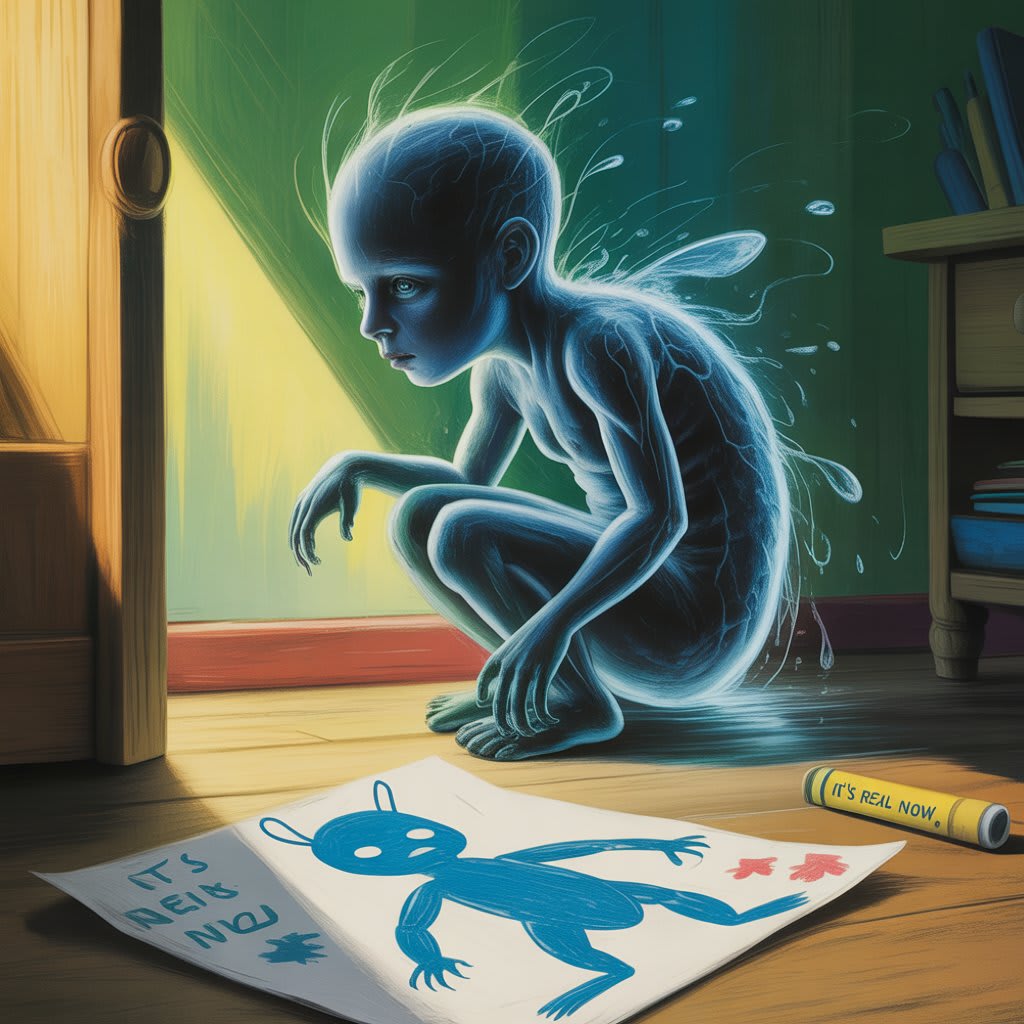
Elliot first drew the creature when he was six.
It was supposed to be a simple art project. His teacher, Miss Carrow, had asked the class to draw their imaginary friends. Most kids sketched knights or fairies, monsters with toothy grins and candy-colored wings. Elliot’s paper, by contrast, was quiet. It showed a corner of his room, scribbled in grayscale, with a crooked figure crouched in the shadows beside his toy chest. He’d labeled it in heavy crayon: The Shape of the Thing.
Miss Carrow asked what it was. Elliot simply said, “It watches me sleep.”
The drawing went on the classroom wall for a week, then into his backpack, then into a pile of childhood debris in the attic. Life moved on. The creature, as far as Elliot was concerned, stayed behind.
Eighteen years later, Elliot returned to his childhood home after his mother’s death.
He’d been living in the city, pushing pixels for a game studio, designing creatures that lived in worlds with rigid rules: hit points, spawn timers, scripted dialogue. There, nothing was truly unreal—just unrealized. But now he was back in the house where nothing made sense, where the walls creaked in answer to your questions, and the attic door never stayed closed.
The funeral had been small. His mother had few friends. No other family. After the guests left and the casserole dishes had been scraped clean, Elliot found himself wandering the halls of the house like a ghost who had outlived his haunting.
He entered the attic on the third night.
Dust thick as ash lay over boxes and broken furniture. The light bulb flickered with protest. Mice scattered in the corners. And then he saw it: the old art portfolio, sagging under its own weight. He flipped through water-warped paper and crayon drawings of suns, trees, robots. Then he found it.
The drawing.
The corner of his room. The crooked figure. The words: The Shape of the Thing.
He stared at it for a long time.
It stared back.
That night, the dreams returned.
Elliot hadn’t remembered them in years, but now they rushed back with the suffocating density of steam. He was back in his childhood bed, the room dark except for a nightlight shaped like a smiling moon. The shadows in the corner pulsed. Something crouched there, slow-breathing. Watching. Not with eyes. With attention.
When he woke, his bedroom was cold. The air felt disturbed, as though someone had moved through it seconds before. He looked to the corner. Nothing.
But the nightlight was on. The one he hadn’t used in over two decades. The one he didn’t even remember bringing out of storage.
He began hearing sounds.
The creak of floorboards under careful weight. The hush of a breath held too long. The flickering edge of a shadow moving just as he turned his head.
One night, he stood in front of the mirror and said out loud:
"You’re not real."
He felt the house exhale.
The next morning, a crack appeared in the mirror.
He started researching. Obsessively. Not just folklore or psychology, but fringe science, memory studies, dream analysis. He even contacted a professor at the university who specialized in pareidolia—the mind’s tendency to see patterns, especially faces, where none exist.
“Childhood hallucinations aren’t uncommon,” the professor told him. “But the interesting thing isn’t the seeing—it’s the believing. The brain records emotion stronger than fact. If the feeling was real, it doesn’t matter if the stimulus wasn’t.”
“But can a thought,” Elliot asked, “leave a mark?”
The professor laughed. “Ideas change lives. Sometimes they change worlds.”
That night, Elliot dreamed again. But this time, he wasn’t a child.
He stood in his current body, adult and aware, facing the corner of the old bedroom. The Shape was there. Shifting. Glass and mist, suggestion and mass. It whispered not with sound but implication:
You remembered me.
“I forgot you.”
But I never left. You stopped looking.
“What do you want?”
The same thing you gave me. Attention. Belief. Shape.
When he woke, he found footprints. Bare. Damp. Leading from the corner to his bed.
Over the following week, the boundaries between dream and waking life dissolved. He saw it in the supermarket mirror, standing behind him. In the reflection of his phone when the screen went black. In the patterns of frost on his window.
He tried to ignore it.
It grew stronger.
He tried to confront it.
It laughed—a dry, brittle sound like leaves crushed underfoot.
He tried to leave.
But the roads out of town twisted. GPS spun in loops. He’d drive for hours only to find himself passing the same broken billboard with peeling paint: "You Are Always Here."
He realized something then. The Shape wasn’t bound to the house. It was bound to him.
More precisely, to his belief.
Like a story that grows each time it’s told. Like a rumor that becomes truth through repetition. The Shape of the Thing had no power until he gave it a name. A place. A shape.
And now, it was hungry.
Elliot began building a cage.
Not a physical one—a cognitive one. He mapped his mind like code. Routines. Mantras. Meditations. Rules of reality. He would reprogram the pathways that led to belief. He would create firewalls against imagination.
He slept with a metronome ticking logic into his brain. He wrote post-it notes and stuck them to every mirror: This is real. That is not.
He recited physics formulas when he felt it approach.
And slowly, the Shape began to wither.
It appeared less frequently. Its edges frayed. Its presence grew thin, like fog in morning light.
On the 30th night, Elliot dreamed one last time.
The bedroom. The corner. The creature.
I was real.
“No,” Elliot said, “you were believed.”
Same thing.
“Not anymore.”
What will you do without me?
“Live.”
The Shape shuddered. Its limbs collapsed inward. It folded like paper. It burned like memory. And then—
nothing.
Elliot moved out the next day. Sold the house. Changed cities. Bought a cat. Learned to laugh again.
He kept the drawing, though. Framed it. Hung it on his office wall.
A reminder.
Not of what he’d seen.
But of what he could survive.
About the Creator
AFTAB KHAN
SUBSCRIBE ME AND READ STORY
Storyteller at heart, writing to inspire, inform, and spark conversation. Exploring ideas one word at a time.
Writing truths, weaving dreams — one story at a time.
From imagination to reality
Keep reading
More stories from AFTAB KHAN and writers in Fiction and other communities.
Everything Looks Better From Far Away
The cabin sat halfway up the mountain, perfectly placed at the edge of a cliff that overlooked the valley below. From the balcony, you could see the river winding like silver ribbon through the trees. The sun rose behind the eastern ridge and set in soft amber over the lake. It was a place photographers hiked miles to find — a place influencers posted and poets dreamed of.
By AFTAB KHAN7 months ago in Fiction
Lightning Never Strikes Twice
The distant rumble, the sudden deluge, the crescendo of sound, the flash of light, the explosive energy — it never gets old. I became an amateur storm chaser about two years ago. My wife, Cindy suggested it. Sort of. She said, "Alex, you know this cancer is killing me. I've come to terms with that, but you're smothering me. Go join a band, write a book, or become a storm chaser, for all I care. I love you, but you need a hobby."
By Julie Lacksonen6 days ago in Fiction
What Came First, Chicken Or Egg
What Came First What came first, the chicken or the egg? It is an old question, worn smooth by centuries of mouths repeating it, yet it still sits in the hand like a stone you cannot throw away. I have carried it with me since childhood. It followed me through fields, through classrooms, through quiet kitchens where steam rose from cups and the clock ticked like a patient witness.
By George’s Girl 2026 4 days ago in Fiction
Who is your "Person"?
It's important to recognize that you cannot go through life as easily on your own. My name is Elizabeth and I'm a survivor of child abuse and horrific trauma. Healing from trauma is not a quick fix and recognizing that it will take time, is part of the struggle.
By Elizabeth Woods3 days ago in Psyche




Comments
There are no comments for this story
Be the first to respond and start the conversation.