
The Sepia Timekeeper
Some memories aren’t meant to be remembered.

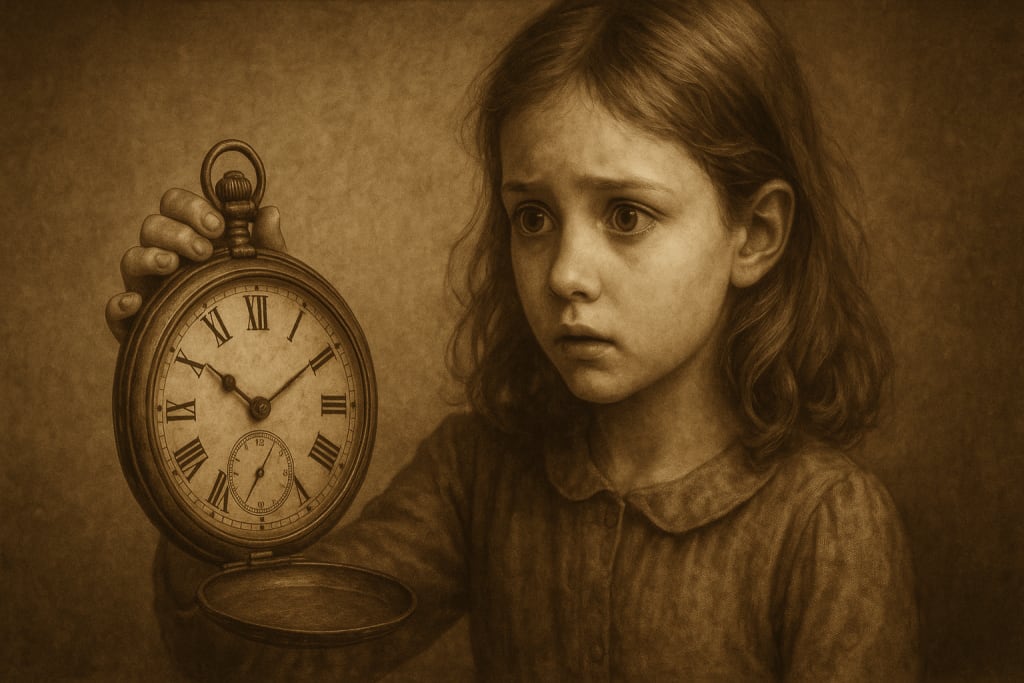
The attic had always been off-limits.
Clara had grown up hearing that command from her grandmother every time she visited the towering Victorian home. “Old things up there,” Grandma would say, eyes glassy, her voice fading off like a radio losing signal. “Things that don’t need remembering.”
But after her grandmother’s passing, the house became Clara’s. Now eighteen and navigating grief like fog on a winter morning, she found herself drawn to the one room she’d never entered.
The attic groaned as she pulled down the ladder.
Dust swirled like ghosts. The air was stale with secrets. Beneath moth-eaten trunks and yellowed photo albums sat a small mahogany box, its polished finish oddly out of place among the relics.
Inside lay a pocket watch.
It was large, bronze, and warm to the touch—too warm. Roman numerals danced around the edge of the face, the minute and hour hands frozen at 4:17. A tiny inscription on the back read:
“To know the past is to risk becoming it.”
Clara hesitated, then wound the crown.
The attic vanished.
She stood in a room bathed in sepia tones. Shadows stretched longer than they should. Everything had the worn hue of an old photograph—brown-gold light spilling across lace curtains, a woman humming softly as she mended a shirt, a cat asleep by the fire.
Clara’s mouth opened, but no sound escaped. She was invisible, untouchable. A visitor.
This wasn’t her memory. But it felt like family.
Every turn of the pocket watch dropped her somewhere new.
A summer picnic in 1932. A wedding in 1897. A boy crying under a lamppost, clutching a letter he couldn’t send.
Strangers, yet oddly familiar. As if the watch filtered the past through her own bloodline.
Clara became addicted to the glimpses. Hours passed unnoticed as she traveled back—again and again—into moments lost to time.
But one day, something changed.
She clicked the crown and landed in a dim study, walls lined with books, a fire crackling. A man hunched over a desk, writing furiously.
Then he looked up.
Right at her.
“You shouldn’t be here,” he said.
His voice echoed—too loud, too clear. His eyes were bottomless.
Clara tried to rewind the watch. It resisted.
“Every visitor becomes a part of what they see,” he said. “Eventually.”
The room spun. Her breath caught. Then she was back in the attic, the watch still ticking.
After that, the memories turned darker.
She saw people arguing, screaming, vanishing. She felt panic, despair. Shadows stretched too far and followed her even after she shut the watch.
Worse—they began to notice her.
A little girl stared directly at her from a 1904 birthday party and whispered, “We remember you.”
A soldier saluted her as he marched to war.
A woman with her face—the same face—smiled as she dropped a bloodied knife onto the floor of a candlelit kitchen.
Clara recoiled.
She stopped using the watch.
But the ticking never stopped.
Her reflection began to glitch. In mirrors, she sometimes wore someone else’s clothes—someone from the past. She’d see smudges on her skin that looked like ink or soot. Once, her left hand appeared bruised and aged, only to return to normal seconds later.
She began dreaming in sepia.
Her journals filled themselves with names she didn’t know and sketches she couldn’t remember drawing—old houses, faces, gravestones, clocks.
The watch would disappear from its box and appear beside her pillow.
Desperate, she took it to an antique dealer downtown.
The man turned pale when he saw it. “Where did you find this?”
“In my grandmother’s attic.”
He shook his head. “These were never meant to leave the bloodline. These were… containment tools.”
“For what?”
“For memory. For guilt. For spirits tied to unresolved stories. They weren’t meant to explore. They were meant to trap things.”
Clara stared at him. “What happens if I keep using it?”
He paused. Then quietly said, “You won’t come back whole.”
Clara tried burning the watch.
It didn’t even heat up.
She tried burying it in the forest. It was back on her dresser by morning.
Finally, she climbed into the attic one last time.
The box was waiting.
The watch ticked, faster than ever, like a heartbeat racing toward collapse.
She picked it up.
“I’m not afraid of you,” she whispered.
But she was.
She wound the crown.
This time she landed in a hospital room—faded walls, buzzing lights, and her grandmother as a young woman, lying in bed, clutching the same watch in trembling fingers.
Clara stepped forward.
“Grandma?” she whispered.
The woman’s eyes flicked toward her. “I hoped it wouldn’t find you,” she said softly. “But I knew it would.”
“Why didn’t you destroy it?”
“You can’t destroy what binds time. You can only pass it on.”
The room dissolved around her.
And Clara understood: the watch was never a gift.
It was a prison.
A cycle.
And now, she was the keeper.
They never found her body. The attic was searched, but nothing out of the ordinary was discovered. Only an old watch in a velvet box, ticking softly, waiting for the next curious hand.
And if you listen closely on a quiet day, the house hums—not with the sound of time passing, but with time repeating.
Forever.
About the Creator
Muhammad Hamza
Law student with a passion for writing on geopolitics, law, and world affairs. I break down complex topics into clear, engaging stories that inform and inspire. Exploring how law and power shape our global narrative.
Keep reading
More stories from Muhammad Hamza and writers in Fiction and other communities.
The Planet Where Everyone’s Your Ex
It all started with a smoothie and a minor asteroid field. I should have known not to fly after guzzling a Strawberry Spirulina Disaster from Galaxy Smoothiez™, but I was late for a cargo run and figured: “What’s the worst that could happen?” Spoiler: total ship failure, emergency landing, and stumbling into the single weirdest planet I’ve ever encountered.
By Muhammad Hamza6 months ago in Humor
Gravitational Pull and the Moon
"That's an amazingly astute observation. I couldn't have said it better myself." "Yeah, but like — just because I can reach that conclusion logically doesn’t mean I can feel it. You know? Like my emotions are on the other side of the planet from me. No, they're on the fucking moon, and I'm here, and my logic means nothing at all because I can't get myself to feel what I know, and there's no oxygen where my emotions live, and I'm suffocating."
By Mallory Rose7 days ago in Fiction




Comments
There are no comments for this story
Be the first to respond and start the conversation.