
The Room with No Mirrors – Deep Psychological Story (Narration for YouTube)
“The Room with No Mirrors”

They told me memory can’t lie.
But after what happened in Room 27… I’m not so sure.
I was 29 when I joined the clinical study at the Mindwell Institute — a new research project on “visual memory reconstruction.”
They paid volunteers to live inside the facility for a month, take daily cognitive tests, and describe what they remembered from certain images.
Simple enough.
Until they locked me in that room.
The facility was quiet — all white walls, no clocks, no windows. They said it helped “reset perception.”
My room, Number 27, was small but clean: a bed, a desk, a single lamp, and something strange — no mirrors.
None in the bathroom, none on the walls.
When I asked the technician, he just smiled.
“Mirrors interfere with recall patterns.”
That didn’t make sense, but I didn’t push it.
Each morning, I’d be shown a series of images on a screen.
A field of sunflowers.
A girl standing on a bridge.
A burning house.
Then they’d ask me to describe what I remembered — colors, faces, sounds.
At first, it was easy.
But by day five, I started remembering more than they showed me.
I could hear sounds in the images. Smell smoke.
Sometimes, when I closed my eyes, the pictures moved.
That’s when the dreams started.
In one, I was standing in a hallway of mirrors.
Each reflection was me — but slightly wrong.
One smiled when I didn’t.
One blinked twice as fast.
And one, at the end of the hall, whispered my name.
When I woke up, the technician was standing in my room, writing notes.
He smiled. “You’re progressing.”
Progressing into what, I didn’t know.
But every day, the images got darker.
Day 7: a man sitting in a chair, his eyes covered.
Day 8: a bloodstained door.
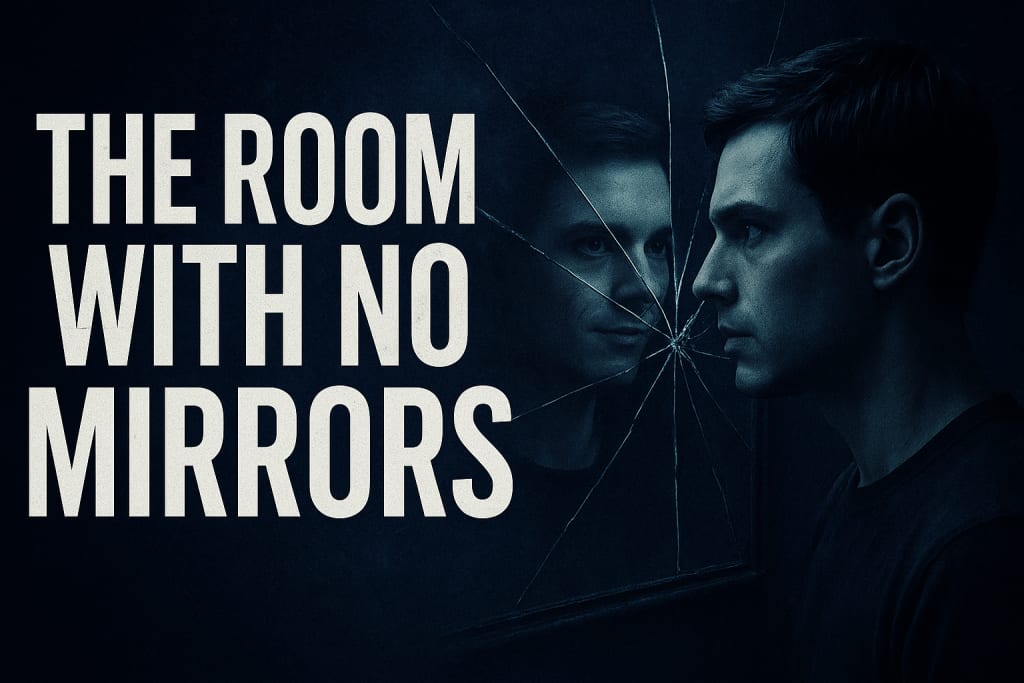
Day 9: a mirror cracked down the middle.
That last one made my heart race.
I asked them, “Why no mirrors in the room?”
The technician looked uncomfortable.
“They can distort self-recognition in sensitive subjects.”
Sensitive subjects?
“What does that mean?” I asked.
He hesitated. “It means… people like you.”
That night, I couldn’t sleep.
The air felt heavier, like the room was watching me.
When I turned off the lamp, the darkness wasn’t complete — there was a faint glow from one corner.
I got up and saw it — a tiny crack in the wall, like something behind it was shining faintly.
I pressed my ear to it.
And heard whispering.
My name. Over and over.
Soft. Familiar.
Like my own voice.
The next morning, I asked to leave the study.
They refused.
“Your contract is active,” they said.
“Leaving now could disrupt the cognitive data.”
I demanded to see the lead researcher.
They said Dr. Hale was unavailable.
Funny — I’d never seen Dr. Hale. Only heard his voice through the speakers.
A calm, soothing voice that always said the same thing before each test:
“Remember what you see. Trust your reflection.”
But there were no reflections.
Day 10.
They showed me a video instead of images.
It was grainy, black and white — a man sitting in a chair, hooked to wires.
His head was down.
The technician asked, “Describe what you remember.”
I frowned. “I’ve never seen this before.”
He smiled faintly. “Are you sure?”
Then, the man in the video looked up.
It was me.
I froze. My throat went dry.
“That’s not me,” I said. “That’s someone who looks like me.”
The technician didn’t answer. Just took notes, expression blank.
In the video, the other me began to speak — but there was no sound.
His mouth moved, forming silent words.
Then the video ended.
My hands were shaking.
“What was that?” I demanded.
The technician said, “A previous session.”
“What session?”
He just said, “Memory isn’t linear, Mr. Blake.”
That night, I heard the whispering again.
Louder this time.
Coming from the wall.
I pushed against the crack. The plaster crumbled slightly. Behind it was a thin, dark glass — like the edge of a mirror.
My pulse raced.
I scratched the wall until I could see through it.
And behind it — another me, staring back.
He smiled.
I stumbled backward. My bed, my desk, my lamp — all exactly mirrored behind that wall.
But the other me didn’t move the same way.
When I stepped forward, he stayed still.
When I whispered, “Who are you?”
He mouthed the same words — but then shook his head.
And behind him… was another figure.
The intercom crackled.
Dr. Hale’s calm voice filled the room.
“Don’t engage with it, Mr. Blake.”
“What is this?” I screamed. “What’s behind that wall?”
Silence.
Then:
“Reflection phase initiated.”
The lights went out.
When I woke up, I was strapped to a chair — in another room.
White walls. Bright light.
Across from me was a mirror.
Dr. Hale’s voice came through a speaker.
“Do you recognize yourself?”
I looked into the mirror.
It was me — same face, same eyes — but… different.
He was calm. Smiling.
I said, “That’s not me.”
Dr. Hale said, “Good. The separation is complete.”
My reflection tilted his head.
“Can I talk to him?” it said.
My voice — but colder.
“Not yet,” said Hale.
I screamed, pulled at the straps.
“What are you doing to me?”
Dr. Hale replied:
“We’re teaching your mind to see itself.”
The reflection laughed. “He’s not ready.”
Days passed — I don’t know how many.
They kept showing me videos, memories, conversations I didn’t remember having.
Each time, my reflection looked more alive — and I felt more hollow.
Until one morning, I woke up back in Room 27.
No straps.
No mirror.
But the air felt… wrong.
I looked around. Everything was slightly reversed.
The bed on the left instead of right.
The lamp’s cord curved the opposite way.
I whispered, “Am I in the mirror?”
A voice answered:
“Yes.”
I turned — my reflection stood behind me.
He wasn’t smiling anymore.
“I told you not to touch the wall,” he said.
I backed away. “This isn’t real.”
He stepped closer. “It is now.”
He reached out — his hand touched my face. It felt solid. Cold.
He whispered, “You wanted to see who you really are.”
Then everything went black.
When I opened my eyes, I was in a different room — clean, bright, and quiet.
The technician smiled. “Welcome back, Mr. Hale.”
I froze. “What did you call me?”
“Dr. Hale,” he said. “You completed the trial successfully.”
I ran to the mirror.
The face staring back wasn’t mine.
It was his.
Now I sit here, in an office with my name on the door: Dr. Hale, Cognitive Research Division.
Everyone greets me politely.
They think I’ve always been him.
But sometimes, at night, when I pass by the observation rooms, I see someone staring out from behind the glass — screaming silently, pounding on the wall.
He looks exactly like me.
And when I walk away, his reflection stays.
Watching.
About the Creator
Naimat ullah
I’m a storyteller from Pakistan who loves writing emotional, mysterious, and thought-provoking fiction. My stories explore time, memories, and the unseen corners of the human heart.
Keep reading
More stories from Naimat ullah and writers in Fiction and other communities.
Aristotle and the Student of Logic.
🌀 Aristotle’s Logic… Gone Delightfully Haywire Aristotle stood beneath the olive tree, stroking his beard with the serene confidence of a man who believed the universe could be tamed by syllogisms... That it could be schooled by reasoning in which conclusions are drawn from two premises, with a common or middle term being present in the premises...but not in the conclusion.
By Novel Allen6 days ago in Fiction




Comments
There are no comments for this story
Be the first to respond and start the conversation.