
The Room Upstairs
By the time I moved in, she had already left. Or maybe she was never there at all.

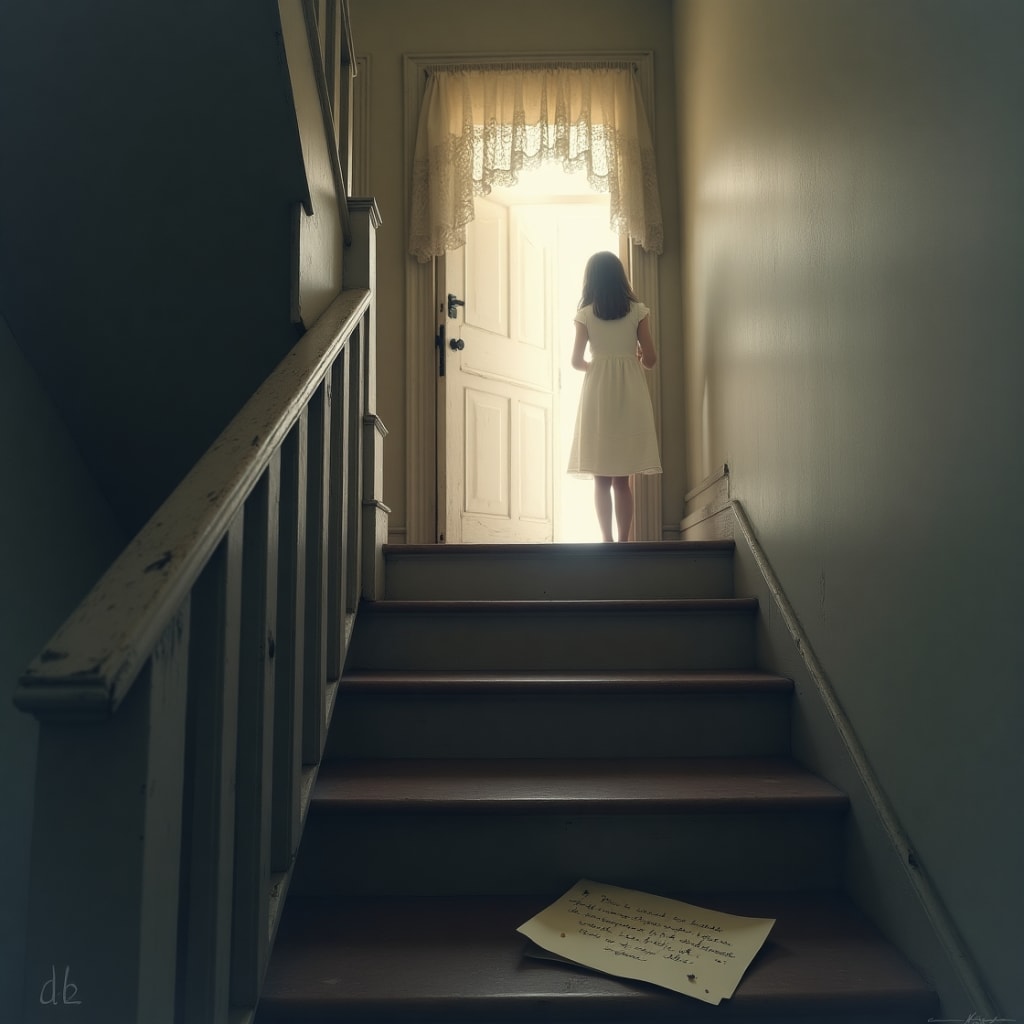
The real estate agent called it “cozy,” which I’d learned meant small, old, and likely full of ghosts — though she never used the word. She said it was ideal for a single writer, which was generous considering it had no working outlets in the kitchen, and the upstairs bathroom faucet ran backwards.
But it was what I could afford.
A month into living there, I finally opened the room upstairs.
Not because I was ready, but because I kept hearing things.
Not sounds, exactly. More like… a shift in the air, as if the room had been breathing quietly, waiting.
There was no lock on the door. Only a handle worn smooth by decades of use. When I turned it, the hinges let out a soft sigh.
The room was small — just enough space for a bed, a dresser, and a tall window with faded lace curtains. It smelled faintly of lavender and dust. Not unpleasant, just old. As if the room remembered someone.
A girl had lived here once. I could feel it. Or maybe I only wanted to.
Her name wasn’t in the lease. But I found it written in the closet wall in pencil, just above eye level: “Elise.”
There were other marks too — faint lines etched into the wood, tracking height, each dated with a month and year. The last was nine years ago.
Nothing else.
No photos, no forgotten toys, no letters tucked behind floorboards.
Just a name. A presence. A hush.
Elise.
I said it out loud.
The room seemed to hold its breath.
I started writing again.
Not right away. For the first few weeks, I just rearranged my notebooks, sharpened pencils I never used, and stared out the upstairs window.
But something about the quiet helped. Or maybe it was Elise. Sometimes I talked to her — aloud, like a lunatic — about plot holes and dead-end paragraphs, asking questions like:
“Do you think my character would actually forgive her mother?”
“Is this too much exposition?”
“Am I wasting my life?”
She never answered. But the silence was kinder than usual.
My sister called to check in one night. I told her about the room. About Elise.
There was a pause on the line, the kind that fills with skepticism.
“You think you’re haunted?” she asked.
“No,” I said. Then, “Maybe.”
I didn’t believe in ghosts. Not really. But something in that room had shape. Not cold spots or flickering lights — just attention. As if someone else was always just leaving as I entered. A girl-shaped absence, trailing lace and lavender and long-forgotten thoughts.
I didn't know if Elise was dead, or moved out, or imaginary. But she was there in a way no one else was.
Sometimes I left notes on the dresser. Short things.
“First rejection today. Didn’t even bother to personalize it.”
“Cut 800 words. Hated all of them.”
“Dreamt I was ten again and someone held my hand.”
The notes were never moved. But I wrote them anyway.
One night, I woke up to music. A music box tune, soft and lilting, came from the upstairs room.
I climbed the stairs barefoot, heart pounding.
The room was empty. Still. The only sound was the wind through the cracked window.
But on the dresser was something new: a folded piece of paper.
I opened it with shaking fingers.
There was no handwriting, just a drawing — a house, like mine, and a stick figure girl standing in the upstairs window. Alone.
I should’ve been afraid. Instead, I felt… seen.
I asked around the neighborhood about Elise.
Mrs. Dobbins, who walked her dog past the house every morning, paused when I mentioned the name.
“Elise?” she said. “There was a girl here, years ago. Sweet child. Loved chalk drawings and birds. But they left after—”
She stopped.
“After what?”
Mrs. Dobbins shook her head. “Wasn’t my business. Some things just don’t heal right.”
That night, I sat in the room with a notebook in my lap and wrote the first full scene I’d written in months.
It wasn’t part of any novel.
It was just about Elise.
In my version, Elise was nine, and she had a box of secrets buried in the backyard. She used to leave notes for the birds, asking them to take her messages to the clouds. She believed the attic was a portal, and once, she climbed out the window to sit on the roof, waiting for her future to arrive.
Her mother drank. Her father yelled. She learned to fold herself into smaller and smaller spaces until no one noticed when she was gone.
Maybe she ran away.
Maybe she faded.
Maybe she was never there to begin with.
But in my story, she stayed. In this room. Waiting for someone to finish her sentence.
The day I sold my first short story, I brought a cupcake upstairs.
Vanilla with pink frosting. I set it on the windowsill and said, “Thank you.”
That night, when I went to take it back down, it was gone.
Only crumbs remained.
One evening, I woke up to find the light on in the hallway. Not a bulb. Just… light. Pale, like moonlight through gauze. And a shape — the outline of a girl.
I didn’t move. I just whispered:
“Elise?”
The shape paused.
I could feel her there, not scary. Just curious.
She didn’t speak. She never did.
But when I blinked, she was gone.
I left the house a year later.
My book was done. The kind of book that wraps around your ribs and whispers things you forgot you felt. I dedicated it to “E.”
The real estate agent who sold the house back shrugged at my stories. “These old places always have a story,” she said. “Usually mice or mold.”
I didn’t argue.
Months later, I drove past the house.
A little girl stood at the upstairs window.
She waved.
I waved back.
[End]
About the Creator
Yasir Nawaz
Bringing stories to life🎙️✨ Dive into adventures, mysteries, and heartfelt tales. Join me on a journey where words paint vivid worlds and every story sparks your imagination. Follow for your daily dose of captivating vocal storytelling!
Keep reading
More stories from Yasir Nawaz and writers in Fiction and other communities.
Whispers from the Locked Door
Emma had always been drawn to old houses. Their stories felt like silent companions, waiting patiently to be uncovered. When she found the quaint Victorian on Maple Street, she knew she had to have it — despite the quirks, the creaky floorboards, and especially the locked door at the end of the hallway.
By Yasir Nawaz7 months ago in Fiction
Choose Your Own Adventure: St Helena Station
*****Preface***** I have been obsessed with Choose Your Own Adventure stories since I was a kid. I credit them with my love of reading and writing. I've been struggling to get my own kids to embrace words the same way I have but they love video games and our occasional Dungeon's and Dragon's game... which gave me an idea. I'll write an interactive story. So far its working; my middle son loves it and can't wait for the next section to come out.
By Sandor Szabo3 days ago in Fiction
The Last Chair
Every evening, after the house goes quiet, I return the chairs to their places. It doesn’t matter how late the session ends, or whether the power’s been out, or whether my body has already started bargaining with sleep. The chairs must go back. Two of them, mostly. Sometimes three. Occasionally more, depending on the day and the stories it brought with it.
By Teena Quinn about 6 hours ago in Fiction


Comments
There are no comments for this story
Be the first to respond and start the conversation.