


He woke on cold stone, cheek pressed against grit. A throb pulsed behind his eyes—deep, steady, like a slow hammer striking bone. When he tried to move, pain shot through his shoulders. His wrists were bound behind him with coarse rope, tight enough to bite.
He lifted his head an inch, blinking through the haze.
A dim bulb hung from a wire. Its glow trembled across concrete walls. A faint draft slipped through the room, carrying the smell of mildew and old paper—basement air, stale and forgotten.
He shifted, and the hem of his garment brushed his ankle: black wool, stiff from starch. A thin white collar cut across his throat, cool against his skin.
His mind lurched. He knew those clothes. He had worn them for years. He had spoken blessings in them. He had delivered homilies, baptisms, penance.
But nothing about this room felt consecrated.
He tried to speak; his voice scraped like rust. “Hello? Is someone there?”
Silence pressed back.
Then—the groan of a heavy door. Hinges stiff with disuse.
Footsteps entered, slow and measured.
A man stepped into the light wearing a smooth, featureless black mask. He dragged a wooden chair across the floor. The legs scraped a long raw note that made the bound man flinch.
The masked figure set the chair directly in front of him, flipped it backward, and sat—forearms resting on knees, a precision knife held loose in his right hand, as if he had all the time in the world.
He didn’t speak.
He didn’t even seem to breathe louder than the room itself.
The prisoner shook with trepidation. “You’re… you’re making a mistake,” he said. “If something has happened—if you’re hurting—I can listen. I can pray with you.”
Still silence.
His head pounded, stirring his vision. He scanned the room—boxes stacked haphazardly on sagging shelves, dusty books, and a purple stain on the floor nearest the door.
Something about it gave him the sense of familiarity, though every reason he might normally consider, currently swam behind a fog of confusion and panic. He was half-convinced that he might have been in the clutches of delirium.
“Tell me what you need,” he tried. “If you’re here for confession, I can—”
His words died.
Somewhere overhead, faint as breath, organ pipes stirred. A low rumble. A trembling chord.
He froze.
Again, the sound. The soft warm-up of ancient pipes wheezing through a familiar melody.
He knew those pipes. He had heard their moan every dawn for decades. The slight drag of the blower. The uneven swell at the start of each hymn.
Dear God…
He wasn’t in an unknown building.
He was beneath the church. His church.
This room—this forgotten pocket—lay beneath the sanctuary, beneath the painted saints, beneath the carved altar where he had placed chalices with careful hands.
His gaze drifted across the wall again.
The books coated in dust—not just books, but worn hymnals, placed here a decade prior when the church replaced them with new ones.
The stain on the dark wood—not a stain, but smudge of wax left years ago when someone dropped a crate of advent candles.
A faded corkboard, its edges curled—one corner still showing the torn remains of an old youth retreat flyer.
The masked man finally moved—but only a fraction. He shifted his weight. Tilted his wrist. Lifted the knife a hair, then lowered it again. Not a threat. Not a warning. Just… acknowledgment.
Then, without a word, he rolled up the sleeve of his left arm.
The priest’s breath hitched.
A birthmark.
The dark patch swept across the forearm in a shape roughly resembling the head of a rabbit, with one ear folded.
He knew this mark. He had seen this mark.
On a child.
A boy who used to come to catechism class with wide eyes and nervous hands. A boy who trusted easily. A boy who believed every word spoken by a man wearing a collar—the only man he had ever called Father.
A ripple of nausea rolled through him.
The priest hung his head—shame and regret permeating the once-forgotten room.
He breathed in deeply, letting the stale air settle in his lungs. “If you came for answers, I have none. If you came for apology, I offer one, though it is ash. But if you came for justice—” His voice dropped to a steady, resolute weight. “—well. That is long overdue.”
The masked man leaned back in his chair.
Still silent.
Still waiting.
The priest continued, words slow and deliberate: “I will not beg for mercy. I will not plead for forgiveness. I forfeited the right to both.”
He lowered his gaze for a moment—a gesture not of fear, but of acknowledgment.
“If you mean to end me, then end me. But do it as justice, not vengeance. And do not spare me pain. Let it be an honest accounting.”
The organ trembled through a final chord overhead.
The masked man rose.
No theatrics. No raised blade. No threats. Only focus. Intent. Resolve.
The priest closed his eyes, hung his head, and began a final prayer:
“God of justice… let the wickedness of the guilty, be repaid by the hands of the innocent.”
The masked man stepped forward.
And the room remembered.
About the Creator
SUEDE the poet
English Teacher by Day. Poet by Scarlight. Tattooed Storyteller. Trying to make beauty out of bruises and meaning out of madness. I write at the intersection of faith, psychology, philosophy, and the human condition.
Keep reading
More stories from SUEDE the poet and writers in Fiction and other communities.
Unstitched
The key stuck twice before it turned. Eli cursed under his breath, jiggled the old brass until the deadbolt surrendered with a sigh that sounded too much like relief. The front door of the Benning house—he still thought of it that way, even after dropping the name—opened on a spill of stale air and dust, thick with the faint, sweet rot of closed-up summer.
By SUEDE the poet4 months ago in Fiction
The Cracks in the Stone: What the Myth Refused to Record
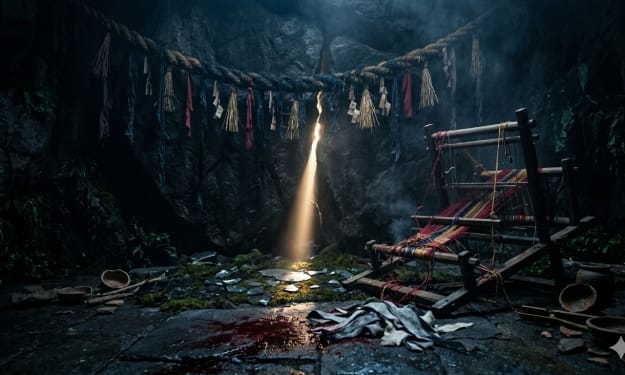
The myth-makers like to say that when Amaterasu Omikami entered the cave, the world simply went dark. They use the word "dark" as if it were a clean, binary switch—the absence of a lamp, a blanket thrown over a birdcage. They tell you that the gods gathered by the river to laugh her back out, as if a divine party could cure a cosmic trauma.
By Takashi Nagaya4 days ago in Fiction



Comments
There are no comments for this story
Be the first to respond and start the conversation.