
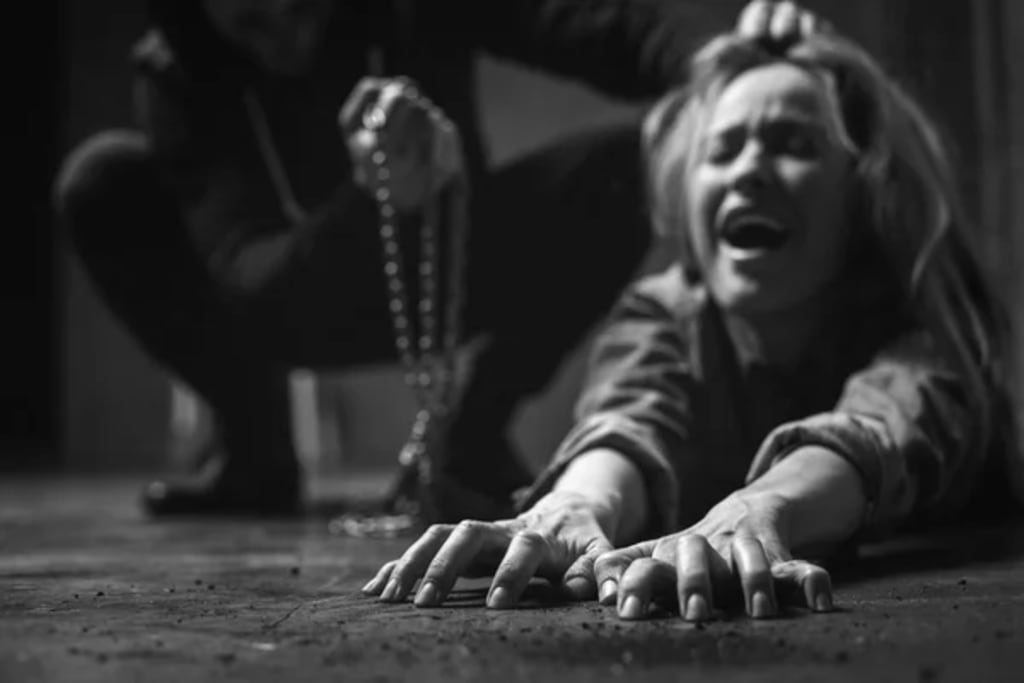
For thirteen years, the room at the end of Jane Albrecht’s hallway had remained closed. She dusted the doorknob now and then, polished it the way one polishes a memory: carefully, without daring to open anything. Guests sometimes asked what was inside.
“Just old things,” she always answered.
But she never turned the handle.
She had learned how to avoid it—even how to angle her body so that her eyes wouldn’t fall on the door when she passed. It was easier that way. Avoidance had become its own architecture, a form of self-built safety.
But on the morning everything changed, Jane was not thinking about the room at all. She was on her way to work, mentally rehearsing a presentation she dreaded delivering. Fog clung low over the street, muting color, turning every car into a shadow gliding over wet pavement.
That was when she saw it.
At first she thought the woman standing on the sidewalk ahead of her was just waiting to cross the street. Then a dark van pulled sharply toward the curb. A man jumped out. The woman tried to step back, but he grabbed her arm. She let out a choked sound—half cry, half breath—and tried to twist away.
Jane froze.
Everything unfolded too fast to feel real. The woman’s eyes met hers—wide, disbelieving, pleading. Another man emerged from the van. They shoved the woman inside, slammed the door, and sped off. It happened in less than five seconds.
Jane tried to scream, but her voice died at the back of her throat. Her hands trembled violently as she fumbled her phone. Twice she misdialed. The third time, she reached the emergency dispatcher, but her voice came out as a whisper.
“A woman… she was taken… a van…”
The police arrived within minutes. She repeated what she saw, struggling to focus, describing the men, the van, the terrified woman. She forced her mind to remember—even as another part of her brain recoiled against remembering anything at all.
Afterward, she drove to work, though she could barely feel her own hands on the steering wheel. At her desk she stared at the computer, the words on her screen sliding out of meaning. Her boss sent her home within an hour.
She thought going home would help.
It didn’t.
She sank into her oversized armchair—a soft, comforting piece of furniture that had held her through breakups, job losses, and every winter flu. She wrapped a blanket around herself and closed her eyes.
And her mind began to move—slowly at first, then with increasing speed and weight—toward the door at the end of the hall.
Toward the memory sealed behind it.
Thirteen years earlier, the room had been full of laughter.
She had just started university then, young and excited about everything from textbooks to cafeterias. To celebrate, she had booked an appointment at her favorite salon. Her best friend, Sophia, worked there—an apprentice hairdresser with more confidence than skill, though she improved daily.
Jane could still see her as clearly as if she were standing right in front of her: glossy curls of black hair, eyes bright and alive, a smile that made strangers turn their heads. Sophia had a way of speaking as if every word came wrapped in joy. She wasn’t just beautiful—she was magnetic.
They had met years earlier when Sophia shampooed Jane’s hair for the first time, chatting nonstop about music, history, travel, and food. By the time Jane’s stylist took over, the two young women felt as though they had always known each other.
Sophia had dreams—big ones.
Finish her apprenticeship.
Earn her master certificate.
Open her own salon with gold-framed mirrors and bright red styling chairs.
She loved life in Germany. Loved walking through the city on her own, meeting friends, swimming at the pool, buying pastries on Saturday mornings. And she was in love—a soft, glowing, secretive love—with a German boyfriend who adored her.
But her family did not.
And that was where the nightmare began.
It had been an ordinary day. Jane arrived for her usual appointment, expecting chatter, music, the smell of hair products. But when Sophia began washing her hair, she barely spoke. Her movements were stiff, jerky.
Then, as she started to cut, she nicked Jane’s ear.
Once.
Twice.
A third time.
“Hey,” Jane said gently. “Sophia… what’s wrong?”
Sophia didn’t answer. Her face was chalk white. Tears trembled at the edges of her lashes. Her hands shook violently. Her lips had lost all color.
Her boss noticed immediately. He stepped in, took the scissors from her hands, and guided her away. Jane followed, heart pounding.
In the back kitchen, Sophia collapsed to the floor. She trembled so hard Jane feared she might faint. They both knelt beside her, whispering reassurance, until eventually her breathing steadied and she could speak.
What she told them shattered every assumption they had made about the world.
“My father knows… about my boyfriend,” she whispered. “And he knows I want to move out on my own. He said… he said I have to go back to Turkey. He already signed marriage papers. For me. With a man I never met. He said I will marry him.”
Jane stared at her friend in horror.
Sophia wiped her eyes. “He said… the man hates Germans. He said he will ‘teach me’… to behave. To remember who I am.”
She doubled over, sobbing.
Her boss wrapped an arm around her. “You’re staying here tonight. You’ll stay with me until we sort this out. I won’t let anything happen to you.”
Sophia nodded, trembling.
They finished the workday with the salon door locked. That evening, she waited in the kitchen while her boss closed the shop. Jane stayed with her, keeping her company, trying to talk about small things.
Then came the sound of the back door.
It hadn’t been locked.
Sophia’s father, her brother, and two other men burst inside. Before Jane or the boss could react, one man grabbed Sophia. She screamed—a sound Jane would never forget—and tried desperately to cling to the table leg. Another man struck Jane across the face, sending her crashing to the floor. The boss was thrown against the wall. The men dragged Sophia toward the exit as she kicked and cried.
They locked the salon door behind them, trapping Jane and the boss inside until a neighbor heard the commotion.
The police came. But Sophia was gone.
Completely gone.
INTERPOL became involved. Months passed. Then years. And eventually the world simply moved on—as if a young woman hadn’t been stolen from her life.
Jane couldn’t move on.
But she knew she had to function, to survive. So she packed Sophia’s things—the gifts she’d given her, the photos, the letters written in perfect looping handwriting—and placed them all in one room.
The room at the end of the hall.
Then she closed the door.
And did not enter it again.
Now, sitting in her armchair, Jane felt the memory pressing harder and harder against her chest. The woman she saw kidnapped this morning—her eyes—had pulled everything loose.
Her heart hammered. She drew in a shaking breath.
“I need to open it,” she whispered to the empty house.
She stood. Her legs wobbled.
The hallway felt impossibly long. The air grew colder with each step. And when she reached the door, she rested her palm on the handle, waiting for courage to catch up with her body.
When she pushed the door open, a wave of warm, dusty air enveloped her. The scent hit her like a memory made physical: hair spray, jasmine tea, old paper.
Light slanted in from the small window, illuminating the room like a stage long abandoned.
Everything was exactly as she had left it.
Sophia’s scarf hung on the chair.
Her framed photo stood on the shelf.
The small box of earrings she had made at age sixteen still lay open on the desk.
A hairbrush, tangled with a few dark curls, rested beside it—strands that had once belonged to someone alive with dreams.
Jane stepped inside.
The floor creaked under her feet. Dust motes danced in the thin beam of light, rising like spirits disturbed by a living presence.
She went to the dresser and touched the edge of a postcard Sophia had written to her during their first vacation apart. The ink had faded. The corner was bent.
Jane felt herself break.
All the years she had avoided these memories crashed over her. She sank to the floor, burying her face in her hands. Her sobs echoed quietly through the room, filling the silence that had been building for over a decade.
Eventually, she stood again.
She opened a drawer.
Inside lay a folder of newspaper clippings she had collected—the last thing she tried to hold onto before grief became too heavy.
One article caught her eye.
A retired customer from the salon had traveled to Turkey two years after the kidnapping. She had searched the outskirts of Istanbul. And she had found Sophia—barely alive, with two small children. They had arranged to leave together the next morning.
But they never made it.
The next day, the woman found Sophia stoned to death in the road. The police accompanying her did nothing. They said it was a “family matter.”
Jane pressed the clipping to her chest.
“Sophia…”
As she stood there, a soft breeze drifted through the window. And for a moment—just a moment—she sensed Sophia beside her, the way she used to stand close while styling Jane’s hair, humming some pop song she loved.
Then another image surfaced—the wide, terrified eyes of the woman kidnapped this morning.
Jane wiped her face. Something inside her shifted. She could not save Sophia. But maybe—just maybe—she could help someone else.
She closed the drawer and stepped back into the hall, leaving the door open behind her for the first time in thirteen years.
The room did not feel like a tomb anymore. It felt like a witness.
The next morning, Jane returned to the police station. She met with the investigator assigned to the case and pushed herself to repeat every detail she could recall—every movement, every sound, every fragment of the kidnapper’s face.
When she finished, the officer nodded slowly.
“This helps,” he said. “It really does.”
Jane stepped outside into the cold brightness of day.
She knew she would never forget the room again.
But she would not seal it.
Not anymore.
She would enter it whenever she needed courage.
Whenever she needed to remember why she could never look away again.
As she walked home, she whispered a quiet promise.
“For you, Sophia. And for the woman they took today. I won’t freeze again.”
And somewhere—maybe only in her memory, maybe somewhere deeper—she felt the faint warmth of a smile behind her.
The room at the end of the hall remained open.
And the past, finally, breathed.
About the Creator
Keep reading
More stories from Dagmar Goeschick and writers in Fiction and other communities.
Winter Ritual
Winter arrives without asking. It comes quietly, often overnight, when the world has decided to slow down. Winter is cold. Winter is white. Winter lasts three long months—sometimes more—and sometimes it comes with snow, and sometimes only with the promise of it. Either way, it changes everything.
By Dagmar GoeschickExclusive • about a month ago




Comments (1)
heart-shattering, especially knowing this does actually happen, too. I hope this wasn't based on a true story for you. <3