
The Rise of Iron North
Forgotten Prince, Wandering Healer

In the Empire of Zhuyan, the firstborn prince was a shadow in his own palace.
His name was Lián Feng, son of Emperor Zhuyan Long and his first consort, Lady Mei Lin—a woman the world pretended to forget.
Lady Mei Lin had once been the brightest scholar of the Skyward Academy, a woman who wrote of equality, righteousness, and the duty of the strong to protect the weak. Her ideas threatened the old families and elder scholars, so they branded her dangerous, expelled her, erased her work, and whispered that she was mad.
Then the Emperor married her.
The academy never forgave this. Nor did the great clans that sat behind it like unseen mountains.
Lián Feng grew up hearing two kinds of whispers in the palace halls.
“First prince.”
“Son of that scholar.”
His mother died when he was still young. His father, buried under scrolls and petitions, rarely had time for him. The court glanced past him toward the son of the second empress—Prince Zhuyan Rui, bright, arrogant, and supported by the most powerful clans.
When Lián Feng was old enough, the Emperor sent him to the Skyward Academy, as tradition demanded.
The academy received him with smiles that never touched their eyes.
They hated his blood, not because he was royal, but because he was his mother’s child.
Skyward Academy was a city of jade roofs and stone courtyards, where the sons and daughters of nobles learned to call their privilege “merit.”
In those halls, Lián Feng was never the crown prince. He was the son of the expelled scholar.
Teachers mocked him subtly. Students laughed openly. Every time he quoted his mother’s ideas—justice over birth, merit over clan—they called him naïve, foolish, unfit for a throne.
The worst day came in the grand debating hall.
There, in front of elders, nobles, and students, Prince Rui stood proudly beside his teacher, Master Qiu Renshan, the academy’s most famous scholar. Lián Feng stood alone.
Beside Lián Feng was his fiancée, Shangguan Yue, daughter of the mighty Shangguan military clan. Or so he thought.
When the debate ended, Master Qiu praised Rui as the “pillar of the future,” while jeering at Lián Feng’s “childish” ideals. Laughter rippled through the crowd.
Then Shangguan Yue stepped forward in crimson robes, her voice clear and cold.
“I, Shangguan Yue of the Shangguan Clan, hereby annul my betrothal to Lián Feng,” she declared. “Why would I marry a man who clings to the failed ideals of a fallen scholar? I stand with Prince Rui, who is guided by true wisdom.”
The hall exploded into murmurs.
She turned to Lián Feng, eyes sharp like drawn steel. “A crown prince in name, with nothing but a homeless woman’s ideas behind him. You are not worthy of me, nor of this academy.”
Rui smiled, hand resting arrogantly on his teacher’s arm. The elders watched, saying nothing.
Lián Feng’s hands trembled at his sides. He looked not at Shangguan Yue, nor at Rui, but at the banners hanging from the ceiling—inscribed with words like virtue, loyalty, righteousness.
How easily they lied.
Without a word, he bowed—not to them, but to the ideals they had betrayed.
Then he turned his back on the academy and walked out, alone.
No servant followed. No teacher called his name.
Outside the mountain gates of Skyward Academy, beneath a gray sky, Lián Feng made his decision.
“If my name is not enough,” he whispered, “then I will carve one that is.”
Lián Feng did not return to the capital.
Instead, he went north, to the bitter, wind-torn border where the Empire of Zhuyan met its enemies.
At the gates of Northern Iron Fortress, he presented himself as a common man, giving only the name Feng.
He joined the army as the lowest-ranked soldier—no rank, no title, no crest on his armor.
The border did not care about pedigree. It cared about whether you could stand when arrows fell and steel sang.
Feng stood.
He stood in blizzards where the dead froze with swords still in hand. He stood in night raids where torches became rain of fire. He stood when commanders fell and lines broke, stepping forward to rally men who barely knew his name.
He never ran. He never abandoned a comrade.
At first, captains brushed him aside. Then they began to notice.
He had a way of reading the battlefield, of seeing patterns in chaos, of knowing where the enemy would break. Quietly, without asking for praise, he made small, decisive suggestions—ways to move troops, when to retreat, when to strike.
Step by step, rank by rank, he rose.
Squad leader. Captain. Commander.
By the time the northern snows began to melt, the border soldiers spoke of him with a mixture of awe and relief.
They called him General Feng of the Iron North.
Few knew his face. Fewer knew his past.
None knew he was the crown prince.
On a night when the moon hid behind storm clouds and the wounded filled the fortress, Feng first met Yun Qiao.
She arrived with a caravan of refugees—a young woman wrapped in a travel cloak, carrying a worn medicine case. Her eyes were calm, steady, and old with grief.
She was the last daughter of the Yun Clan, a small house destroyed years ago for refusing to join a noble’s corrupt scheme. Her kin scattered, her home burned, her family name reduced to a footnote in someone else’s glory story.
Since then, Yun Qiao had wandered from battlefield to battlefield, from village to village, searching for a place to belong.
She treated generals and beggars with the same stern care. She scolded officers who wasted lives and nobles who wasted medicine.
Feng watched her from a distance at first.
Then, during a harsh winter campaign, he watched her wade into a storm of fleeing soldiers, dragging one man after another out of arrow range, screaming at them to move, to live.
That night, he found her in the makeshift infirmary, hands stained red to the wrists, shoulders shaking from exhaustion.
“You should rest,” he said.
She glanced up, annoyed. “And leave them to bleed alone?”
“They are not your clan,” he replied gently.
“They are someone’s clan,” she shot back. “Someone’s son, someone’s father. Isn’t that enough?”
Feng was silent for a long time.
At last, he said, “Yes. It is enough.”
From that night on, he made sure the infirmary had the best guards and the warmest fires. He always visited after battle, not to be praised, but to carry water, lift wounded men, and, sometimes, to sit beside Yun Qiao when the night grew too quiet.
Their relationship began with arguments.
“You cannot push them so hard,” she would say.
“If we do not, the frontier will fall,” he would answer.
“And what good is a frontier held by corpses?”
But under the arguments was respect.
He listened to her. She saw him.
Campaign after campaign, they moved together.
When fortresses fell, they rebuilt them. When villages starved, they shared army supplies. When nobles tried to steal credit, Feng remained silent, but his men never forgot whom they actually followed.
Stories began to spread across all four borders.
An iron-willed general who ate from the same pot as his soldiers.
A wandering healer who cursed like a soldier and wept like a mother.
Together, they became a legend whispered by campfires.
The soldiers began to call them Heavenly General and Earthly Healer.
They shared tents on long campaigns, shared scars on cold mornings, shared rare, quiet laughter under tired stars. One night, after barely surviving a siege, when the fires burned low and the fortress still smelled of smoke, they kissed for the first time.
It was not the wild kiss of a court romance. It was weary, desperate, and honest.
After that, they were no longer just commander and healer.
Everyone in the army knew. No one dared mock them.
In a small fortress on the edge of the empire, with soldiers pounding drums on their shields, General Feng and Yun Qiao were married. Their wedding feast was simple: hard bread, rough wine, and laughter that echoed off stone walls.
“Where is your home?” she had once asked him.
He looked around at the fortress full of scarred men and tired smiles.
“Wherever you stand,” he replied.
For a while, that was enough.
The summons came on a clear autumn morning.
A messenger rode into the fortress, falling to his knees before General Feng.
“His Majesty Emperor Zhuyan Long is gravely ill,” he said. “Both princes are summoned to the capital.”
Feng’s face did not change, but Yun Qiao saw the storm in his eyes.
That night, in their tent, he told her the truth.
“My name is not just Feng,” he said quietly. “It is Zhuyan Lián Feng. I am the crown prince of this empire.”
Silence fell between them like snow.
Yun Qiao closed her eyes for a moment. Then she opened them, steady.
“You’re still the man who carried water buckets in the infirmary,” she replied. “That’s enough for me.”
They rode together to the capital.
The imperial city of Longjing greeted them with white mourning banners and the tolling of deep bells. In the palace, where he had once walked unseen, Lián Feng knelt beside his father’s bed.
Emperor Zhuyan Long, older and smaller than he remembered, reached out with a trembling hand. He did not have breath for long speeches.
He simply pressed the heavy jade Imperial Seal into Lián Feng’s palm.
A single tear slid from the Emperor’s eye.
Whether it was regret, apology, or blessing, no one could say.
Lián Feng bowed his head over his father’s hand and wept for the mother he lost, the father he never really knew, and the child he had never been allowed to be.
Yun Qiao stood beside him, her hand on his back, grounding him in a palace that had never felt like home.
The Emperor died before dawn.
After the grand funeral, the court gathered like a flock of vultures.
The throne hall was filled with nobles in silk, officials with stiff hats, clan leaders with hidden knives behind their smiles. At the front stood Empress Dowager Lianhua, second wife of the late emperor, her son Prince Rui at her side.
The hall steward announced, “This assembly is to confirm the next Emperor of Zhuyan.”
Before Lián Feng could step forward, Empress Lianhua raised a hand.
“Before such a decision,” she said sweetly, “we must discuss suitability. An emperor must be learned, refined, recognized by scholars and clans alike. He must be properly cultivated, not… wild.”
Her gaze slid to Lián Feng like a blade dipped in honey.
Prince Rui stepped out, smiling in practiced humility.
“Elder ministers,” he said, bowing, “my brother is brave, but he has spent his years in the wild frontiers, far from court, far from learning. It would be a burden to force him into a role he cannot fulfill.”
Laughter, thin and poisonous, rippled through some of the officials.
Master Qiu Renshan, the famous scholar, took a step forward.
“Crown Prince Lián Feng carries the shadow of a woman whose ideas almost shattered the order of this empire,” he said. “His late mother defied the academy and the great clans. How can we trust that such blood will not destabilize the realm?”
Shangguan Yue came forward, gleaming in martial finery.
“I once believed I would be bound to the crown prince,” she said, her voice loud and clear for all to hear. “But the more I saw, the more I understood—he clings to childish dreams of equality. How could a daughter of the Shangguan Clan, protectors of this empire, follow such a man?”
She smirked, eyes flicking to Yun Qiao. “He has chosen a wandering vagrant instead. A homeless vixen clinging to his side. They are well matched—in their lack of station.”
Some officials chuckled openly now.
Lián Feng’s fingers tightened around the hidden Imperial Seal in his sleeve. Yun Qiao stood behind him, head lowered. The words cut, but her back remained straight.
Empress Lianhua spread her arms gracefully.
“For the stability of Zhuyan,” she announced, “let the court recognize Prince Zhuyan Rui as the new Emperor.”
Some ministers immediately dropped to their knees in support. Others hesitated, looking from Rui to Lián Feng, uncertain.
Before anyone could speak further, the sound of boots thundered outside the hall.
The great doors swung open.
Seven figures entered, each in battle-scarred armor, each bearing a cloak marked with a different symbol of the empire’s borders.
They were the Seven Heavenly Generals of Zhuyan, legends whose names mothers taught their children when speaking of strength.
Behind them came other commanders—among them, General Shangguan Tai, father of Shangguan Yue and patriarch of the Shangguan Clan.
The officials straightened, startled. Many smiled in relief, expecting the generals to support Rui, the “academy’s prince.”
A herald announced, “The Heavenly Generals arrive to bear witness.”
Empress Lianhua inclined her head. “You come at a crucial moment. We are about to confirm the next Emperor. Surely, you will—”
“Forgive us, Your Majesty,” said the eldest general, Han Wuyin of the Western Flame, his voice like gravel, “but we are not here for him.”
He turned.
As one, the Seven Heavenly Generals walked past Prince Rui.
Past Master Qiu. Past the gathered ministers.
They stopped in front of Lián Feng.
Then, in the stunned silence of the throne hall, all seven dropped to their knees.
“Your Majesties!” Han Wuyin’s voice rang out. “We, Heaven’s Seven, greet the Crown Prince of Zhuyan, General of the Iron North, the man who defended every border of this empire while the court slept.”
The hall erupted into gasps and whispers.
“…General Feng?”
“That was the crown prince?”
“He led the northern lines… and the eastern campaign… and the south…?”
General Shangguan Tai knelt as well, bowing his head low.
“Shangguan Tai of the Border Spear pays respects to the true heir,” he said hoarsely. “If not for General Feng, my soldiers and my house would have fallen long ago.”
Lián Feng slowly stepped forward.
He drew the Imperial Seal from his sleeve—a solid block of jade carved with the dragon of Zhuyan.
“This,” he said quietly, his voice cutting through the chaos, “was placed in my hand by my father before he died.”
He walked toward the throne with steady steps.
No one moved to stop him.
When he sat upon it, he did not lounge like a conqueror. He sat as he had always stood—upright, calm, and unshakable.
A second, slightly smaller throne was brought and placed beside him.
Yun Qiao approached. For a moment, hesitation flickered in her eyes—she was a healer from a fallen clan, not a noblewoman.
Lián Feng extended his hand.
“This empire,” he said, loud enough for all to hear, “has bled for the thirst of the greedy. From this day, it will heal. I cannot do that alone.”
She took his hand and sat beside him.
“The Heavenly Emperor of Zhuyan,” murmured someone in awe, “and the Earthly Empress.”
“Bring forth the records,” Lián Feng ordered.
His officers came forward with scrolls and ledgers seized from border campaigns and secret investigations. Names. Accounts. Letters.
The truth spilled into the hall like cold water.
Empress Lianhua’s brother had been sending encoded messages to a neighboring empire, promising internal access in exchange for help placing Rui on the throne. Some ministers had taken gold to support this plan. Certain clans had been quietly selling weapons to rebels.
Among them, the elders of the Shangguan Clan.
Empress Lianhua paled. “These… these are forgeries,” she stammered.
Han Wuyin stepped forward.
“I was there,” he said. “We captured these documents when General Feng led us to crush the very army your allies sent against us.”
The evidence was undeniable.
Lián Feng’s gaze was steady as stone.
“Empress Lianhua,” he said, “for conspiring with foreign powers and placing your ambition above the safety of Zhuyan, you are stripped of authority and confined to the Cold Palace. You will live—not in honor, but in reflection—for the rest of your days.”
Guards stepped forward, hands trembling as they took her away. She screamed, cursed, wept—but no one moved.
He turned to the line of corrupt officials.
“You who lined your tables with the blood of soldiers,” he said, “you who bargained with the lives of common people for more land, more gold—your titles are gone. Your names will be remembered only as warnings.”
By his order, they were dragged out. Some would hang upon the city walls, their estates seized and dedicated to war orphans, widows, and the rebuilding of ruined lands. Their families, protected from slaughter but not from consequence, were exiled far from court.
Then Lián Feng faced General Shangguan Tai.
“Your clan’s elders trafficked human lives and armed rebels,” he said. “Speak.”
Shangguan Tai bowed to the floor.
“They did,” he replied. “I was away at the border. When I learned of it, I was already bound by blood to their shame. My loyalty, however, has never left this empire.”
Lián Feng studied him for a long moment.
“The guilty elders of the Shangguan Clan will be executed,” he declared. “Those who knowingly aided them will be exiled. The soldiers who fought loyally at the border will remain under your command, General Shangguan Tai. The empire still has need of your spear—cleaned of rot.”
Shangguan Tai trembled, tears falling silently. “Your Majesty is merciful,” he whispered.
Lián Feng then turned his gaze to Shangguan Yue.
She tried to stand tall, but her face was ashen.
“You once declared yourself too noble for a man who believed all lives were equal,” he said. “From this day forth, you and Prince Rui will return to the academy as simple students.”
Gasps filled the hall.
“As for the Skyward Academy,” Lián Feng continued, “Zhuyan severs all official ties. No more will one school hold the empire by the throat.”
Master Qiu Renshan stepped forward, face red with rage.
“You dare?” he shouted. “The academy forged the minds that rule this land! You were nothing but a failed student in its halls. You—”
“Silence,” Lián Feng said softly.
His voice was not loud, but it cut through Qiu’s words like steel.
“My mother stood in your halls and spoke of loyalty, righteousness, and equality,” he said. “You cast her out because truth threatened your comfort. You call yourself a scholar, yet you feared knowledge that might free the weak. You taught pride instead of humility, greed instead of justice.”
He leaned forward slightly on the throne.
“A man who twists learning into chains for the innocent,” he concluded, “is not a scholar. He is a decorator of rotten hearts.”
No one spoke after that.
Later that day, the doors of the palace opened.
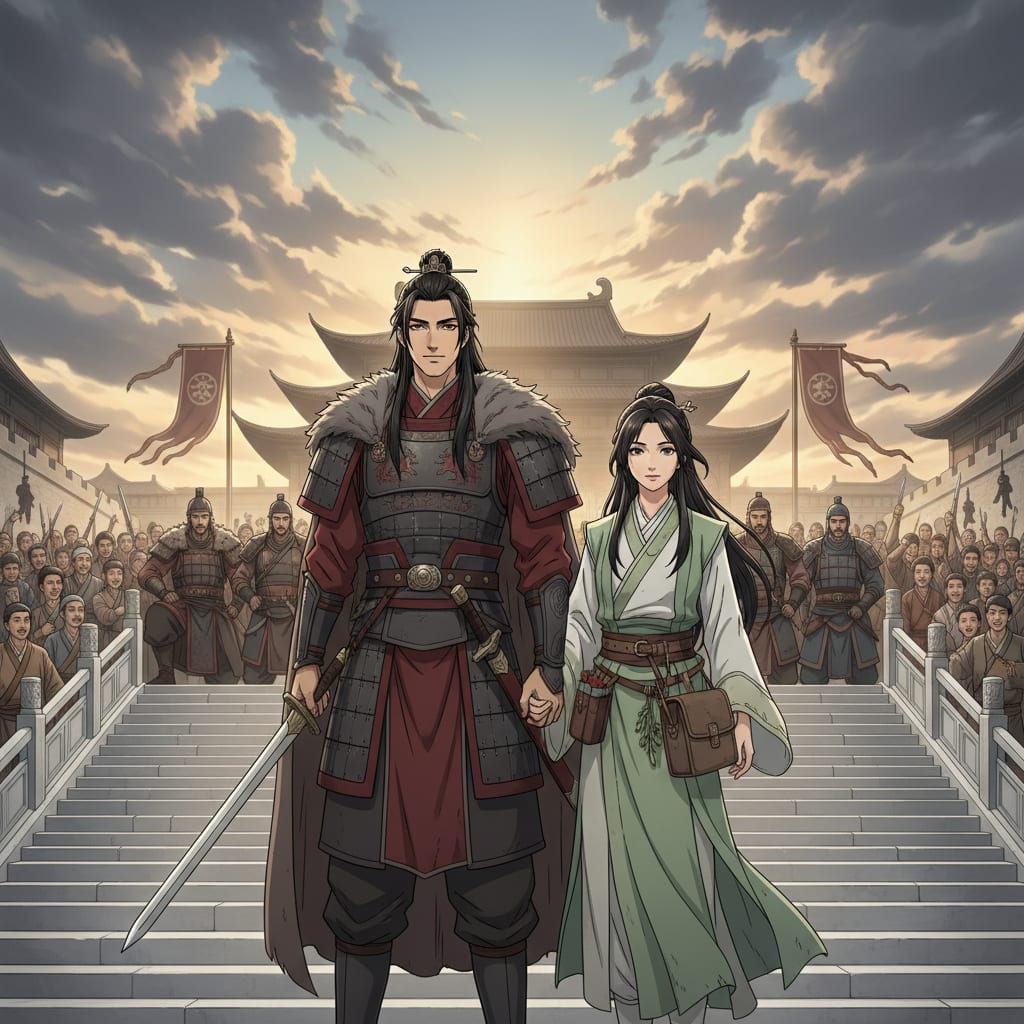
Lián Feng stepped out onto the long staircase that led down to the main avenue of Longjing. Yun Qiao stood beside him, the Heavenly Emperor and Earthly Empress framed by banners snapping in the wind.
The square below was filled with people—farmers, merchants, soldiers on crutches, widows in plain cloth, children balanced on shoulders to see.
For years, they had watched white banners of mourning and black banners of war. Now, they watched in expectant silence.
Lián Feng’s voice carried across the crowd.
“People of Zhuyan,” he began, “you have bled for the wars of those who never saw the battlefield. You have starved while your rulers feasted. You have been told that your lives are light as feathers and the lives of nobles are heavy as mountains.”
He paused, eyes sweeping over them.
“My mother was cast out for saying all lives are equal before heaven,” he said. “I was mocked for believing her. Today, I stand before you as your Emperor, and I say this: from this day forward, the weight of a life will not be measured by its surname.”
Murmurs spread through the crowd, hopeful and fearful at once.
“Corrupt officials have been punished,” he continued. “Clans will answer for their crimes. The gold taken from your hunger will rebuild your homes. The blood you shed at the borders will no longer be forgotten in the capital’s halls.”
He glanced briefly at Yun Qiao, then back to his people.
“We will build an empire where a child from the poorest village can stand beside a prince if their heart is righteous and their hands are willing to work,” he said. “We will build a court where scholars speak truth, not flattery; where generals protect, not oppress; where healers are honored more than those who cause wounds.”
His final words rang like a bell.
“Once, this empire belonged to a few,” he said. “Now, it will belong to all who call it home.”
A quiet murmur rose, then grew into cheers, shouts, sobs. In the crowd, soldiers bowed their heads, mothers clutched their children closer, and old men wiped their eyes on their sleeves.
Above them, for the first time in many years, the banners of Zhuyan fluttered not over a city at war, but over a people daring to hope.
Years passed.
The Empire of Zhuyan did not become perfect. No kingdom ever does. But slowly, the walls of fear between palace and street began to crack.
In the imperial gardens—once wild and neglected—new trees took root. Young saplings grew where old, twisted branches had been cut away. Flowers spread along the paths, and light fell softer on stone.
On one quiet afternoon, two children laughed as they ran between the trees. A boy with his father’s eyes and a girl with her mother’s smile chased each other around a pond full of lazy fish.
On a stone bench nearby sat Emperor Zhuyan Lián Feng and Empress Yun Qiao.
He no longer wore armor, though his posture still carried a soldier’s alertness. She wore simple robes, her hands resting idly in her lap, though old callouses still marked her fingers.
“They run like the wounded you dragged back from the battlefield,” he said dryly. “Wild and refusing to listen.”
Yun Qiao smiled, leaning her shoulder against his.
“And you stand like the general who threatened to march into the infirmary if I didn’t sleep,” she replied. “Some things do not change.”
He chuckled softly.
For a moment, they simply watched their children play.
“Do you ever regret it?” she asked quietly. “Taking the throne. Leaving the fortress.”
He shook his head.
“I did not leave the fortress,” he said. “I only moved its walls. The ones we protect now are more than a garrison of soldiers.”
She was silent for a heartbeat, then nodded.
“And your mother?” she asked. “Do you think she would be proud?”
Lián Feng looked up at the sky, where banners bearing the dragon of Zhuyan now flew beside a new symbol—a simple circle, ringed by sixteen small points, one for each province of the empire.
“She wanted a world where no one was born above another,” he said. “I cannot give her perfection. But I can give her a world that tries.”
He turned to Yun Qiao, eyes soft.
“And I can give our children a home that is not built on fear.”
She reached up, cupped his cheek, and kissed him.
In that moment, there were no courtiers, no banners, no armies. There was only a once-forgotten prince and a once-homeless healer, sitting in a garden that had finally become their own.
Their children’s laughter drifted through the air like a blessing.
Once, they had been a disliked prince and a wandering adventurer.
Now, they were the heart of an empire that had learned, at last, that greatness is not measured by how many kneel before you—but by how many you help to stand.
About the Creator
Aries Mimsy
I am excited to share my knowledge and passion with other anime fans, and I'm dedicated to providing high-quality content that informs, entertains, and inspires. I'm always on the lookout for the latest anime news and trends.
Keep reading
More stories from Aries Mimsy and writers in Fiction and other communities.
The Warrior's Destiny
In a land where magic wove through the very fabric of existence, there lived a young warrior named Aric. Born in a humble village nestled within the verdant valleys of Eldoria, Aric’s early life was marked by tales of valor and legendary battles. His father, a seasoned warrior himself, taught him the art of combat and the wisdom of ancient magic. From a tender age, Aric showed a remarkable aptitude for both, often besting older children in sparring matches and exhibiting an uncanny ability to sense the ebb and flow of mystical energies around him.
By Aries Mimsy2 years ago in Fiction
Beginner's Luck: Liminal 2
Fluke was stunned with confusion, and his face must have made that apparent. "It's rude kid. Unless you get permission. Do you let anyone come up and pat your head?" The rabbit raised a paw and smacked the boy between the eyes to assert his point. The rabbit retreated a step, cocked his head and then raised an eyebrow at the boy. Stunned into silence Fluke didn't know how to respond, just letting his jaw drop.
By Everett Scaifea day ago in Fiction


Comments
There are no comments for this story
Be the first to respond and start the conversation.