
The Rise and Fall of Fast Food PlaygroundS
Were are this Plagrounds
Legend has it that a young boy named
Kevin Archer was celebrating his third
birthday at a McDonald's when he was
pierced by a hypodermic syringe before
his mother had a chance to take him to
the hospital he fell ill and died.
an autopsy declared his cause of death as a
heroin overdose and a police
investigation found knives feces and
other hypodermic syringes Within the
play pit, now Kevin's story was
completely fabricated and many other
stories like it, mainly because of the
public perception of these play areas as
filthy and dangerous.
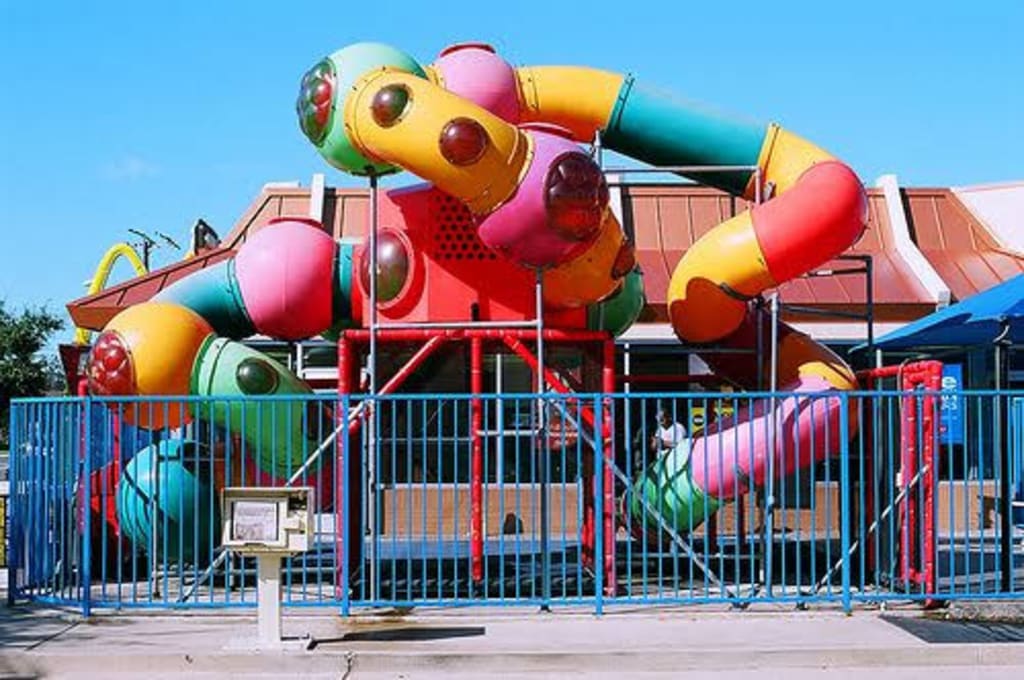
the sites of colorful tube slides and smells of cheap
plastic is all too familiar.
well hold on to that Nostalgia because
they're slowly disappearing in fact the
number of families who take their
children to these play areas decreased
by 18.6 percent from 2011 to 2016.
It might be, they're riddled with issues
before we dive any further we need to go
back to where it all began back to 1972
in this unassuming city in California
at this McDonald's
like all good stories about McDonald's
our tale begins on a beautiful
spring-like day
this is McDonald's Playland.
the first playland in Chula Vista
brought in a 34 increase in business
before the park was even completed and
others wanted it
first Burger King in 1985 and then other
restaurants like Chick-fil-A and Carl's
Jr would soon follow soon
but it wasn't long before safety issues
began popping up in every direction
remember that creepy Big Mac structure
that kind of looked like a mini
children's jail
well in 1999 the U.S consumer product
safety commission revealed that more
than 400 children were injured after
playing on it from the 1970s to the
1990s and McDonald's failed to report
anything instead the franchise slowly
phased out the climber and other hard
metal play structures and replaced them
with padded equipment
in the end McDonald's paid out four
million dollars to the federal
government the largest penalty the CPSC
had ever received and in the same decade
playgrounds moved indoors but these
didn't last long either why people have
found some of the weirdest and
potentially dangerous objects hidden all
throughout these playgrounds
like cigarettes scissors a dead iguana
and lots and lots of feces
and it's not just safety concerns that
have gotten fast food playgrounds in hot
water either more and more are
also disappearing because of organisms
too small for the naked eye to see okay
so it's not that surprising that Fastway
playgrounds are cesspools for germs
germs and more germs but there are
alarmingly few federal or state
regulations for Playground cleanliness
at least Dr. Aaron Carr Jordan thinks so
mother of four and somewhat of a
playground sanitation vigilante she set
out across the country to take bacterial
swabs at different fast-food chains
Her results, nearly every single one of the 50
playgrounds she surveyed showed several
strains of bacteria that could endanger
children
so what's been done to combat this well
not much playgrounds are technically
considered non-food zones so restaurant
inspectors from the CDC often ignore
them but that hasn't stopped concerned
parents and restaurant goers from
fighting against playground filth
non-profit groups like kids play safe
push restaurants to improve regulations
for proper Sanitation
nevertheless plastic fast food
playgrounds have become more of a relic
of the past
the slides in ball pits once the
Pinnacle of Childhood Carefree Madness
may now even be permanently lost as
they're being replaced by iPads and
iPhones.
for people like my age I think we'd rather
run the risk of coming eye to eye with a
dead iguana then be glued to a screen
all day but maybe that's just me.
About the Creator
Keep reading
More stories from Dominic Odey and writers in Fiction and other communities.
The Adventures of quantity forty-five
The story of a Gutenberg Bible, from fifteenth-century Mainz to Keio University, Tokyo. On 6 October 1982, a 500-year-old Gutenberg Bible spends a night time within the evidence locker of the University of California. There are 48 (possibly 49) recognized surviving copies of this rare e-book, printed c.1456 in Germany by means of a portable kind pioneer Johann Gutenberg. Representing one of the earliest predominant works of ecu printing, it is envisioned that the simplest around one hundred eighty of those Latin Bibles were ever produced.
By Dominic Odey3 years ago in Fiction
Becca
"Everything is so... flat." Denille said stupidly as she looked around her new neighborhood. She looked around at the muted desert where even the smallest sign of life seemed to have given up. The plant life was shrubs that were half cooked by the heat and where there should have been a lawn, a mess of white rocks laid glistening in the sun. Even the sky looked stretched thin, like the sun had ironed it smooth. She’d moved from Riverside, where at least there were hills, but here in Barstow, everything felt baked and brittle.
By Sara Wilsonabout 19 hours ago in Fiction
The Mermaid Who Was Mourned
The yearly Mourning Procession was one of the most important gatherings of the Nesirkie Merpeople. The event was their way of paying homage to a fallen sister who would never have a resting place in the sea. To the Mer, this was a fate far worse than death itself.
By Justiss Goode4 days ago in Fiction



Comments
There are no comments for this story
Be the first to respond and start the conversation.