
The Ridge: The Whisper of the Leaves - Chap. 3
The Confrontation Part I

More than anything else, Wynne, Arkansas had the railroads to thank for its relative prosperity. With a population of three thousand, it was the largest city in the county as well as the county seat. Two other cities had vied for Wynne’s prominence, but had failed. Wittsburg, seven miles to the southeast and Vanndale, five miles to the north, had preceded Wynne as the centers of county government. But while both towns still existed, neither one had had what was necessary to attract eastern money men. Wynne did.
Wynne had the good fortune to be selected in the late 1800’s as a major crossroad for the Missouri Pacific and the L & J lines. From Wynne, a company could ship to literally anywhere in the country. So from almost the first day that tracks were being laid, rice dryers, cotton gins and implement companies, just to name a few, began construction in or movement to Wynne. And naturally, the people followed
So now, nearly forty years after those tracks were laid, Wynne was a small city of two pool halls, one bar, two liquor stores and seven churches of various denominations. The primary sources of commerce in the area were still farming and ranching. But on weekends, the streets bustled with retail activity from the goodly number of stores that were now there. And even though it would be nearly twenty years before Wynne would have its first factory and begin to delve into real commerce, the town still attracted country boys like bees to pollen. Marshall and Gerald were no different.
As farmer’s kids, they both had learned to drive at an early age, but that Friday night they walked because, as Carl Bentwood would have put it, it was an “unnecessary trip”.
If they had been going to the store for flour, cornmeal, sugar, or some other staple, they could have ridden a horse or mule. For a load of cotton seed, egg pellets, or corn chops, using the truck would have been justified. But, for a person going to town just to “play,” the only sort of transportation allowed was walking……so, they walked.
By the time they had traversed the two and a half miles to the edge of town, where the dirt and gravel changed to concrete, it was 9:00. After walking two hundred yards up the street, a car pulled up from behind and drove beside them as they walked. It was Thomas and Gerald’s brother, Simpson in Simpson’s 1932 Ford roadster. It was normally dusty as most cars from in the country were, but apparently Simpson had just finished washing and polishing it because its ebony surface gleamed in the moonlight.
“Ain’t it a little late for you boys to be out?” Thomas grinned. “They have a curfew for babies, ya know.”
“Mind ya own business, Tom.” Marshall said, not looking at his brother.
“Took ya’ll a while ta get here, didn’t it?” Thomas grinned. “Sim had time to come get me and we done drove round town and ya’ll just now ta here. Must be terrible havin’ ta walk everywhere.”
“Hey, boy,” Simpson yelled at Gerald whom he never called by name. “Does Daddy know where you are?”
“What Marsh said goes for you, too, Sim,” Gerald said. “Mind ya own business.”
“Marsh,” Thomas pointed at his brother. “Ya better remember what Daddy told you at supper. He catches ya fightin’ again and he will skin ya. And didn’t the cops tell ya they’d lock ya up the next time they had ta pull you offa somebody?”
Marshall’s eyes were barely more than slits as he stopped and stared at his brother.
“Leave us alone, Tom, or they’ll be pullin’ me offa you.” It was a menacing tone that Thomas knew well and older brother or not, he knew when to back off.
“Well, me and Sim gotta be goin’ anyway,” Thomas said. “We don’t have time ta mess around with you girls.”
Without waiting for a response, the two men sped off leaving their younger brothers once again in the dark.
“Sometimes I hate him.” Marshall said as they began walking again.
“Aw, don’t worry about it, Marsh.” Gerald said. “They’re just jealous.”
“Jealous! Jealous of what?”
“Of us,” Gerald feigned mock surprise that Marshall did not know the reason. “They just wished that they’s as young and good lookin’ as we are.”
Marshall snickered then said, “Well, anyway, what’cha wanna do?”
“Let’s go ta tha pool hall first.” Gerald said.
“What’cha wanna go in there for, them old guys cleaned ya out last time?” Marshall answered the suggestion.
“I feel lucky tonight.” Gerald’s eyes gleamed.
“That don’t mean nothin’. Ya felt lucky that night and ya didn’t win a game.” Marshall said trying to be realistic, but Gerald would have none of it.
“It’ll be different tonight, I promise ya.”
“We’ll see.” Marshall said, resigned to tag along, at least for the time being.
Gerald fancied himself an excellent pool player, when, in reality, he was average at best. Even Marshall could beat him occasionally and he didn’t even care about the game. The regulars at Sully’s Pool Hall built him up, of course. They knew when they had an easy mark and were more than willing to oblige Gerald in his apparent quest for poverty.
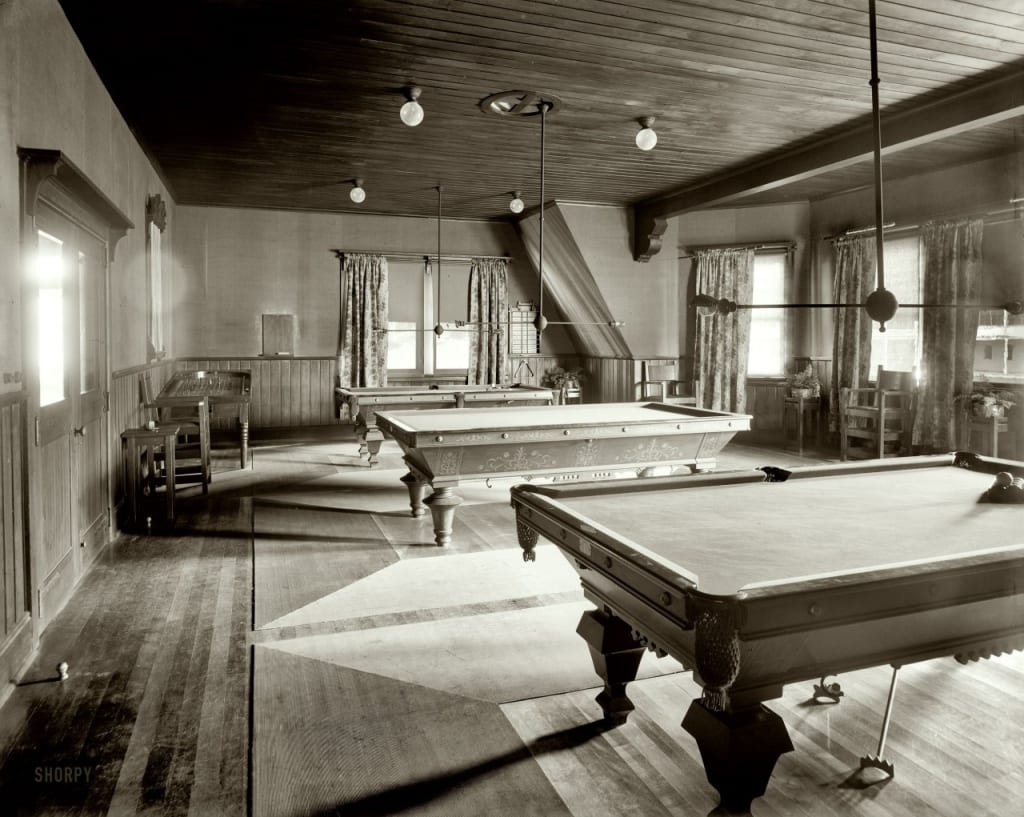
The two boys pushed through the front door of the hall and were immediately met with the odors of beer and cigarettes and sweat and aged pine. The freestanding building was long and narrow, twenty-feet wide by eighty-feet long, with a plank floor and 12-foot-high tin covered ceilings.
Six long bladed fans hung from the ceiling, spaced evenly down the center of the room. Peeling wallpaper partially covered the walls and where it did not, plaster lathing slats were visible. Pool cue racks, some full of cues and extra balls and some not, hung on much of the wall space, prepared to go to battle at a moment’s notice. The building had been recently wired for electricity and the resulting lights hung above the pool racks at eight-foot intervals on both walls. Plus, naked bulbs hung on five-foot cords down the length of the building at the same intervals as the wall lights.
A black pot belly stove stood in the center of the building three quarters of the way to the back. It was audibly roaring as it fought against the early March cold. Behind the stove were three wooden tables with chairs around each. At these tables, poker was occasionally played, but more often, the game was dominoes. That night, all three tables were filled with men of various ages, each with a line of black or white dominoes in front of them. No one looked up when the boys entered the building.
In front of the stove were four average pool tables, two abreast, eight feet apart. Over each table counting beads were strung on wires that stretched from wall to wall. In front of these four was the first thing everyone saw as he entered the establishment, the “prime” table.
It stood perpendicular to the other tables, as if to show that it was the best, but any true pool player would have known that immediately. It was heavy, made of solid oak, polished to a high sheen, with green felt covering its two-inch slate table bed. The position marks on the table rim were made of inlaid ivory and it had six massive clawfoot legs that looked capable of pouncing at any time. Well oiled, leather pockets completed the look. It was, without a doubt, as good a pool table as there was anywhere in the state.......including Little Rock
“C’mon in boys,” ‘Sully’ Sullivan said from behind the bar that ran along the wall to the right. It was from that bar that he sold beer legally and a few other things under the table.
The only thing Sully ever sold to minors, though, was a game of pool, a root beer, or a piece of hard candy. And since everyone in town knew it, there was never any fuss about the occasional teen who came in. That opinion, however, was not shared by the church going crowd who looked upon the establishment as a “den of iniquity” and home for the devil.
“Gonna try ya hand at another game, Borden,” Sully said. He used Gerald’s last name as he did all the area boys who came into his business. Most of them liked it.....made them feel older.
“Yes, sir, Mr. Sully,” Gerald grinned and placed a dime on the counter. “Rack ‘er up.”
“Big spender,” Marshall mumbled. His friend could have played on one of the other tables for a nickel. But Gerald being Gerald, he wanted to show whoever might be looking that he meant business, so he started out on the main table. To him, it was worth the extra nickel.
Sully picked the dime up and nodded to a shadowy area of the room where chairs were lined against the wall. Almost immediately, Ned, the black rack man, janitor, etc., appeared out of the darkness.
The hunched old man hobbled around the table digging balls from the pockets and rolling them toward the racking dot. Once finished, he threw them into a triangle he had pulled from its place under the table, tightened them with arthritic thumbs and fingers then carefully lifted the triangle off.
Marshall watched as Gerald confidently set the cue ball in position and after a careful aim, sent it hurtling into the rack. It smashed into the group with a satisfying “crack”, sending colored balls in all directions.
Gerald looked at Marshall as if to say, “I told you so,” Then after taking careful aim, proceeded to miss his first shot. As Gerald cursed the cue stick, Marshall said, “I’m goin’ outside for a minute.”
“Yea, fine,” Gerald said, lining up his next shot.
Marshall meant, of course, that he was going to the outhouse behind the pool hall. As he walked to the back door, he passed the men at the card tables and nodded at them collectively. Some responded with “Marsh,” while others said “Bentwood,” but all at the very least nodded.
To Be Continued........
About the Creator
Keep reading
More stories from Dan Brawner and writers in Fiction and other communities.
Miss Persephone's Manual to a Seemingly Ordinary Life
Miss Persephone was found at the dining table, her blue eyes swollen, her tears arriving and retreating like the tides of the ocean. Earlier that day, her family had visited her in the retirement home where she had lived for eight years. It was her eightieth birthday.
By Imola Tóth3 days ago in Fiction
Center Stage with Paul Stewart
*** I'm keen to republish the interviews I did for my series with Vocal creators. It's been a few years and I thought it might be nice to revisit these wonderful conversations. I'll be releasing them one at a time for a few weeks/months.
By Heather Hubler3 days ago in Interview




Comments
There are no comments for this story
Be the first to respond and start the conversation.