
The Rain in Her Bones
Some people carry storms inside them — but still learn to bloom.
Mira was born during a monsoon. Her mother used to say it rained for seven days and seven nights, as if the clouds themselves were crying — not from sorrow, but from a fierce, wild joy. Or maybe it was a warning. The kind of warning only nature could give, heavy and relentless.
“She’s got rain in her bones,” the village elders whispered when Mira was still a child. “She’ll either drown… or grow.”
For a long time, Mira believed she was drowning.
She felt everything too deeply. Even as a small girl, she noticed the sadness of animals — the way stray dogs would curl up under trees, eyes hollow and waiting. She noticed the loneliness that clung to strangers walking past the market, faces turned away like they carried invisible burdens. She felt the silence in a room that should have been warm and full of love, but instead felt cold and hollow.
Mira cried easily and smiled rarely. But no one ever accused her of being unkind. Her kindness was quiet but fierce, like the steady drip of rain that nourishes a thirsty plant.
Her father, a fisherman who worked dawn till dusk hauling nets heavy with the day’s catch, didn’t understand Mira’s quiet moods. “You need a tougher heart, Mira,” he would say, his voice gruff but not unkind. He was a man shaped by the sea — weathered and unyielding. “The world won’t wait for you to feel safe.”
“But what if my heart is made of water?” Mira whispered once, her voice barely a breeze. “What if it breaks too easily?”
At school, Mira didn’t talk much. Not because she lacked words — inside her, they fluttered like frightened birds, too many to catch and too fragile to release. Whenever she tried to speak, they scattered, escaping her grasp. Instead, she turned to writing. Poems in her notebooks, lines traced on the edges of windowsills, dreams carved carefully into the rough bark of the ancient tree behind the schoolyard.
She wrote words no one ever read. Words she wasn’t ready to share — words that were her secret refuge.
One day, a new teacher arrived at school. Ms. Rahila was young, sharp-eyed, and wore sturdy boots that made her seem as if she’d walked across continents. Her voice carried a kind of strength that filled the room without raising in volume.
On her first day, she asked the class, “Who here has something to say but doesn’t know how to say it?”
The room erupted in laughter — all except Mira. She didn’t laugh. She just looked up, and for the first time, someone looked back and truly saw her.
After class, Ms. Rahila slipped a note into Mira’s hand. It was simple, written in clear handwriting:
“You are not too much. The world is just too quiet.”
Those words settled in Mira’s chest like seeds.
It didn’t change everything overnight. Change never did. But slowly — like spring unfurling after the harshest winter — something inside Mira shifted.
She began to write with new purpose. She wrote about the river that sang behind her village, about the sky’s endless blue, about the ache inside her chest that came and went like the tide. Her poems became a bridge from silence to voice, a way to speak without scattering her fragile words.
One afternoon, Ms. Rahila read one of Mira’s poems aloud to the class. She didn’t say who had written it — but Mira knew. Her heart trembled, fierce and wild like a storm just before it breaks.
That night, it rained again. Hard. Cold. Familiar.
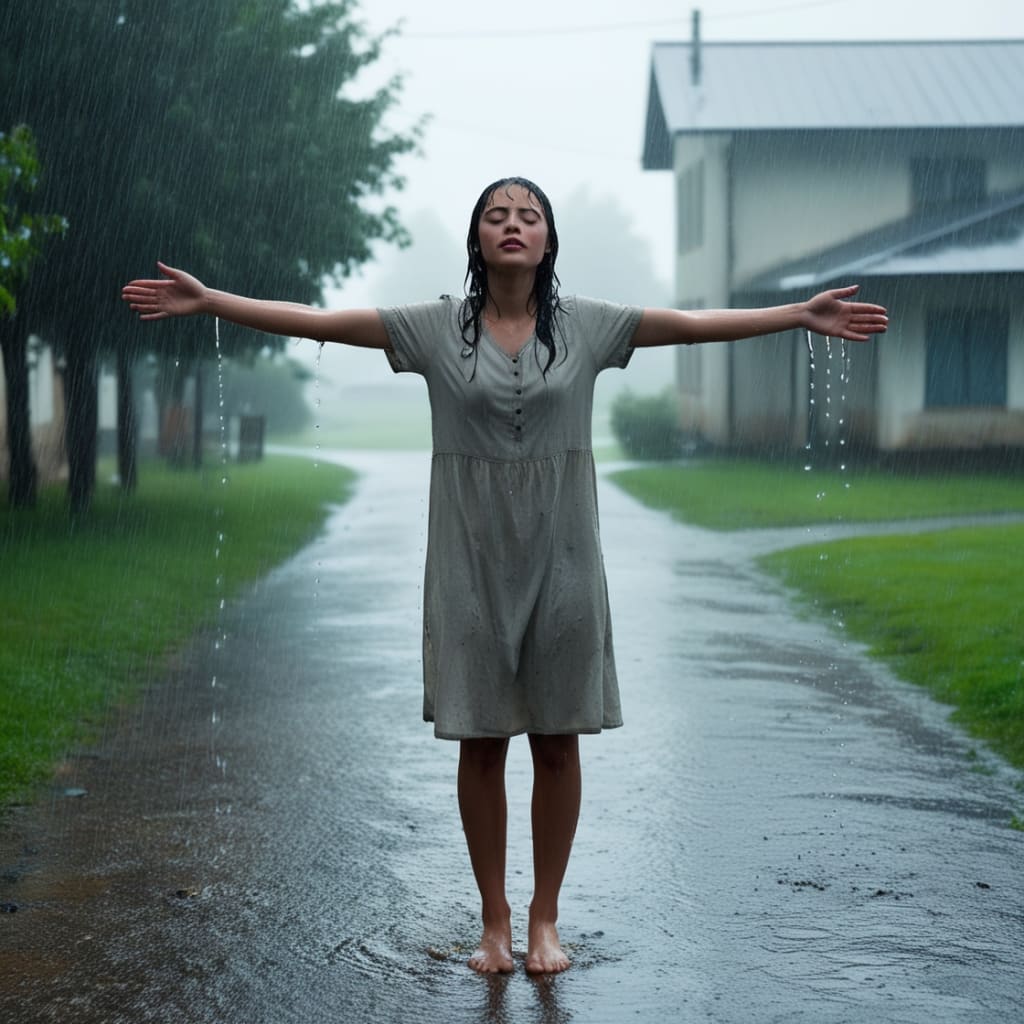
But Mira didn’t hide like she used to. She stood in the rain, face lifted toward the sky, arms open wide. She let the storm touch her — not to hurt, but to cleanse. The rain washed over her like a baptism, cleansing years of silence and fear.
For the first time, Mira didn’t feel broken.
She felt alive.
Years passed, and Mira left her village to seek a wider world. She became a writer, a poet — a name whispered between pages and dreams. Her words traveled farther than she ever had, carried on the breath of readers who found parts of themselves in her lines.
But she never forgot the rain.
She never stopped carrying it within her.
She learned that the rain in her bones wasn’t a curse to fear. It was her root system — the source of her strength. It was the way she felt everything so deeply. The way she loved fully and fiercely. The way she could break open the hard, dry soil of the world and help new things grow.
If you ever meet a girl like Mira — one who listens more than she speaks, who cries when no one is watching, who writes poems no one sees — hold her gently.
For she is thunder and moonlight, the soft rainfall and the wild storm.
She is the very rain that made this world green again.
About the Creator
Keep reading
More stories from Abuzar khan and writers in Fiction and other communities.
She Carried the Sky on Her Back
When I think of strength, I don’t think of iron or stone. I think of my sister. Her name was Safiya, and she was born during the hottest summer our village had ever seen. The kind of heat that clings to your ribs and wraps around your breath. They say the sky was red when she came into the world — angry, beautiful, and wide.
By Abuzar khan8 months ago in Fiction
Bomb Scare
It was 2027, and the world never thought it would happen. A missle hit the United States, but it wasn't where they had anticipated. A little town in the northeast was hit by a missile strike, they didn't know why, and they didn't know exactly where it hit, but they did know it was a coastal community, somewhere between Maine and Delaware.
By Gregory Payton6 days ago in Fiction



Comments
There are no comments for this story
Be the first to respond and start the conversation.