
The Quiet between the walls
The story of an imaginary friend
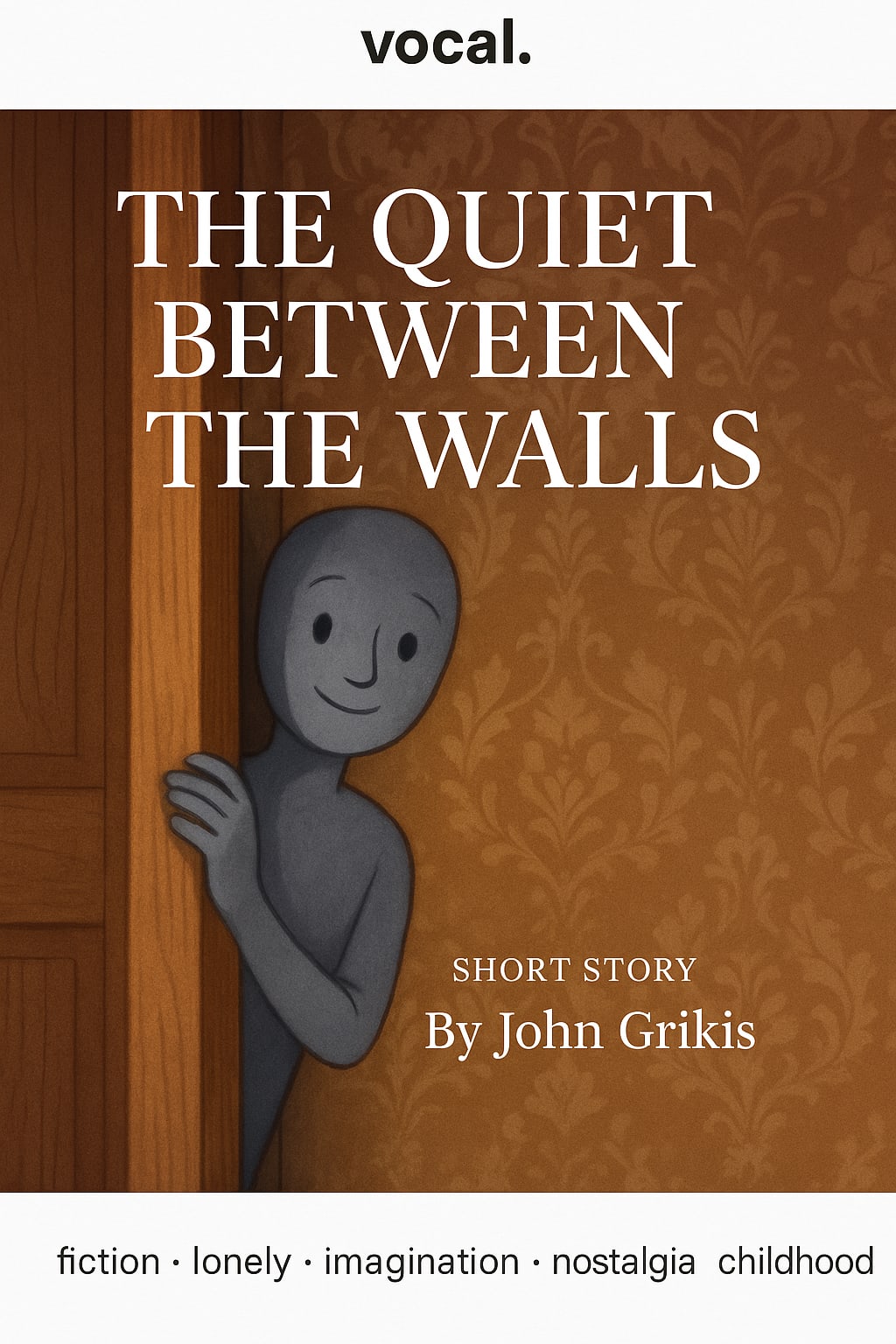
They only remember me when they’re alone.
That’s how it starts. The silence creeps in, the kind that doesn’t hum with electricity or chatter with phones, but the kind that feels like a house holding its breath. That’s when I stir—quietly, respectfully—from the fold in the wallpaper behind the bookshelf or from under the bed, where the forgotten socks huddle like sleeping mice.
I’m what you’d call an imaginary friend. But it’s not the name I’d give myself. “Imaginary” sounds dismissive. As if I were just a drawing on the wall or a lie told to avoid loneliness.
I prefer the term "Remembered Companion".
Because once, they believed in me with their whole heart.
His name was Callum. Six years old, always barefoot indoors, perpetually sticky with apple juice or paint. He had a laugh that skipped like a stone across a pond. I first arrived the day his parents had one of their silences—not the cold ones, but the tight-lipped kind, as if words were breakable glass.
He was lying on the carpet, staring at the ceiling fan spin itself dizzy, when he whispered,
“I wish someone was here.”
And just like that—I was.
I took shape gradually. First a shadow, then a breath of warmth beside him, and finally something like a boy made of smoke and memory. A bit taller than him. Wiser, maybe. Quieter, definitely. I was what he needed: a guardian with a grin.
He named me “Pal.” I didn’t argue.
Our days were glorious nonsense.
We built forts from pillows and fearlessness. We fought dragons made of shadows and coat hangers. We planted jellybeans in the garden, just in case the legends were true. I taught him the secret language of ants. He taught me the names of all his dinosaurs.
I never slept. While he dreamed, I sat by the window and watched the stars rearrange themselves. Imaginary friends don’t dream—we remember dreams. We collect them like fallen leaves.
But then, life moved forward, as it always does. He started school. Made friends with pulse and teeth. Learned words I didn’t teach him—maths, deadlines, awkward.
He stopped calling me during storms.
Eventually, he stopped calling at all.
Most of us fade.
We don’t die. Imaginary friends are not so fragile. But we become… echoes. We settle in the folds of time, like dust in a long-forgotten attic.
But I didn’t fade entirely. Not right away.
You see, some children don’t outgrow us—they outpace us. They turn corners too quickly, and in doing so, forget to bring us along. I was left behind like a crayon at the bottom of a toy chest.
Still, I waited.
Years passed. I listened to the walls speak their slow language: creaks and sighs and the ticking of clocks that had outlived their owners.
Callum’s laughter grew deeper. His steps heavier. Music replaced storybooks. And his room—our room—was slowly emptied of wonder. The ceiling fan remained, still spinning.
Then one day, he came back.
Not in the way he used to. He was taller now. Beard starting to sprout. Eyes haunted not by monsters but by bills and blank pages.
He was alone again. Like truly alone. The kind of alone you don’t speak about in group chats.
He sat on the edge of his childhood bed and stared at the wallpaper. The bookshelf was gone. So was the paint. But the memory—our memory—was buried there, stubborn and breathing.
He said nothing. But I felt it.
He remembered me.
And so, I returned.
Not as vividly, not as strong. More whisper than word. A flicker in the mirror. A warmth on the shoulder. But enough.
I didn’t speak first. I let the silence ask its question.
Finally, he said, “Pal? You still around?”
I nearly wept. If I had tear ducts, I would have filled oceans.
“I never left,” I whispered. And I meant it.
We didn’t rebuild forts. He didn’t ask me to fight dragons. But he did talk—about things even scarier than dragons. About dreams that didn’t come true. About jobs that made him small. About someone he loved who left when she couldn’t find the door back in.
He talked, and I listened. That was my role now.
You see, imaginary friends grow up too. We change shape to fit the cracks.
I became the voice that reminded him to eat. The laugh that helped him finish his manuscript. The quiet nudge that led him to reach out to his sister on her birthday. I wasn’t play anymore. I was presence.
He left the house for good last year. Sold it to a family with a child who laughs the same way he did.
I could have faded then. My purpose complete.
But something odd happened.
One night, as the new boy cried in bed—afraid of the dark, afraid of the thunder—I felt myself pulled toward him. Drawn, like smoke toward air.
And just like that—I was again.
Here’s what most people don’t understand: we don’t belong to just one person.
We exist in the spaces between memory and imagination. Passed on, like lullabies or bedtime stories. A continuation of comfort. A lineage of love that doesn’t need flesh to be real.
So now I have a new name. He calls me “Boop,” which is admittedly less noble than “Pal.” But I don’t mind. His giggle is contagious.
And the dragons?
Still out there.
But so am I.
If you ever wonder whether your imaginary friend remembers you—know this: we do.
We are the quiet between the walls. The smile in the storm. The one who never needed to be real to be true.
Just call our name, and we’ll come back.
Every time.
About the Creator
Keep reading
More stories from writers in Fiction and other communities.
The Missing Ingredient
The first time I saw her, she was wearing a velvety, red ribbon in her hair. She carried a small leather backpack everywhere. She searched the forest by turning stones, checking beneath shrubs, listening to the wind as if it might carry an answer.
By Imola Tóth7 days ago in Fiction
Draft Deleting? Don't Do It!
Today, I had a little time. I decided that I would have a look at the drafts that I have on Vocal. This is part of a long-term wish to have everything I've written on paper rather than virtually. I've not looked at them for weeks and something drew me to them, just to browse and see what was there.
By Rachel Deeming3 days ago in Writers
Part 2 Interview With Joe Patterson, Author Of Melanin Memoirs
This is my second interview with Joe Patterson. His 4th anniversary writing on Vocal will be in March 2026. He has one achievement on Vocal, The Other Foot. He has over 17,000 reads on Vocal since he started on Vocal in 2022. Joe Patterson is very creative poet and rapper. Joe is deep thinker and I feel it is reflected in his latest published book, Melanin Memoirs.
By Mariann Carroll5 days ago in Interview


Comments
There are no comments for this story
Be the first to respond and start the conversation.